
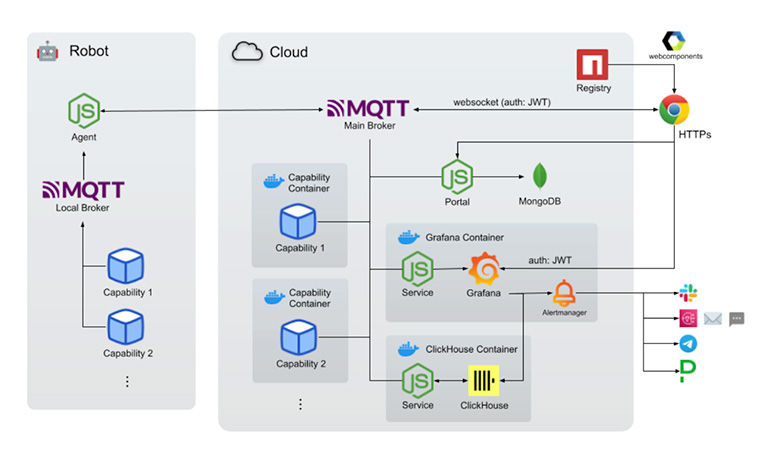
Transitive Robotics is announcing a new major version of Transitive, the open-source framework for full-stack robotics. Version 2.0 adds significant new integrations and features: storage of historic and time-series data in ClickHouse, visualization in Grafana, and custom alerting via Alertmanager. Together with the release of some capabilities, like the free Health Monitoring capability, robotics companies already use these features, providing added value to robotics companies with growing fleets.
Fleet operation at scale
Until now, Transitive has been very much focused on transactional features needed for the operation of robot fleets. This includes popular capabilities like WebRTC Video streaming, Remote Teleop, and ROS Tool. These capabilities are particularly empowering to robotics companies that have not yet deployed more than 50 robots. Transitive’s open-source MQTTSync data protocol, its realization of full-stack packages, and the built-in fine-grained authentication and authorization features formed the foundation to develop such transactional capabilities efficiently and reliably.
But as fleets grow, so do the challenges in monitoring and operating. Companies need tools that go beyond the direct form of one operator working on one robot at a time, but provide both longitudinal and historical views of the fleet. Similarly, passive monitoring and alerting need to gradually replace active monitoring by (remote) operators. Supporting robotics companies in this second chapter of growth was the goal in this new major release, while still staying true to Transitive’s philosophy of embeddability, ease of use, and fine-grained, namespaced access control.
Store: ClickHouse
From all the great open-source databases to choose from, Transitive Robotics found ClickHouse to be the most versatile and highest performing for the types of robotics data companies tend to ingest, analyze, and visualize. ClickHouse is a highly efficient, columnar data store that is already being used by many AI and robotics companies, including OpenAI, Anthropic, and Tesla. Its column-based data layout is well-suited for on-disk compression as well as temporal analysis of robotics data.
Transitive 2.0 integrates ClickHouse along multiple dimensions. First, the Docker Compose file includes and configures a ClickHouse instance, adding it in both the hosted solution on transitiverobotics.com as well as any self-hosted deployments. Second, Transitive automatically provisions per-Transitive-user accounts in ClickHouse and adds the necessary ROW POLICYs to extend Transitive’s namespace-based access control. Third, for developers, it provisions a designated ClickHouse database for each capability as well as several convenience functions in the @transitive-sdk/clickhouse npm package to write to and query the database. This also includes a deep integration with MQTTSync itself.
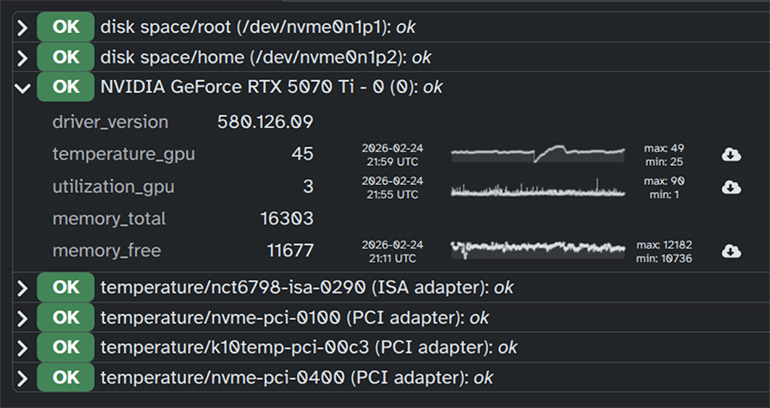
Capability developers can now register specific MQTT topics to be stored in the database, and they can just as easily query this history, e.g., for simple visualizations. The Health Monitoring capability, for instance, uses this to render sparkline plots of health sensor histories from ROS diagnostics directly in the UI components that users can embed in their own web dashboards:
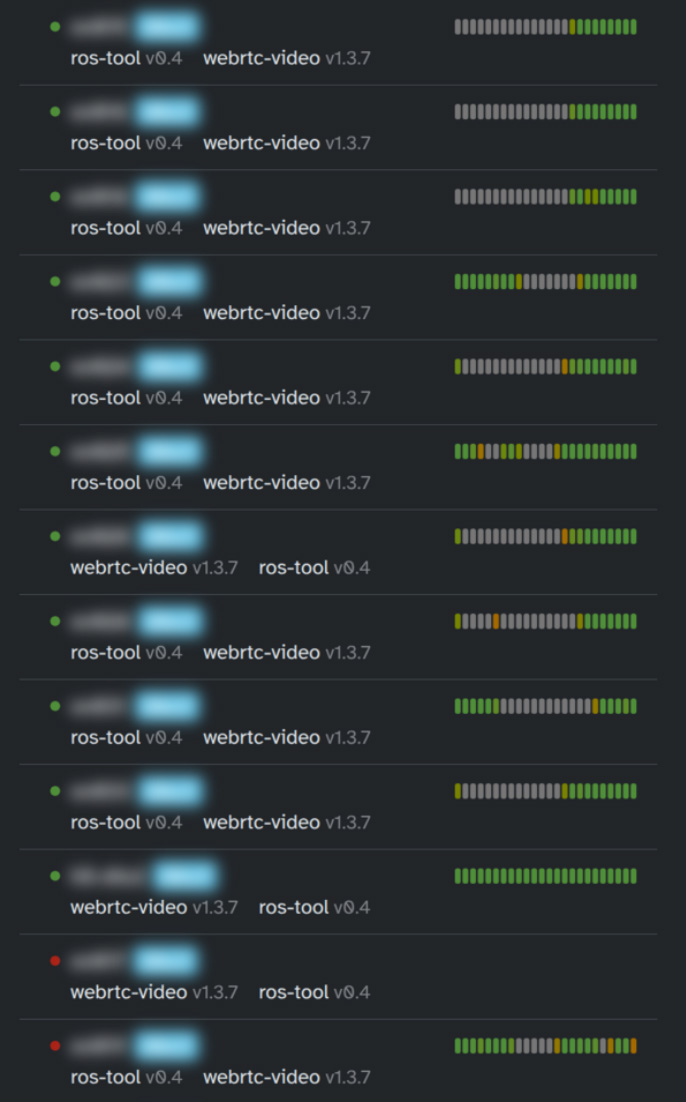
Similarly, the robot-agent itself stores and visualizes the last 24 hours of heartbeats from robots in the fleet, making it easy to see online and offline periods:
Visualize: Grafana
Grafana is a popular and powerful framework for creating visualizations and data-driven dashboards, exactly what robotics companies need to get an overview of the health and operational status of their fleet. It is also well-suited for diving deeper into this data, especially for plotting and analyzing time series.
Transitive now integrates a Grafana instance that uses the aforementioned ClickHouse accounts as data sources. Like the integrated ClickHouse instance, it is auto-provisioned to include a separate organization for each Transitive user, both in the hosted and self-hosted deployments.
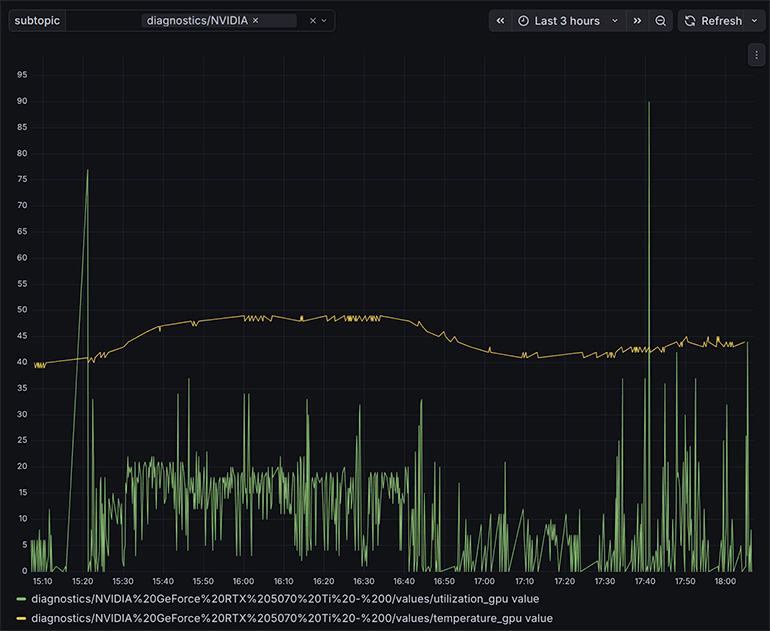
Access control is configured to mirror the same principles as used elsewhere in Transitive: orthogonal per-user/per-device and/or per-capability permissions. Among them is the ability to provide short-term access to capability- and device-specific plots of historic MQTT data, all encoded in a versatile, dynamic URL. This URL, whose capabilities can be programmatically generated on the fly, is used to embed Grafana visualizations or to link to a full dashboard that the user can use to explore their data further. This example shows its use for visualizing ROS diagnostics data, plotting GPU temperature, and utilization.
Transitive capabilities can further provision capability-specific assets directly into Grafana now, to provide users with custom dashboards and alert templates that the capability author deems useful for working with the data collected by the capability.
Alert: Alertmanager
Included with Grafana is the powerful Alertmanager, the same one used by Prometheus. It operates like a switchboard: data in, notifications out, with intelligent routing in the middle. Its integration into Transitive means that users can define complex SQL queries against their MQTT and capability-specific data in ClickHouse to trigger alerts. Users can define policies for notifying specific “contact points” such as Slack, PagerDuty, or custom webhooks when these alerts trigger.
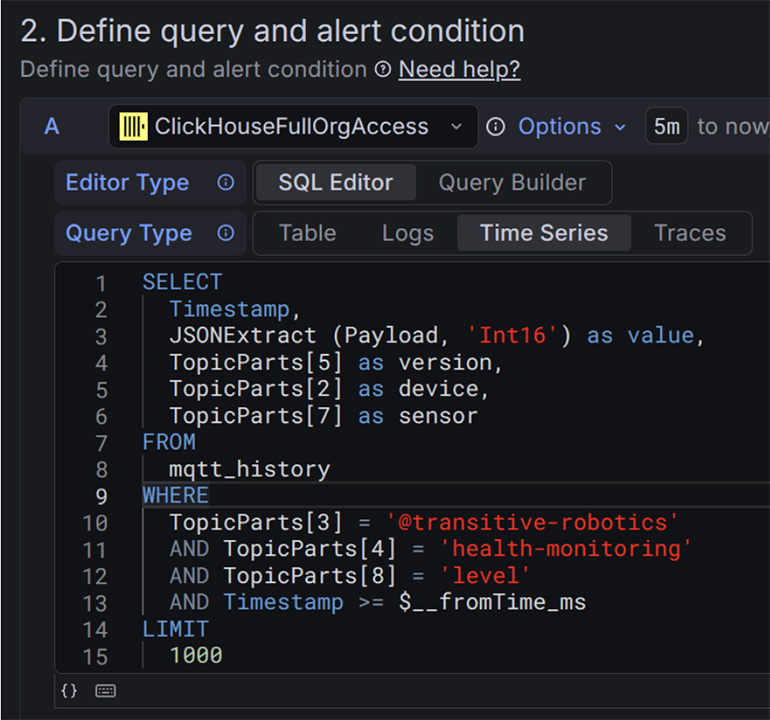
The Health Monitoring capability demonstrates one use of this. It automatically provisions an alert template that users can copy and configure to receive notifications when a robot has become unhealthy and may require attention.
Try it out
Current Transitive users will see these features appear in the capabilities they use. In Health Monitoring, for example, they will see all the above-mentioned plots and features, allowing them to explore their recent ROS /diagnostics history, visualize it, define custom dashboards around it, and configure alerts. New users can create a free account and install these capabilities on their robots. The documentation has been updated with more details about these new features, including how to directly access the data in ClickHouse and Grafana.
Those who prefer to self-host Transitive in their own cloud, on-prem, or directly on their robots for offline use, can follow Transitive’s instructions for self-hosting to bring up the Transitive stack in their dev environment. There, they can also start writing their own capabilities, which they can submit to the Transitive capability store if they want to.
About the Author
 Christian Fritz is the founder and CEO of Transitive Robotics.
He previously served as the VP of Software at Savioke, maker of the Relay delivery robot for hotels and hospitals, where he helped scale the fleet from 5 to over 100 robots operating on three continents.
Christian holds a PhD in artificial intelligence (computer science) from the University of Toronto and has authored over 40 publications and 17 patents.

The post Transitive Robotics announces Transitive 2.0 open-source robotics framework appeared first on The Robot Report.