
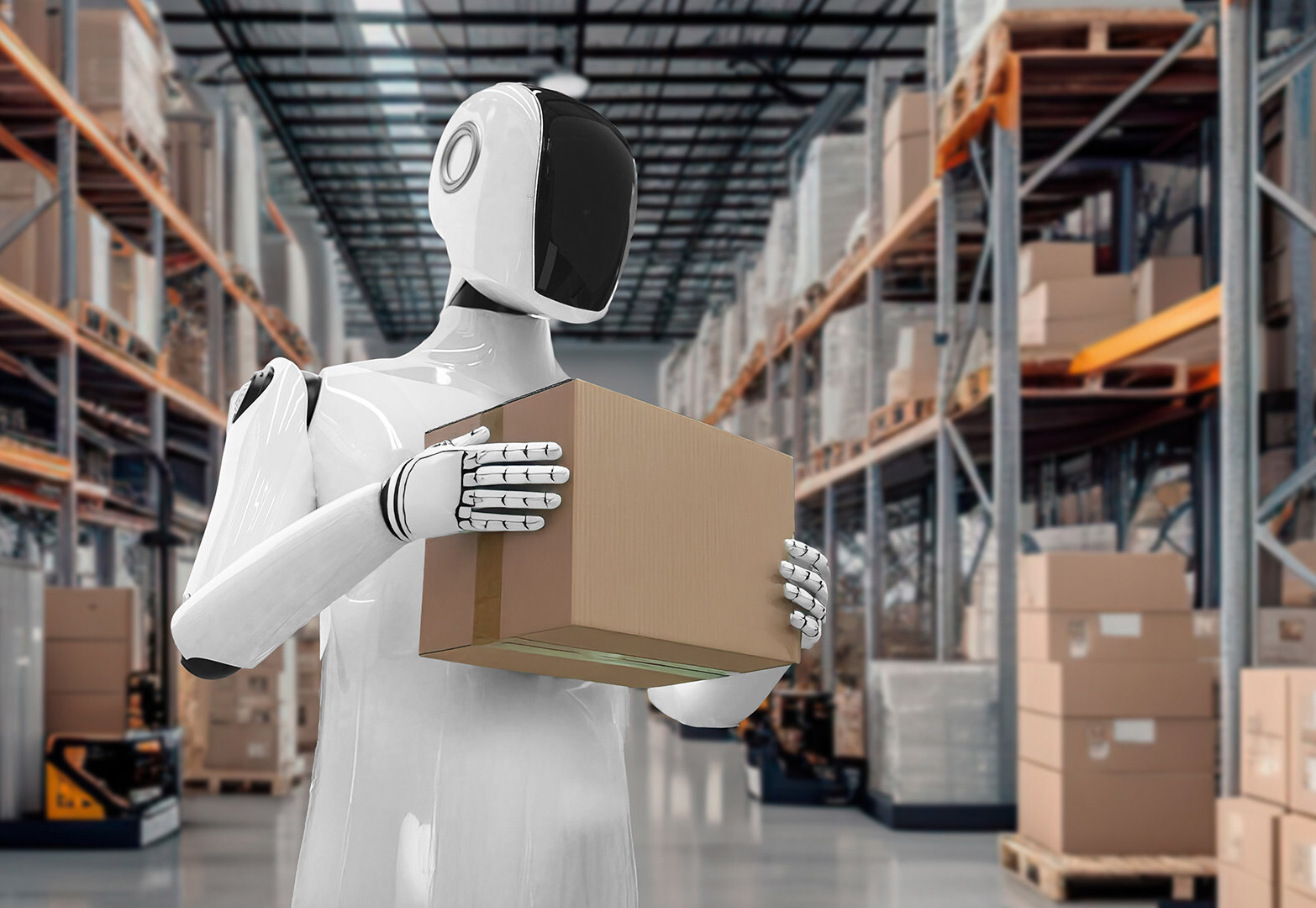
TI says its technologies, combined with NVIDIA AI infrastructure, enable humanoids to operate safely and efficiently in complex environments. | Source: Texas Instruments
Texas Instruments Inc., or TI, recently announced a partnership with NVIDIA Corp. around last week’s GTC event. The company said that by combining its real-time motor control, sensing, radar, and power technologies with NVIDIA’s advanced robotics compute, Ethernet-based sensing, and simulation technologies, robotics developers can validate perception, actuation, and safety earlier and more accurately.
“We can address literally every subsystem in the robots,” Giovanni Campanella, the general manager of industrial automation and robotics at TI, told The Robot Report at GTC. “Our technologies today power already a lot of OEM systems in the humanoid, mobile robot, and industrial robot spaces.”
TI connects NVIDIA physical AI compute to real-world applications with deterministic control, sensing, power, and safety at every joint and subsystem. This partnership will help developers move faster from virtual development to production-ready, scalable, and safety-compliant systems, the company said.
TI says sensor fusion is key to reliable robots
As part of this collaboration, Texas Instruments integrated its mmWave radar technology with NVIDIA Jetson Thor for sensor fusion. It used NVIDIA Holoscan Sensor Bridge to enable low-latency, 3D perception and safety awareness for humanoid robots. TI said it’s applying what it learned from building rugged sensors for the automotive sector to robotics.
“We are actually showing how humanoids, or any type of robots, could perceive more safely and reliably the environment around them,” Campanella said. “For example, a lot of systems today use cameras, but cameras have a lot of limitations.”
Dust, fog, or other environmental conditions can make cameras completely ineffective. “That’s why radar comes now into the game, similar to automotive. Radar is basically able to see in all these types of conditions, rain, glare, low light, any conditions, and on any type of material,” Campanella said.
TI’s IWR6243 mmWave radar sensor is connected via Ethernet to NVIDIA Jetson Thor. It enables scalable low-latency 3D perception and safety awareness for physical AI applications.
By fusing camera and radar data, the system can improve object detection, localization, and tracking, according to TI. At the same time, it reduces false positives for confident, real-time decision-making in humanoids, it said.
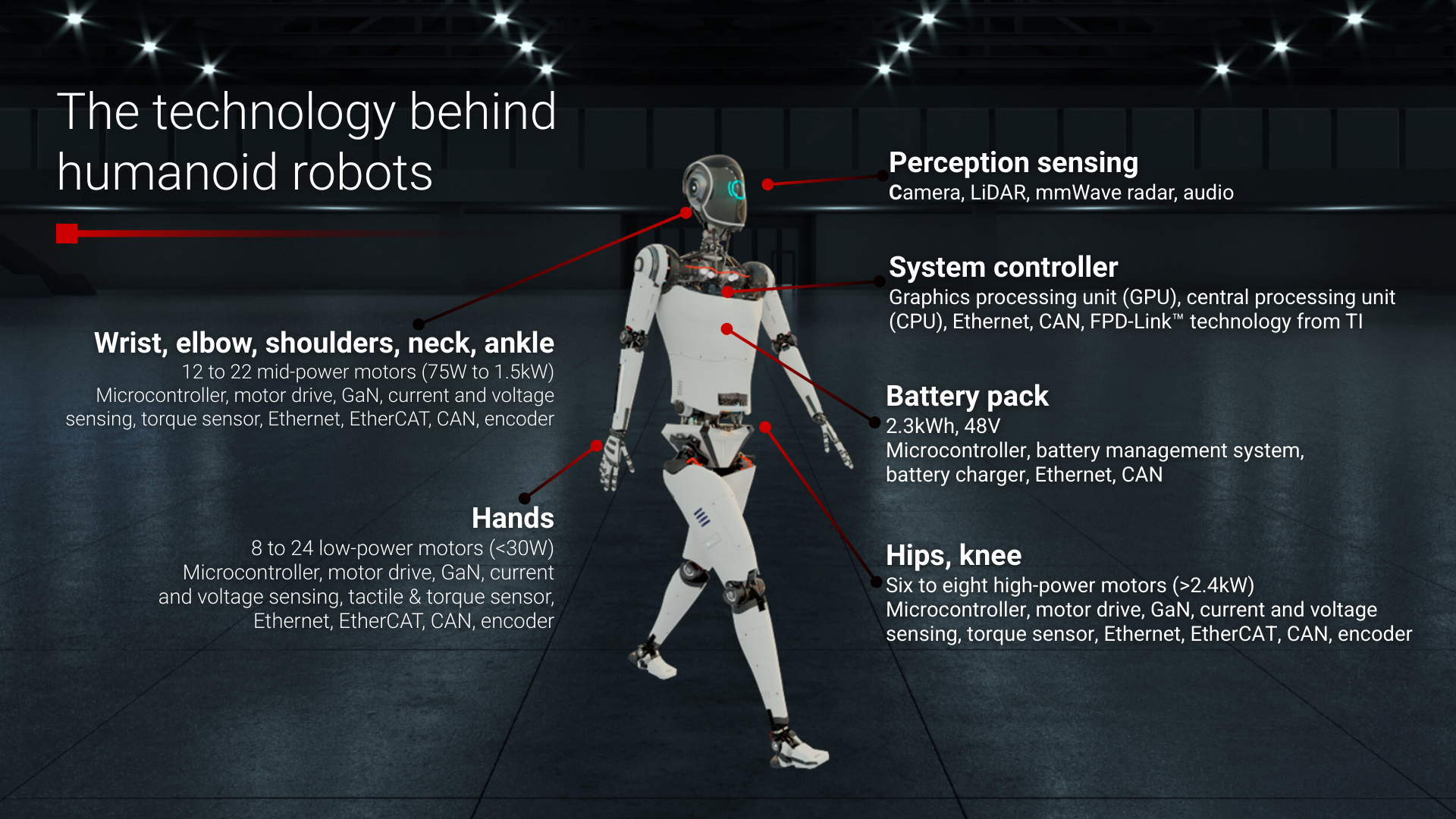
TI offers a range of components to speed up robot development processes. | Source: Texas Instruments
Safety, size, and power consumption are priorities
While Texas Instruments is marketing its latest products to humanoid developers, the company has been interested in a range of robots for a long time.
“We have been working with OEMs around the globe, and over the past three to four years, we began engaging with the first OEMs investing in humanoids. But for us, the focus is really across the board,” Campanella said.
Safety is another big area of focus for TI. “For robotics, we have devices that are safety-certified. Customers can create what they call a safety bubble around the robot,” noted Campanella. “So when a human or another robot gets in the vicinity of it, the robot either slows down to stops
In addiotion, TI has worked to make its products smaller and more energy-efficient to make them a better fit for robotics.
“A lot of these robots run on battery power. So, having a low-power solution is very important,” Campanella said.
Learn from TI at the Robotics Summit
Campanella will speak at the Robotics Summit & Expo on May 27 and 28 in Boston. He will talk about “Humanoids That Scale: A Systems and Semiconductor Perspective” on the second day of the show at 2:30 p.m.
The session will provide a technical roadmap for building smarter, safer, and more efficient humanoids. It will also explore how integrated semiconductor technologies and optimized system design can enable the next generation of humanoids that perceive, think, and move more like humans 0- safely and efficiently.
Registration is now open for the Robotics Summit & Expo, the world’s leading technical event for commercial robotics developers. The event is produced by The Robot Report and parent company WTWH Media.

The post TI partners with NVIDIA to accelerate robot deployments appeared first on The Robot Report.