
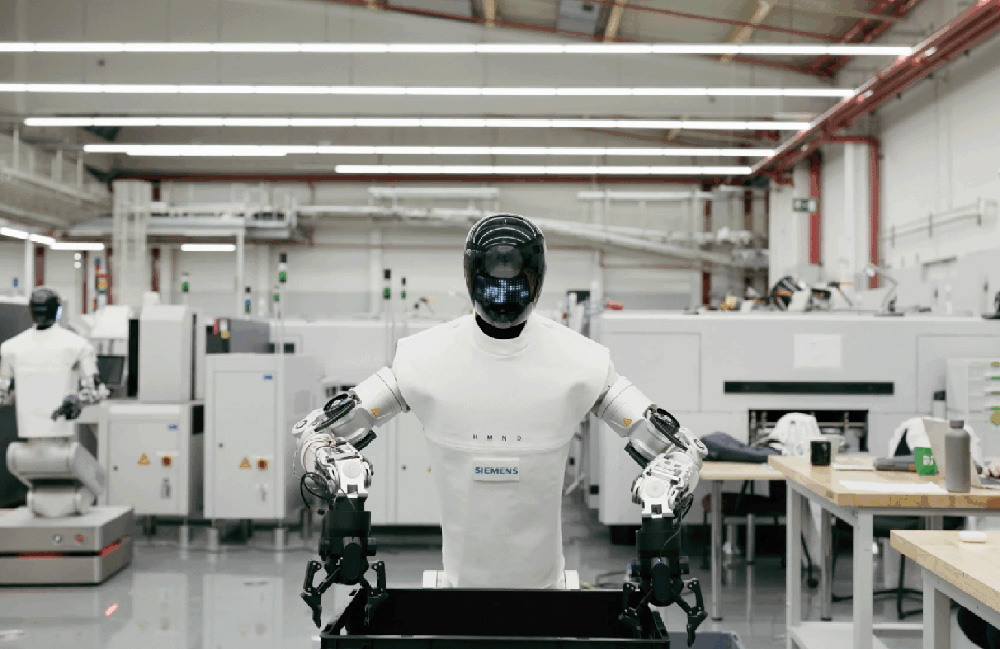
A mobile manipulator from Humanoid picking up a tote from a conveyor. Source: Siemens
Siemens AG and Humanoid yesterday said they have successfully tested the HMND 01 Alpha wheeled humanoid robot in Siemens’ electronics factory in Erlangen, Germany. Building on Siemens’ strategic partnership with NVIDIA, the robot autonomously performed logistics tasks.
“Our mission is to create humanoid robots that perform not only in controlled lab settings, but also in real-world factory environments, handling meaningful industrial tasks,” said Artem Sokolov, founder and CEO of Humanoid. “Our collaboration with Siemens and NVIDIA gives us a powerful advantage by combining NVIDIA’s leading AI infrastructure, simulation tools, and frameworks with Siemens’ deep industrial expertise and integration capabilities.”
Founded in 2024, Humanoid said it has designed HMND for industrial environments. The robot combines an omnidirectional wheeled platform with advanced manipulation capabilities, powered by the KinetIQ proprietary AI framework. The London-based company said its mobile manipulator can work in human-centric spaces, adapt to diverse tasks, and handle complex actions.
Siemens partners to bring AI to manufacturing
Siemens and Humanoid first announced their proof of concept in January. In addition, strategic partners Siemens and NVIDIA had said at CES that they plan “to build the world’s first fully AI-driven, adaptive manufacturing sites.”
“Physical AI — the discipline of training intelligent machines to perceive, reason and act in the physical world — is poised to transform how goods are made,” said Siemens. “Bridging the gap between AI research and the demands of a real factory requires a high-performing ecosystem: world-class AI compute and simulation, a proven robotics platform, and the deep industrial automation infrastructure to tie it all together.”
Humanoid has integrated NVIDIA‘s full physical AI stack into the HMND 01 platform, including NVIDIA Jetson Thor for edge compute, NVIDIA Isaac Sim for simulation, and NVIDIA Isaac Lab for reinforcement learning and policy training.
“Factories of the future demand robots that can perceive, reason, and adapt autonomously alongside human workers, tackling the labor shortages and operational complexity that traditional automation struggled to handle,” stated Deepu Talla, vice president of robotics and edge AI at NVIDIA. “With Siemens providing the industrial integration backbone and Humanoid deploying NVIDIA’s full physical AI stack — from simulation-first training to real-time edge inference — this deployment paves the way for humanoid robots meeting real production targets on a live factory floor.”
Editor’s note: At the 2026 Robotics Summit & Expo next month in Boston, there will be sessions on embodied and physical AI, as well as on humanoid robot development. Register now to attend.

Humanoid touts fast deployment
Humanoid claimed that its “simulation-first hardware design has also enabled the team to optimize actuator selection, joint strength and mass distribution virtually, cutting prototype development from a typical 18 to 24 months to just seven months.”
The HMND 01 Alpha robot was deployed in Siemens’ logistics operations, where it autonomously picked, transported, and placed containers for human operators. The company reported that it met all target performance metrics, including throughput of 60 tote moves per hour, uptime exceeding eight hours, and autonomous pick-and-place success rates above 90%.
Siemens also noted that to be valuable, a humanoid robot must be fully integrated with other production systems, exchanging data in real time with automated guided vehicles (AGVs), other machinery, and human operators. New systems must also be able to respond dynamically to changing conditions, it said.
The Munich, Germany-based electronics supplier said its Siemens Xcelerator provides this layer, from a comprehensive digital twin and AI-enabled perception to integrated control and PLC-robot interfaces. It also provides fleet management, industrial communication networks, and high-performance drives.
“Together, these technologies form the digital backbone and automation infrastructure that help to ensure humanoid robots operate efficiently and in concert with the broader factory environment,” Siemens asserted. “The outcome is a factory-grade model for deploying humanoids in any industrial setting.”
Siemens will exhibit and discuss its approach to industrial AI next week at Hannover Messe.
The post Siemens and Humanoid test HMND 01 Alpha for logistics tasks appeared first on The Robot Report.