
From the 1st-5th June, the robots descended on Vienna. The 2026 IEEE International Conference on Robotics & Automation (ICRA) brought together the top minds in robotics for one short week to showcase the latest technologies, form new collaborations, and exchange ideas. Held at the Messe Wien, a stone’s throw from the bank of the Danube, ICRA proved to be equal parts technological marvel and thought-provoking discussion.
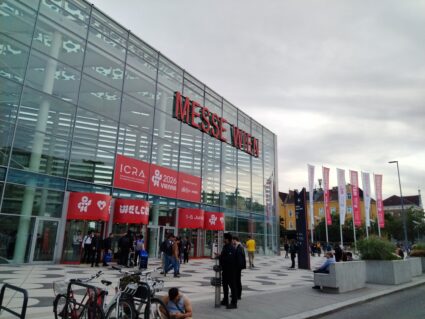
The host venue for ICRA 2026: Messe Wien, also known as VIECON.
Workshop on robot ethics
My week at ICRA began with the 2nd ICRA 2026 Workshop on Robot Ethics: Ethical, Legal and User Perspectives in Robotics & Automation (WOROBET). WOROBET provided a space for researchers to share ideas, thoughts, and concerns on the future of robot-human interaction, and how to create ethical frameworks to navigate this rapidly changing technology.
Yasuhisa Hirata, Professor at Tohoku University, began by presenting his vision of a world with physically assistive robots, such as detachable exoskeletons or cycling wheelchairs. These tools can affect people’s sense of self-efficacy and motivation, and there are a host of ethical implications that come with this – how do you help people just enough to build their confidence, without slipping into deception?
We then heard from Prof. Minoru Asada from Osaka University, who discussed his aim to implement pain signals into robots, so they can experience the world as we do. This was a highly interesting and niche proposition that brought up more ethical questions than we have answers for at the moment. Perhaps most pertinent to a technical conference: is a sense of embodied morality necessary for true intelligence?
Alan Winfield, Professor of Robot Ethics at UWE Bristol, presented a vision of robotics that acted as a counterweight to Prof. Asada’s: robots as tools, not potential beings. This also somewhat reflects differing attitudes in Eastern vs Western cultures. Thinking about the practical issues we are likely to face in the near term, he outlined a framework for social robot accident investigation. In his view, robot ethics is not just an engineering problem, but requires appropriate social and governance frameworks, just as we do for aviation. His talk also emphasised the risk that programming ethics into robots runs the risk of removing moral responsibility from the roboticist, and can always give rise to unethical robots via malicious hacking. The theme that we must focus on human morality, as opposed to machine morality, was repeated throughout the day.
After a morning of differing ideas and visions of what robot-human interaction could be, we were invited to ground this into a real robot social care scenario by Praminda Caleb-Solly, Professor of Embodied Intelligence at the University of Nottingham. In this red-teaming exercise, we examined the safety risks and possible mitigations of an assistive robot for a schoolteacher recovering from a stroke at home. Our group discussion circled around human agency: how ethical is it to make design choices for people that take away some of their autonomy, in the name of their best interests? As robots in social care will become a more urgent need in the years to come, these questions may become more salient.
I left WOROBET with plenty to think about, and a renewed sense of appreciation for the ethicists who are already grappling with the problems that are to come. I hope that progress in robot ethics keeps pace with progress in robotics, so that we are well prepared as robots become more of a part of our daily lives.
Welcome to the jungle – the robot exhibition floor
Every time you entered the exhibition hall, you were greeted by one of the child-sized Booster robots, either playing football, dancing, or demonstrating some kung fu. They were always an endearing welcome to the sea of robots.
The robots ranged from the endearing to the uncanny, but the common thread was their technical capabilities were astounding. Veteran attendees consistently remarked on how much the robots had improved year on year.
|
The cute. |
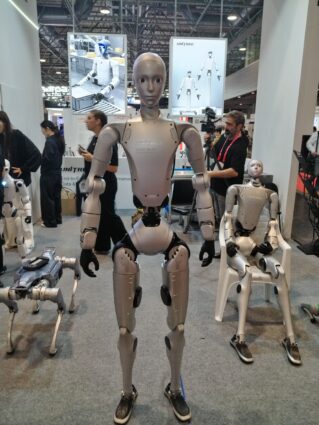 The slightly uncanny. The slightly uncanny. |
The below clips show the robots that most caught my eye. After admiring a phosphorescent, Stranger Things-esque robotic flower display, I was blown away by the D1-modular robot from Direct Drive. Unlike most robot dogs, it can split into two halves, with the ability to jump, twist, and traverse difficult terrain.
Sharpa’s North was always a friendly face, waving and making love-hearts at visitors to its booth. Around the back of the booth, you could even challenge it to a round at blackjack. We saw humanoids zipping up rucksacks and trying to fold laundry. Enchanted Tools’ social care robot, Mirokaï, was an unusual sight among the mass of black and steel, with a bright orange body, feline ears and an orange, furry face. Tesollo’s humanoid spent much of its time at ICRA using its long, wavering arms to pick up fruit and drop it into baskets, with impressive dexterity. Vietnamese company Vinrobotics’ humanoid offering was reminiscent of the Cybermen, with its gently wheezing joints, but the team assured me it was much friendlier. The pint-sized Boosters were almost always playing football, not far from their similarly sized Agibot cousins.
However, humanoids didn’t steal the show this year, as they have done previously. The big trend this year was robotic hands, and the levels of dexterity were truly impressive. Closing the gap between human and robot abilities here would unlock whole new swathes of tasks to automate – and who wouldn’t want a robot folding their laundry?
Industrial challenges: solving dexterity
Tackling the dexterity challenge really defined the industrial talks for me this year. A talk by ARIA’s program director, Prof. Jenny Read, demonstrated how the UK government is already laying the groundwork here.
They outlined their funding proposals as part of their Smarter Robot Bodies program, which is split into two branches: robot locomotion and robot dexterity. The robot locomotion branch aims to enable robots to traverse messy, unpredictable physical environments, while the robot dexterity branch will try to break the bottleneck of adept physical manipulation by robotic hands. With the programme set to launch in early 2027, it’ll be exciting to see what kind of innovations this attracts.
One standout innovation in the realm of dexterity was TARS, a record-setting newcomer in the Chinese robotics market. Co-founded by Dr Ding Wenchao just 18 months ago, TARS has already raised the most funding in angel and pre-seed rounds of any company in the Chinese embodied intelligence sector, and achieved a Guinness World Record for robotic flexible robotic flexible wiring-harness insertion completed in one hour.
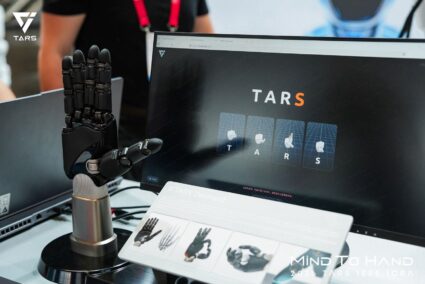
TARS’ DexHand. Image credits: TARS.
DexHand is a 1:1 model of the human hand, even replicating the 21 degrees of freedom we have in the wrist joint and hand. According to TARS, “it can interpret tactile data to distinguish slipperiness, roughness, and hardness in real time and perform 26 English alphabet hand gestures with high-precision finger control.” I was given the chance to control the hand using my own, and was impressed by how well it emulated my own movements. I was also impressed by their humanoid zipping up a backpack – despite the technical abilities of all the robots on the floor, few were able to perform tasks which required such fine motor skills.
TARS robot zipping up a rucksack.
On Thursday, Dr Wenchao Ding delivered an industry keynote where he presented TARS’ roadmap, charting the path from academia to industrial deployment. With an impressive academic team behind them, TARS may be one to watch.
Plenary talks
Aside from the wealth of invention and innovation taking place in the exhibition hall, the breadth and depth of academic research at ICRA was fantastic. The plenaries especially gave an insight into the research trends that are currently defining the field.
Ken Goldberg delivered an electrifying plenary, titled “A Tale of Two Cultures: Can Agentic Coding Close the Gap?” In this talk, he called for a step change to close the data gap faced by robot manipulation. With the rise of diffusion models and LLMs, it is clear that big data has solved computer vision and language. He challenged the audience – when will the ChatGPT moment for robotics come? With state spaces larger than 50 dimensions in robotics, there is not enough training data to close this gap. Currently, the data required to train vision-language models is equivalent to 100,000 years of real physical experience.
According to Goldberg, the 2 dominant cultures in engineering – model free “good old fashioned” engineering (GOFE), and, the currently more popular model based engineering. GOFE encapsulates rigorous engineering methods that pre-date AI, but may have been slightly forgotten about in the AI wave of recent years. He also highlighted how, in his career, he has always been working to bridge the gap between 2 cultures: from science and art; to robotics and automation.
He outlined 4 possible solutions to the data gap:
- Simulations – these work incredibly well for locomotion and body control, but less so for manipulation due to the number of forces and instabilities involved.
- World models – they do not currently properly capture the physics, and hallucinations can be problematic.
- Human teleoperation – this is currently big business and a good way to obtain high quality data. However, the largest dataset is currently only equivalent to a year’s worth of data.
- Real data from functioning robots – this is less commonly used, but can be powerful.
Prof Goldberg described how he used the fourth approach in his robotic delivery packing company, Ambi Robotics, for 22 years. Picking up bags is an example of variational automation – one task is done repeatedly, but with different initial conditions each time. From this rich dataset, they created a generative model to train robots in the best way to pick up bags. Here, they close the gap between model-free and model-based methods – Ambi exploits both to achieve industry-leading results. This plenary served as a call for other researchers to use their own production data to do the same.
During Thursday’s keynote on Robot Learning, Planning & Foundation Models, Stefanie Tellex from Brown University gave a compelling talk titled “Towards Complex Language in Partially Observed Environments”. While current research is bounded in known, predictable scenarios, using action-based language, this does not reflect what the real world is like, nor how people would naturally communicate with robots. Prof. Tellex described her work creating robots that can understand complex, goal-based commands in only partially observed, dynamic environments, and outlined the grounded Turing test – a reimagining of the Turing test for embodied AI.
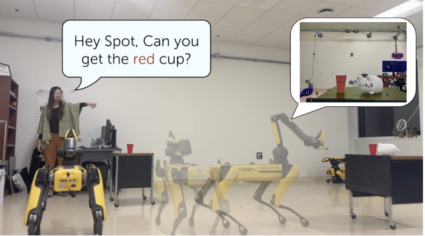
An example of a robot performing a goal-based task in a dynamic environment. Credits: Tellex et al, 2026.
Both plenaries spoke to current pinch points in robotics: data, reasoning, and operating in complex real-world environments. It’ll be interesting to see what solutions are developed in the coming years.
Science communications crash course
One of my favourite parts of ICRA was delivering the Science Communications Crash Course. Along with Robohub Executive Trustee Sabine Hauert, IEEE Spectrum Senior Editor Evan Ackerman, and IEEE Spectrum Community Manager Kohava Mendelsohn, we gave our guidance on effective science communication to an audience of 100 academics. It was encouraging to see so many people interested in communicating their research effectively – it is a crucial skill, especially in the era of AI and robotics when mainstream narratives can be hijacked by doom-mongering, hype, and corporate interests. More academics communicating their work clearly and neutrally will go a long way to grounding our societal discussion in technical reality, not sci-fi futures.
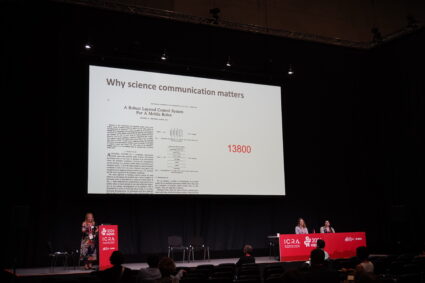
Sabine kicking off the science communications crash course. Image credits: Taraja Arnold
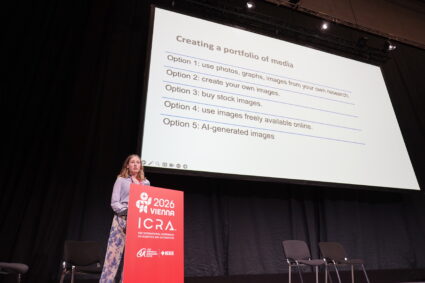
Delivering my part of the course. Image credits: Taraja Arnold
Art and robotics
The arts and robotics section was rich and interesting. There was a lot to visually take in, with constant background music from a robotic saxophone.

Masatoshi Hamanaka’s robotic saxophone. Image credits: ©Denes Erdos – Your Event Photographer
PET – marked by a large “PET ME” sign – was a white and orange mass of connecting, rotating pyramids, that gently pulsed and hummed in response to touch, responding by curling towards or away from you depending on how you touched it, The effect was strangely lifelike.
Rhombus Research presented “Reptile: A Bio-Mimetic Choreography Engine for V2X and A2X Swarms”. This artistic simulation visualises the contracts negotiated within autonomous vehicle and swarm fleets in dreamy blue, browser-based visualisation. Performance artist and former Cirque de Soleil acrobat Silke Grabinger explored human-robot interaction via her piece, AREYOUARE.
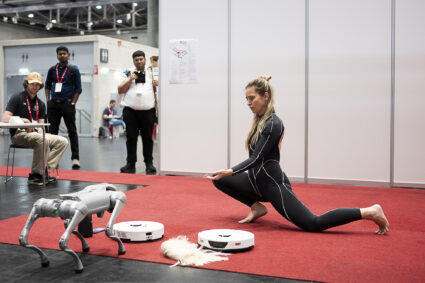
Silke Grabinger performing AREYOUARE. Image credits: ©Denes Erdos – Your Event Photographer
I’d also like to acknowledge some of the video creators I met there. YouTubers Back to Engineering and the. Amazing, PhD are making some fantastic videos about physical AI.
Nothing lasts forever – ending with the robot parade
ICRA 2026 ended with the robot parade, which attracted quite a crowd. See if you can spot the panda, dragon, and headless humanoid!
Seeing all the robots gathered together was a real spectacle. The technology on display was state-of-the-art, and it only improves year on year. What struck me most was the sense that robotics is moving from proving what is possible to tackling the remaining barriers to real-world deployment. Across the exhibition floor, industry keynotes, and plenary talks, the focus was often on the same challenges: dexterity, data, and operating reliably in complex environments. Solving these bottlenecks will open up new avenues to real-world applications of robots.
While workshops such as WOROBET highlighted important questions around ethics, agency, and governance, the overwhelming emphasis at ICRA 2026 was on capability. Researchers and companies alike are working to close the gap between what robots can do in carefully controlled demonstrations and what they can do in the messy reality of the world outside the lab. Judging by the pace of progress on display in Vienna, that gap may be narrowing faster than many of us expected. I hope that the kinds of conversations around human-robot interaction and ethics that were commonplace at WOROBET and in the Arts exhibition space will become more mainstream – we may need to face the questions that they raise sooner than we think.
Note: Where image and video credits are not stated, they belong to Ella Scallan.