
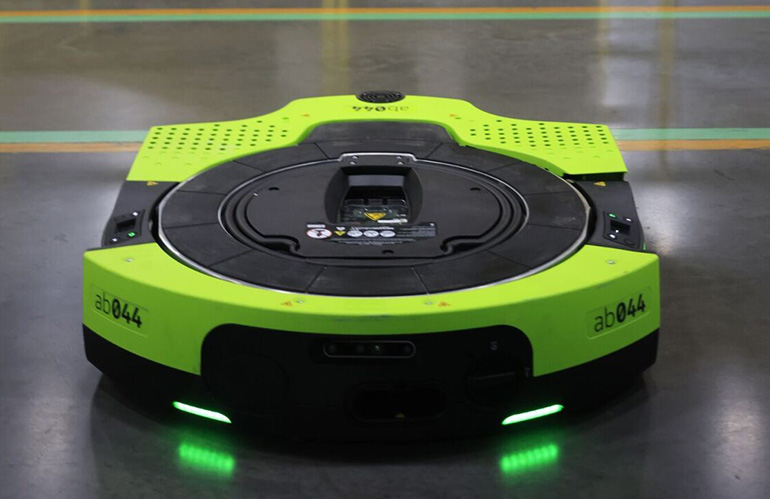
Amazon plans to deploy the Proteus mobile robot across Europe. Source: Amazon
Robots are becoming better co-workers, particularly as they scale across large deployments. At its Delivering the Future event in London today, Amazon.com Inc. introduced the next generation of its Proteus autonomous mobile robot, or AMR.
The Seattle-based company said Proteus can now understand natural-language commands, allowing it to take on more tasks.
“You tell it what needs to be done. It figures out the priority, the route, the timing,” said Scott Dresser, vice president of Amazon Robotics. “It becomes your assistant for material movement.”
Amazon is also expanding deployments of its Vulcan picking robot and STARK collaborative tote-handling system in Europe.
Proteus can take on more tasks
Amazon first unveiled Proteus in 2022, a decade after it acquired automated guided vehicle (AGV) maker Kiva Systems. It designed the AMR to move carts weighing nearly 400 kg (881.8 lb.) and relieve associates of strenuous tasks so they could focus on higher-skilled work such as managing inventory flow and ensuring quality control.
Proteus is currently deployed at 24 e-commerce fulfillment centers across the U.S., noted the company.
Now, thanks to advances in AI, workers can tell Proteus where to go without any programming experience or technical commands, explained Amazon. The AMR can operate beyond dock areas and transport containers as they arrive at a site, transfer them between workstations, and assist employees in delivery sites, it said.
The company is piloting the updated system in its laboratories and plans to deploy it in Europe in the first half of next year.

STARK and Vulcan to spread across Europe
Amazon said Proteus is part of its larger robotics roadmap, as it continues to develop collaborative technology and precise robotic manipulation.
STARK originated from an operations worker’s idea to improve a process and improve site safety, said Amazon. The system uses a FANUC CRX-30iA force- and power-limited arm to pick heavy totes from conveyors and place them on carts.
It can safely work alongside people and was first piloted in Barcelona, Spain. Amazon plans to deploy STARK in 15 sites across Europe by 2027.

Amazon described Vulcan as its “first robotic system with a sense of touch.” It can see and feel objects simultaneously to navigate densely packed environments.
The company originally developed Vulcan for a facility in Spokane, Wash. It is now handling more complex picking tasks at an Amazon facility in Hamburg, Germany. Both STARK and Vulcan will boost employee productivity and customer service, said Amazon.
“This transformation is designed to deliver a step-change in how we support our employees and serve our customers,” said Armin Cossmann, vice president of operations for Europe. “Customer expectations aren’t slowing down—and neither are we.”

Amazon invests billions in modernization
Amazon said it plans to invest more than €10 billion ($11.6 billion U.S.) in modernizing and expanding its fulfillment operations in Europe over the next few years. In addition to growing its Proteus, Vulcan, and STARK deployments, the company said it plans to hire 25,000 more employees in the coming years.
Even as it has deployed more than 1 million robots, Amazon said it has hired hundreds of thousands of people worldwide. It also asserted that it has created new reliability, maintenance, and engineering roles.
“Europe is at the center of how we’re building our operations for the future,” Dresser said. “The investment we’re making here, the talent we’re building with here, the technology we’re deploying here—this is where the next chapter of operations innovation is being written.”
Aaron Parness, director of applied science and AI at Amazon Robotics, participated in the opening keynote panel at last week’s Robotics Summit & Expo.
The post Proteus gets natural-language ability as Amazon expands European robot deployments appeared first on The Robot Report.