
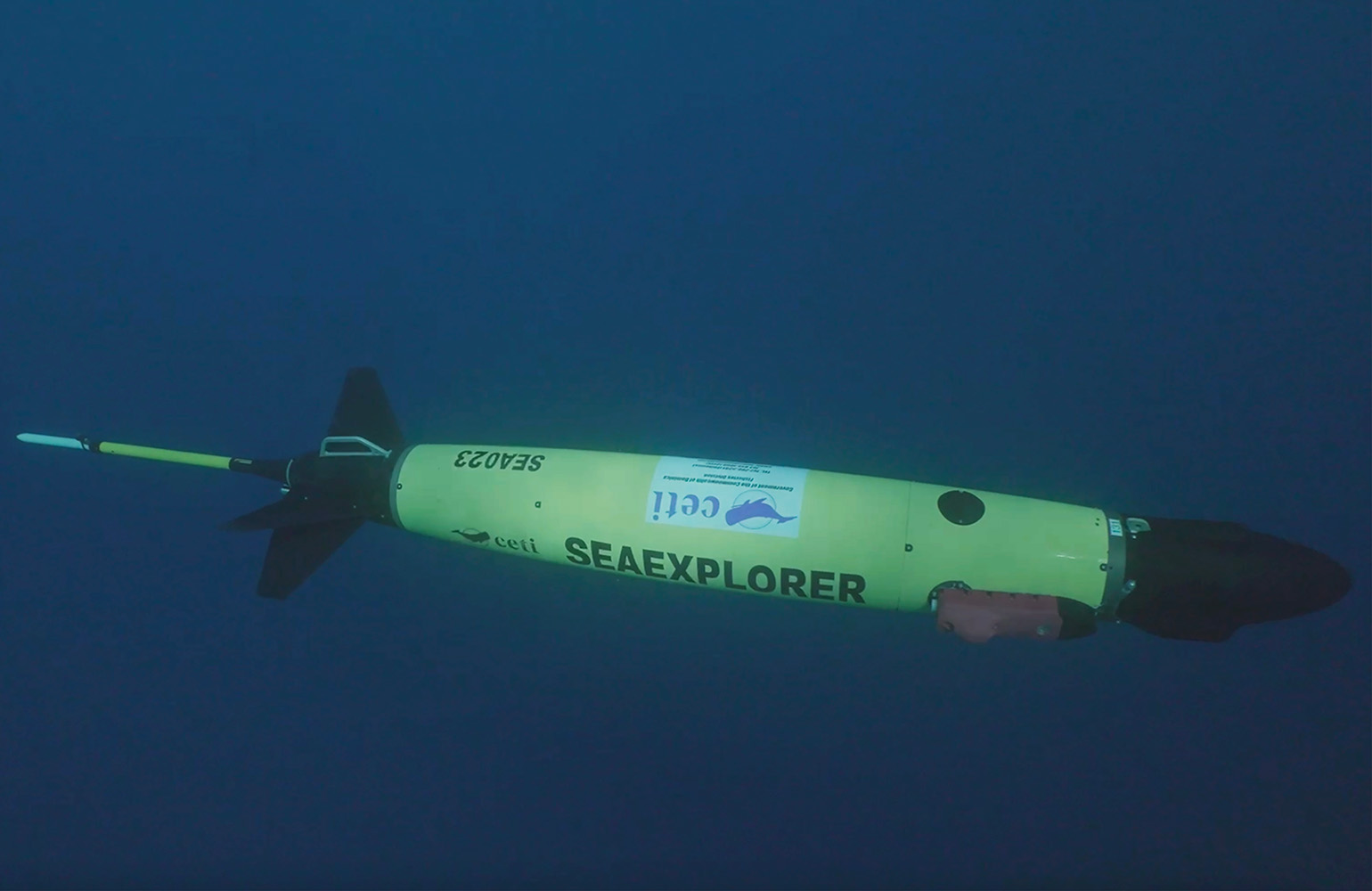
The Project CETI glider communicates with the team when it surfaces periodically. | Source: Project CETI, David Gruber
The Cetacean Translation Initiative, also known as Project CETI, yesterday said it is working with French robotics developer Alseamar to deploy underwater gliders capable of following sperm whales by listening to their voices. The team published a peer-reviewed study diving into the latest research.
Until recently, Project CETI has tracked whale movements using a variety of technologies, including deploying buoys or boats to collect data and attaching tags to whales using drones. With the glider, the organization can follow whales underneath the surface.
“There are so many challenges with the whales, because they’re only at the surface for 10 minutes, and then they’re diving for 50 minutes. Predicting when and where they are in this three-dimensional space out there in the ocean is one of our biggest challenges,” David Gruber, founder and president of Project CETI, told The Robot Report.
Project CETI has integrated its Backseat Driver into the gliders. This system listens to whale vocalizations and directs the glider to follow those whales.
“This project marked the first deployment of an SEAEXPLORER glider in Dominica, which was already a milestone,” said Jérémy Sitbon, systems architect at Alseamar. “Beyond that, the collaboration gave us access to a remarkable level of expertise in sperm whale monitoring.”
“It also stood out because Project CETI was among the first to leverage an intelligent acoustic platform while integrating its own algorithms onboard,” he said. “Additionally, it represented one of the earliest long-term acoustic monitoring missions conducted with the SEAEXPLORER platform.”
Why did Project CETI choose to deploy a glider?
Buoys, boats, and tags all have disadvantages when it comes to listening to whale vocalizations, Roee Diamant, the underwater acoustics lead at Project CETI, told The Robot Report. Buoys and boats often pick up on other noises, such as friction, making it harder for the Project CETI team to hear whale vocalizations.
“Tags are great. In Project CETI, we do tagging of the whales, but they’re short-term. You can deploy a tag for, let’s say, 24 hours, something like that,” Roee said. “[The tags] also don’t give you the sense of interaction, because you only listen to the whale that you tagged. It’s very hard to design a tag that will listen to both the tagged whale and its surroundings, because the sound is very intense.”
The glider, on the other hand, can listen for whale noises, figure out which direction they’re coming from, follow them, and eventually even identify which whale is vocalizing.
“Unlike propelled systems like UVs or surface vehicles, it moves by changing its buoyancy. So, it can control its center of mass [and] go up or down,” explained Roee. This way, the robot moves in a “V” motion in the waves. When moving with the current, the robot can move at up to half a knot above the current, he said.
“The great thing about this motion is you’re utilizing very little energy, so your battery actually lasts for long periods of time. There are gliders that can monitor the water for six months, even,” Roee said. “Every once in a while, two or four hours, it goes up and reports using satellite communication.”
This locomotion method is also very quiet, which means Project CETI doesn’t disturb the whales when the glider approaches. “[The glider] is another way of having a delicate, not passive object recording, and listening, and peering into their world,” Gruber said.
Undersea glider eavesdrops on whales
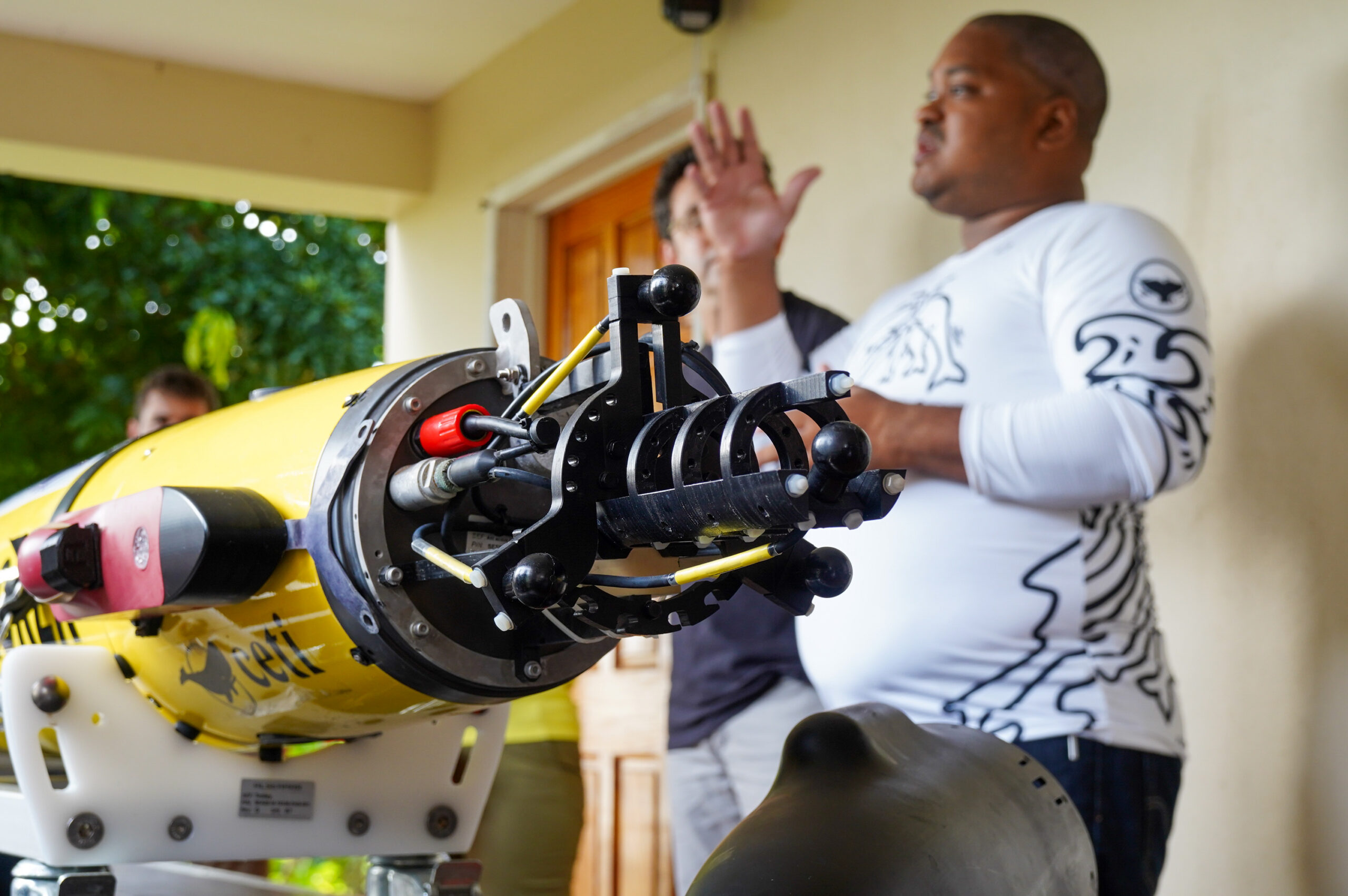
Project CETI custom-designed the sensor stack at the front end of the glider. | Source: Project CETI, Ashley Zafaranlou
At the front of the glider is a sensor stack that includes four tetrahedral microphone arrays. The CETI team had to carefully determine where to place these microphones and how far apart to place them, so that the robot can determine where sound is coming from, according to Gruber.
“Once it finds the whale, it can approach in several ways. It decides on a whale of interest. It finds its angle of arrival,” Roee said. “This is done continuously without humans in the loop at all. So everything is decided and determined by the glider itself.”
Right now, Project CETI can hear whales underwater from around 12 km away, but this depends on the kind of vocalizations the whale is making.
“What we are really working on now is the localization part to know where the whales are, the separation of the whales, and, most importantly, towards the end goal of CETI, which is the classification,” said Roee. “So, if we’re hearing a certain sound of a whale, can we really identify which whale it is?”
Alseamar provided flexibility, open-source access
According to Gruber, Alseamar wasn’t the only underwater glider provider Project CETI was interested in working with. Alseamar stood out for its willingness to collaborate with Project CETI on the gliders.
“It’s been a really unique collaboration with academia and industry here. Some facets, like the whale tags, we’re making all totally in-house. But we don’t know how to make a glider, and I wouldn’t want to reinvent a glider,” Gruber said. “We innovated, and we helped them make the four microphones that go on the front, the acoustic payload.”
The gliders project CETI uses two computers, a science computer and a navigational computer. One of the biggest changes Alseamar made for the project was to allow the science and navigational computers to communicate.
“A key requirement was enabling onboard algorithm integration,” Sitbon said. “Traditionally, gliders operate with a closed software architecture and are tasked via Iridium communications when they surface. For this project, we had to rethink that model by allowing external users to deploy their own algorithms directly on board. This meant enabling the glider to adapt its behavior in real time while underwater, optimizing its performance for monitoring sperm whale activity.”
“[Alseamar] has been very flexible in developing new techniques and new technology for the glider,” noted Roee. “They allowed us to design the head of the glider and include more hydrophones to do the Backseat Driver. That is something that no other glider in the world right now has, and it wasn’t there in the beginning.”
Project CETI conducts first field tests with glider
Project CETI currently has two gliders that it has taken out into the field for tests. Its first tests happened in southern France, where the team did controlled experiments to verify if the robot could follow underwater signals emitted from boats.
“After doing this control test, we also deployed the glider in Dominica Island several times for long periods of time,” Roee said. “Our longest was more than a week. During that time, we gathered a lot of data, much more than we were used to in our regular deployments.”
During this week-long deployment, Roee said the glider picked up whale sounds 40% of the time it was underwater. In the future, the team is hoping to deploy the gliders for months at a time. Last year, the Project CETI team was able to record a whale birth using a drone and a few underwater microphones, something humans had not observed before.
“Witnessing that whale birth was kind of like the double diamond, most complex type of behavior that we’d want to be able to translate,” Gruber said. With the new gliders, the team is hoping to capture more rare events.
Researchers work to make robotic platforms more capable
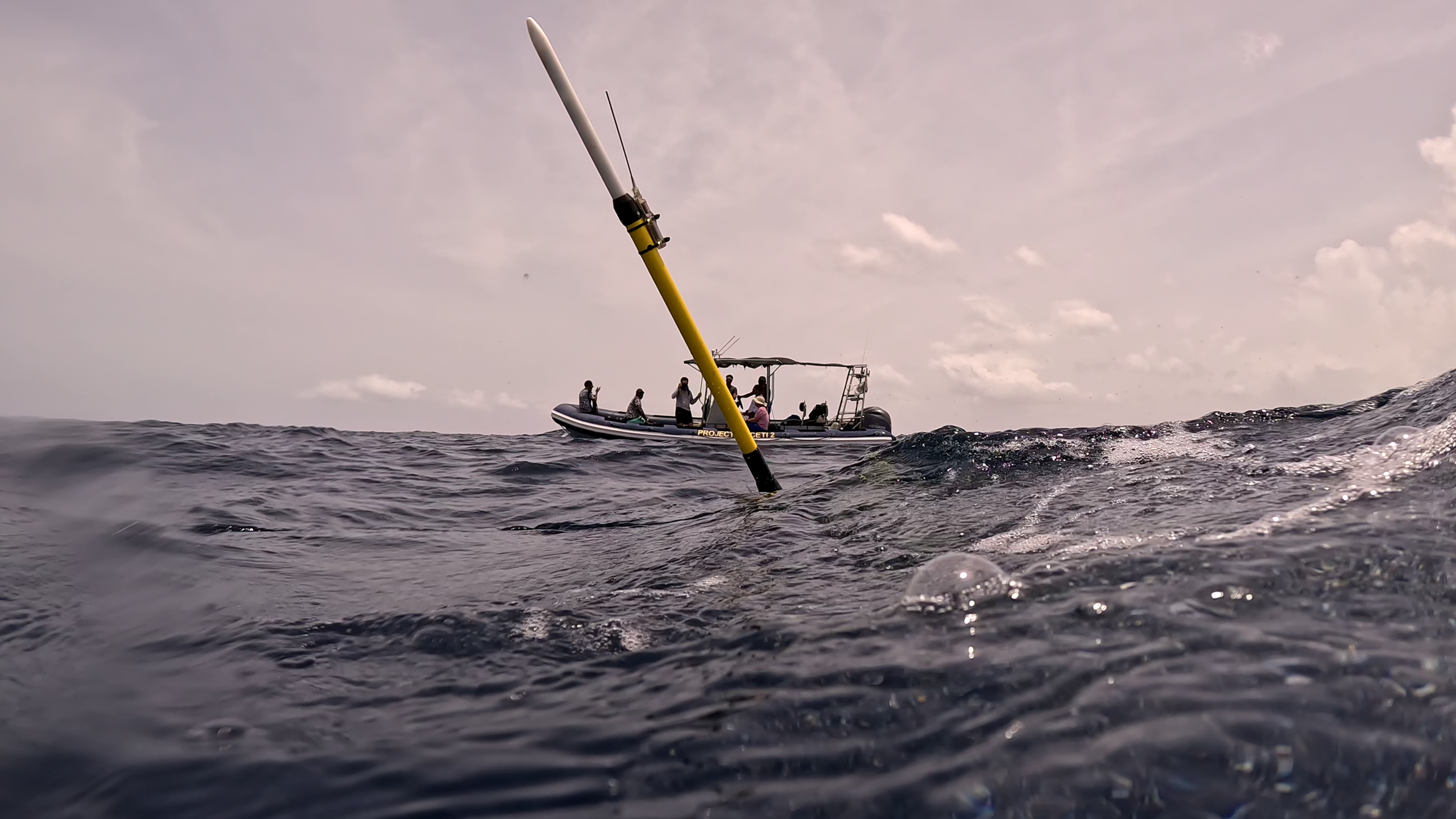
The Project CETI Glider reemerges from the ocean in Dominica after a mission. | Source: Project CETI, Zahrek Gonzalez-Peltier
Looking ahead, Project CETI will be working hard to refine its AI systems and make its gliders even more capable.
“I think our next roadmap in terms of robotics is the collaboration between all those assets that we are running,” Roee said. “So, there are gliders; there are going to be small buoys, tags, and drones that are putting the tags. So all these need to somehow coordinate, and we want ot do it all autonomously.”
The organization also plans to continue working with Alseamar.
“We definitely plan to continue this collaboration, particularly in terms of training and knowledge sharing,” Sitbon said. “While the glider platform itself is already mature, we are continuously improving key aspects such as robustness and power efficiency. Looking ahead, we aim to integrate additional sensors, enhance reliability and repeatability, and further reduce power consumption to extend mission endurance.”
Gruber said he is also interested in collaborating with other robotics developers. “We’re really looking for people that are creative, people that think outside of the box, people that are willing to try something that maybe in the people people thought couldn’t be done,” Gruber said.

The post Project CETI deploys autonomous underwater gliders to better observe sperm whales appeared first on The Robot Report.