
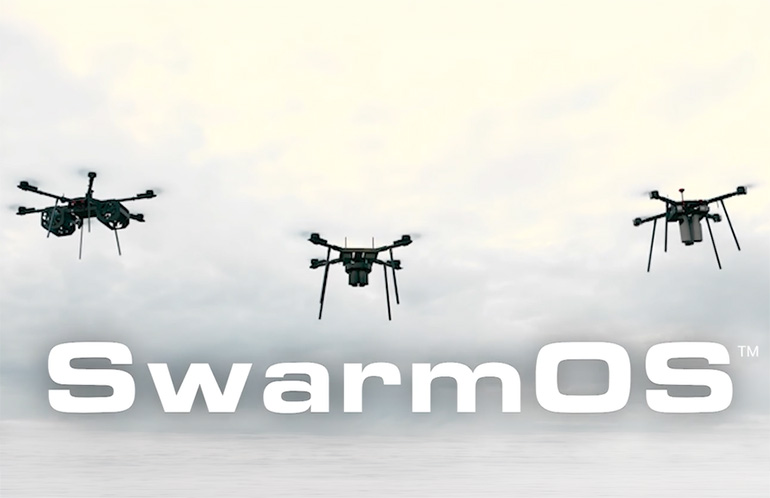
Palladyne has integrated its SwarmOS AI software with Draganfly’s hardwares for autonomous operations. Source: Palladyne AI
Draganfly Inc. and Palladyne AI Corp. today said they have successfully tested Palladyne AI’s SwarmOS platform across Draganfly’s mission-ready drone components and validated the system by completing a flight simulation.
“This milestone is a meaningful proof point,” said Cameron Chell, CEO of Draganfly. “What excites us about this joint effort is the ability to enable true autonomous collaboration where systems that can think, adapt, and operate together in real time. This represents a significant advancement in capability and positions Draganfly to pursue some of the most demanding defense programs.”
Founded in 1998, Draganfly is a leading developer of aerial drones and software for the public safety, civil, military, agriculture, industrial inspection, security, mapping, and surveying markets. The Saskatoon, Canada-based company recently joined the Canadian Army’s first Collaborative Uncrewed Aircraft Systems Working Group. It also sold about $50 million in stock in February.
Integrated system to advance decentralized drone swarms
“Unlike conventional drone automation systems that rely on centralized control or pre-programmed flight paths, the integrated solution is designed to enable decentralized, real-time collaboration between drones operating in dynamic and contested environments,” said Draganfly.
Palladyne AI said its Decentralized Edge Collaborative Autonomy (DECA) approach with SwarmOS enables drones to independently perceive, make decisions, and collaborate. They do not need to rely on continuous communications or centralized command structures, claimed the Salt Lake City-based company, which obtained a patent in November 2025.
SwarmOS-powered systems are designed to dynamically adapt to evolving mission conditions, including degraded communications or asset loss, allowing the swarm to reconfigure and continue operations autonomously.
“Completing the SwarmOS port across Draganfly’s defined platform and validating it through flight simulation is a significant step forward,” stated Ben Wolff, president and CEO Palladyne AI.
“SwarmOS isn’t about pre-programmed drones flying in formation; it’s about giving every drone in the swarm the intelligence to read its environment, collaborate with its teammates, and make the right decision in milliseconds,” he added. “Paired with Draganfly’s proven hardware, we are building something operationally significant for the U.S. DoW [Department of War].”
Draganfly and Palladyne AI continue defense expansion
Palladyne AI and Draganfly first announced their partnership in October 2025. They said this milestone aligns with increasing demand from U.S. defense initiatives, including efforts to deploy large-scale autonomous systems capable of operating in contested environments where traditional communications and command structures may be limited or unavailable.
Draganfly said it has recent engagements supporting U.S. Air Force Special Operations Command, as well as active deployments across intelligence, surveillance, reconnaissance (ISR), logistics, and tactical drone platforms.
In November 2025, Palladyne AI acquired GuideTech LLC, Warnke Precision Machining, and MKR Fabricators for about $31 million. The acquisitions, combined with the defense variant of the Palladyne Pilot embodied AI software for drones, led to the creation of the new Palladyne Defense division.
In January, it won a U.S. Air Force contract to advance drone swarming for cross-domain operations, and last week, GuideTech received a U.S. Navy contract to develop a low-cost, near-hypersonic missile.
“We’re not shifting our focus from the commercial side of our business, but we are bolstering defense opportunities,” Wolff told The Robot Report. “We see opportunities in this sector where we can leverage our AI with innovative hardware platforms to deliver superior results, both in trials and in real-world scenarios.”
“Military objectives are to spend the least amount of money while hitting targets with minimal unintended consequences or collateral damage,” he explained. “Swarming capability enables a number of airframes with sensor suites that collaborate in real time, enhancing precision and enhancing the likelihood of accomplishing the mission at a low price.”
Palladyne AI is integrating its software with GuideTech’s design, avionics, and autonomy capabilities. After moving out of hardware in its former brand as Sarcos, Palladyne is also getting back into manufacturing with defense components, acknowledged Wolff.
“It’s more like a continuation of a sine wave. Sarcos took on some of the most challenging robotics problems with exoskeletons,” he said. “Now, we’re bringing low-cost, highly attritable munitions to market. We’re applying lessons learned about supply chain and scaling, and we’ve brought in teams that have worked with Lockheed Martin and other defense primes.”

The post Palladyne AI and Draganfly reach milestone for autonomous drone swarms appeared first on The Robot Report.