
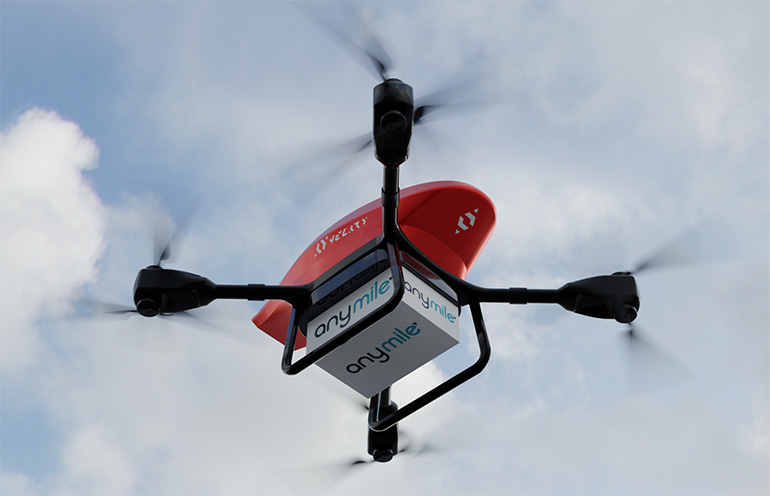
AnyMile is designed to handle cargo drone complexities. Source: Mitsubishi Electric
As robotics and artificial intelligence continue to advance, even longtime machine builders are pursuing digital transformation. Mitsubishi Electric United States, or MEUS, said it is developing software-as-a-service platforms, data-driven tools, and AI-powered systems bridging the physical and digital worlds.
One example of MEUS’s digital-first innovations is its AnyMile logistics software to manage drone cargo operations. Zafer Sahinoglu, vice president and general manager of the Mitsubishi Electric Innovation Center, replied to questions from The Robot Report about the company‘s digital initiatives and air mobility operations.
Digitalization can help businesses of all sizes, with or without AI
What are some of the biggest pain points currently facing large enterprises and small and midsize businesses (SMBs) that digitalization can help address?
Sahinoglu: Large enterprises and SMBs face many of the same structural challenges today: workforce shortages, rising energy and operating costs, fragmented and siloed data, increasing service-level expectations, and growing pressure to operate more sustainably and consistently.
Digitalization helps address these challenges by improving operational visibility and coordination across physical assets and workflows. When done correctly, it enables predictive maintenance, more efficient use of resources, and automation of repetitive or high-friction processes.
Rather than simply adding dashboards, effective digital systems integrate sensing, connectivity, analytics, and governance tools to support better operational decisions. The result is improved reliability, reduced waste, and organizations that are better prepared to scale and adapt in a rapidly evolving environment.
While there has been a lot of interest around AI in manufacturing lately, how has MEUS been working to help with digital transformation? How much involves connectivity, simulation, and digital twins rather than AI?
Sahinoglu: AI has an important role to play, but in our experience, many digital transformation efforts fail because foundational elements are overlooked. At MEUS, we focus first on connectivity, data integrity, and system-level visibility, ensuring that physical assets can be reliably observed and governed in real operating conditions.
Digital twins, connectivity layers, and standardized data models are often more impactful than AI alone, particularly in industrial and logistics environments. These elements create a reliable operational baseline that allows AI and advanced analytics to be applied safely and effectively.
In other words, AI delivers value only when it is built on top of systems that are already observable, reliable, and well-integrated.

How much data is enough, and how do you help users determine what they need?
Sahinoglu: More data does not automatically translate into more value. The real challenge is understanding which data matters, why it matters, and how it creates value in a given operational context.
At the Innovation Center, we developed a “data value canvas” to help teams systematically assess the relationship between data, decisions, and outcomes. The framework evaluates what decisions a system needs to support, what uncertainties must be reduced, and which data sources meaningfully improve reliability, efficiency, or compliance.
This approach helps organizations avoid over-collection and instead focus on high-value, decision-relevant data. By aligning data strategy with operational and business objectives, users can build systems that are both simpler and more cost-effective.
AnyMile addresses cargo drone complexity
How complicated is drone cargo management, and how does AnyMile address it? How closely does Mitsubishi Electric work with drone manufacturers and service providers?
Sahinoglu: Drone cargo complexity is increasing rapidly, particularly as operations move from pilot programs to scaled deployments. At scale, complexity arises not just from the vehicles themselves, but from the growing number of resources and activities that must be coordinated before, during, and after each mission.
This includes fleet availability, airspace constraints, payload requirements, regulatory compliance, ground operations, exception handling, and post-mission reporting. AnyMile addresses this by serving as a mission-centric orchestration layer that manages the full lifecycle of drone operations.
We work closely with drone manufacturers and service providers to integrate their platforms, ensuring that the system can adapt as vehicle capabilities, operational models, and regulatory requirements evolve.
How much integration work and time are required to deploy AnyMile?
Sahinoglu: AnyMile is designed for rapid deployment and minimal integration effort. The platform is already integrated with UTM [uncrewed traffic management] systems in the U.S., enabling airspace-aware operations from the outset.
We are also actively working on EPIC system integration to support seamless medical delivery workflows and compliance with healthcare operational requirements.
From an operational standpoint, onboarding is intentionally lightweight. Registering a fleet of drones and configuring vertiports can be completed within minutes, allowing operators to become operationally ready without lengthy setup or system overhauls.
This modular integration approach reduces deployment risk, accelerates time to value, and allows customers to scale drone operations progressively as mission complexity and volume increase.
Mitsubishi Electric research crosses hardware and software
Do any of MEUS’s technologies apply to other robotics and automation? Do you collaborate with Mitsubishi Electric’s hardware side?
Sahinoglu: Yes. A core strength of MEUS’s approach is the combination of software, data, and hardware to create system-level advantages across robotics and automation. Our software platforms are designed to be broadly applicable across different classes of robotic and industrial systems, enabling coordination, observability, and governance beyond individual devices.
Collaboration with Mitsubishi Electric’s hardware-centric divisions is fundamental to this strategy. By aligning software architecture, data models, and hardware capabilities from the outset, we can deliver integrated systems that are more reliable, scalable, and easier to deploy in real-world environments.
This collaboration is further strengthened through close engagement with Mitsubishi Electric Research Laboratories [MERL], whose research helps shape the advanced technologies embedded in MEUS’s next-generation solutions. Together, this integrated approach creates a durable competitive advantage that extends across multiple robotics and automation domains.

MERL headquarters in Cambridge, Mass. Source: Mitsubishi Electric
What are some ongoing challenges for software and automation still to address?
Sahinoglu: Key challenges include integrating legacy infrastructure, ensuring cybersecurity in increasingly connected environments, managing data quality across distributed systems, and addressing workforce skills gaps.
Another persistent challenge is governance, clearly defining accountability when automated systems interact with physical assets. Addressing these issues will be critical to ensuring that automation and digitalization improve resilience and safety, not just efficiency.
The post Mitsubishi Electric follows digital-first strategy for advanced air mobility appeared first on The Robot Report.