

Nexera’s NeuraGrasp can grasp items that were previously difficult to pick, such as porous polybags. Source: Locus Robotics
Locus Robotics, which launched the Locus Array mobile manipulator last month, today said it has acquired Nexera Robotics to increase the number of SKUs that its robot can handle. Nexera’s patented NeuraGrasp will replace the suction cup gripper on Array, vastly widening its fulfillment capacity, said the companies.
“The frontier of warehouse robotics today is AI-driven mobile manipulation at enterprise scale,” stated Rick Faulk, CEO of Locus Robotics. “Being able to efficiently grasp millions of SKU types with both speed and precision is where the next decade of value gets created. Nexera has built something technically significant in that space, and combining it with Locus Array puts us at the forefront of leveling up mobile manipulation across the industry.”
“We’ve done a lot with Array, particularly on the perception and grasping intelligence side, but we knew that we needed to evolve the gripper technology because there are limits with using suction,” Gina Chung, chief strategy officer at Locus, told The Robot Report. “Since last year, the team identified Nexera Robotics as one interesting technology that we could integrate onto Array to unlock a whole host of benefits around manipulation capabilities.”
Locus Robotics won a 2026 RBR50 Robotics Innovation Award for Array. See this year’s honorees, which will be celebrated at the ticketed RBR50 gala dinner at the Robotics Summit & Expo in Boston next week.
Hamid Montazeri, senior vice president for software and AI at Locus, will participate in the opening keynote panel on “Building the Next Era of Robot Autonomy” at the Robotics Summit. Registration is now open.

NeuraGrasp is designed for flexibility
Rather than trying to solve robotic grasping of diverse goods with just a suction cup or a claw gripper and programming, Nexera Robotics said it designed NeuraGrasp to provide flexibility and reliability in robotic pick-and-place applications. NeuraGrasp combines a soft, compliant membrane with onboard sensing, computer vision, and artificial intelligence.
The Vancouver, Canada-based company said it has proven that NeuraGrasp can dynamically grasp a wide range of items, from small containers to porous polybags and cloth items.
“We built NeuraGrasp to solve the manipulation challenges that have held robotic picking back for years,” said Roy Belak, CEO of Nexera Robotics. “Joining Locus Robotics gives us the platform, scale, and customer base to bring this breakthrough technology into the high-velocity fulfillment environments it was designed for, where speed, reliability, and real-world adaptability matter most.”
“We wanted one gripper to solve them all. Others are limited by suction or tool switching, which most customers don’t want,” Chung said. “Nexera has already done millions of picks, so the integration path should be easy. Locus will handle Nexera’s existing customers on a case-by-case basis.”
With NeuraGrasp, Locus Array will be able to autonomously pick things such as loosely bagged apparel, irregular packages of pharmaceuticals, contoured products, small electronics and industrial items, and consumer goods weighing up to 5 lb. (2.2 kg.) such as a bottle of detergent. Locus said this represents the majority of e-commerce SKUs.
“Whilst robotic picking arms have been around for a while, Locus Robotics is among a small number of vendors to natively embed robotic picking at the heart of the automation, signaling a shift towards fully automated picking,” said Rueben Scriven, a research manager specializing in logistics automation at market intelligence firm Interact Analysis.
“Item manipulation has been one of the biggest bottlenecks to successful robotic picking,” he explained. “Over the years, we’ve seen significant developments in machine vision and path planning. But the actual manipulation and gripping of items — and thus the SKU coverage — has been a significant challenge. Having robust end-effectors is becoming a significant competitive advantage.”
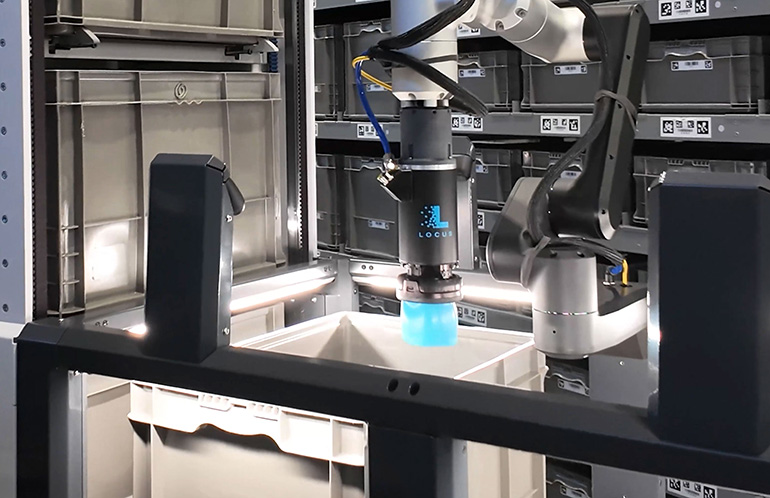
Nexera Robotics is integrating NeuraGrasp into the Locus Array mobile manipulator. Source: Locus Robotics
Locus Array gets a grip on more items
Locus Array formally launched at MODEX 2026, where it was as a top-three MHI finalist for Best New Innovation among more than 200 submissions. The mobile manipulator is currently live in customer deployments, with additional sites in progress.
Teams from both Locus and Nexera are working to integrate the NeuraGrasp end effector into the Locus Array platform. They said they expect the combined technology to become available in the coming months.
“While Array can’t pick surfboards, shoeboxes with flip lids, or books that can open, it will pick 90% to 100% of most customers’ SKUs,” Chung asserted. “We already have AI-driven picking intelligence without preprogrammed SKU libraries, and some of NeuraGrasp’s perception abilities need to be merged into our manipulation stack.”
As with its Locus Origin and Vector autonomous mobile robots (AMRs), Locus Array with NeuraGrasp will use the LocusONE software platform to orchestrate fulfillment workflows across picking, replenishment, sorting, and packout.
“LocusONE provides a single tech stack for all our AMRs,” said Chung. “In addition, Origin and Vector can assist human associates with handling oversize or heavy items that Array can not. Two deployments are already under way, and we have a 24/7 deployment plan for Array.”
Locus Robotics also said its acquisition of Nexera Robotics will significantly broaden its addressable market.
“This is brand-new to our customers,” Chung said. “They knew we had something coming to market and are excited about getting way more inventory coverage from Day 1.”
“In the coming months, we’ll demonstrate to customers at Locus Park how NeuraGrasp can pick almost any SKU, based on the weight limitations of the robot arm. It doesn’t need a large surface area can pick perforated polybags, beanies, or mesh bags — items that were previously impossible to grasp,” she added. “We’re even asking customers to send us representative samples of their SKUs to Locus headquarters to try it out.”
Nexera expands Locus footprint from coast to coast
Founded in 2021, Nexera Robotics will be wholly owned and operated as part of Locus Robotics. The company’s entire team and leadership are joining Locus.
“Nexera gives us a West Coast office,” said Chung. “The acquisition gives Locus a next-generation R&D base, AI and hardware fusion, and deep SKU coverage.”
Locus Robotics is operating more than 17,000 systems through its robots-as-a-service (RaaS) model across more than 360 facilities worldwide, and it has conducted more than 7 billion picks to date. The Wilmington, Mass.-based company said it has over 150 customers in retail, healthcare, third-party logistics (3PL), and industrial brands.
“Locus Robotics is the fourth largest mobile robot vendor globally in terms of revenue, and the second largest mobile robot vendor in the order fulfilment segment,” Scriven told The Robot Report.
“With 190 million autonomous mission miles in the warehouse, we have the most robust indoor autonomy stack in the industry,” Chung claimed. “With Nexera, we’ll be looking at other manipulation use cases.”
Editor’s note: Chung will participate in a webinar on advances in robotic case and each picking at noon EDT on Wednesday, June 3. Register now to attend and to get your questions answered during the live broadcast or to watch on demand.

The post Locus Array expands picking ability with Nexera Robotics’ NeuraGrasp appeared first on The Robot Report.