
Global interest and competition to add AI to robotics is growing, says the IFR. Source: International Federation of Robotics
A new generation of robots powered by artificial intelligence is moving out of research labs and into the real world, according to the International Federation of Robotics, or IFR. The Frankfurt, Germany-based organization this month released a position paper on “AI in Robotics: Trends, Challenges, Commercial Applications.”
With industry analysts predicting a multi-trillion-dollar market, innovators and entrepreneurs are pursuing the goal of giving AI robotic bodies, noted the IFR.
“AI is transforming the field of robotics at a rapid pace,” stated Takayuki Ito, president of the IFR. “Integrating AI into robotics enhances capabilities, increases efficiency and improves adaptability. This development is transforming AI from a supporting technology into a powerful enabler, opening the door to wider robot adoption across industries.”
AI improves robot vision, navigation, and manipulation
Robot and chip manufacturers have invested in dedicated hardware and software that simulate real-world environments. “This so-called physical AI allows robots to train themselves in virtual environments and operate by experience, rather than programming,” noted the IFR. “The excitement about embodied AI has drawn attention from major tech players and governments around the world.”
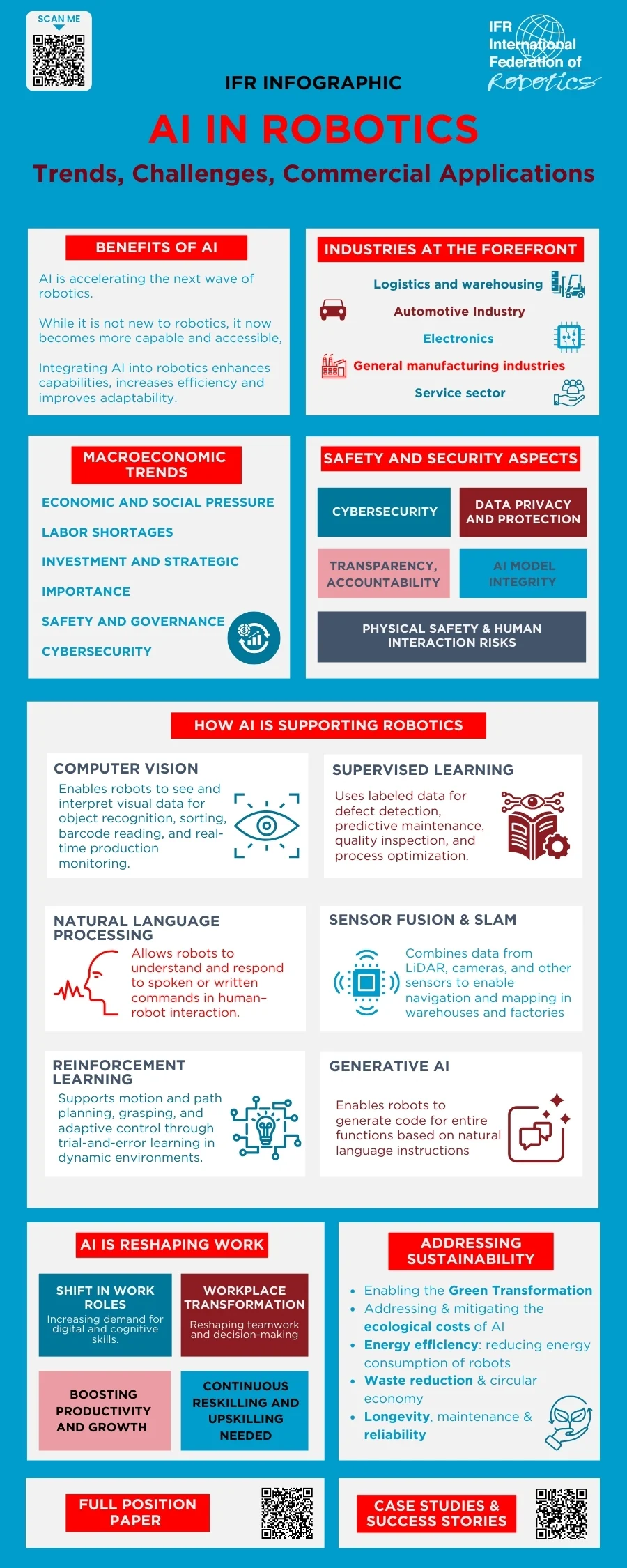
With deep learning, computer vision enables robots to “see” and interpret visual data for tasks such as object recognition, barcode reading, sorting, and real-time monitoring on production lines. The IFR said supervised learning is used for tasks like defect detection, predictive maintenance, quality inspection, and process optimization. Robots can learn from labeled data to make accurate predictions or classifications.
In mobile robotics, AI can combine data from multiple sources such as cameras or lidar sensors for SLAM (simultaneous localization and mapping) navigation in warehouses or manufacturing floors.
In addition, reinforcement learning (RL) is starting to be useful for robot motion and path planning, grasping, and adaptive control, the IFR explained. Robots are learning by trial and error, often with large amounts of data, to improve their performance in dynamic environments.
The next step in robot evolution is with generative AI, said the organization. Generative AI is changing the programming process by creating code for entire functions that a robot will perform based on natural language instructions.
Natural language processing also enables collaborative or service robots to understand and respond to written or spoken commands, said the IFR.

IFR observes regional differences
In the U.S., corporations including Amazon, Tesla, and NVIDIA have announced record-breaking investments. Venture capital is pouring into a growing ecosystem of startups focused on specialized robot applications, the IFR reported.
In Europe, ABB recently agreed to divest its robotics division to Japan’s SoftBank Group, combining ABB Robotics’ with SoftBank’s capabilities in AI.
China’s Ministry of Industry and Information Technology (MIIT) announced a dedicated action plan to accelerate embodied AI, positioning it as “future industry” critical to the country’s economic transformation.
How AI and robotics could change the nature of work
Over the next five to 10 years, the IFR said it expects AI to be widely adopted in various robotics applications. Versions of the technology promise to increase efficiency, reduce errors and maintenance costs, and provide a quicker return on investment (ROI) in comparison with non-AI systems.
“Robot installations are traditionally taking over physically demanding and repetitive tasks, freeing employees from harsh working conditions,” said the IFR. “As AI tools become more common, new roles emerge for supervising, analyzing and making decisions.”
Contrary to some forecasts, the organization said this will create job roles such as AI engineers, data scientists, machine learning specialists, and ethicists. These positions require digital and cognitive skills, such as coding and data literacy, as well as critical thinking and constant learning, the IFR said.
AI in robotics will also affect how teams work, how decisions are made, and how performance is monitored, predicted the organization. This could improve workflows but also raise concerns about employee surveillance or reduced autonomy.
The IFR’s position paper, which is now available, also looks at macroeconomic trends affecting AI development and deployment, as well as safety, security, and sustainability concerns around AI in robotics.
Source: International Federation of Robotics
The post IFR releases position paper on AI in robotics appeared first on The Robot Report.