
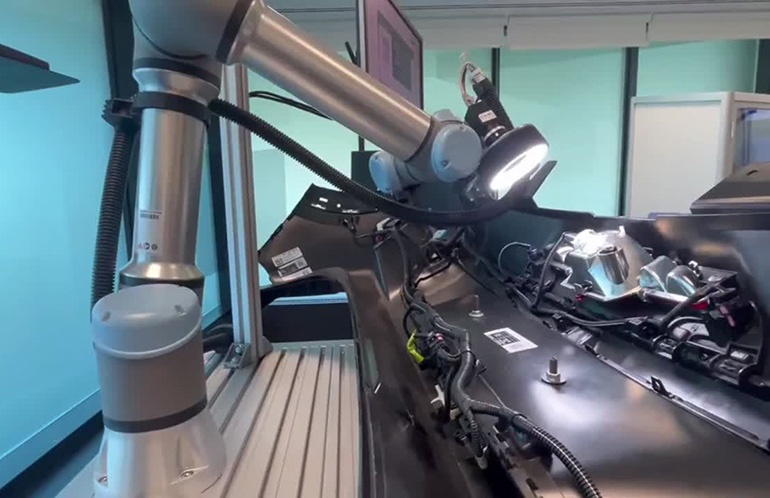
GFT integrates robots, sensors, and software for visual inspetion. Source: GFT Technologies
While many manufacturers use artificial intelligence for visual inspection, most systems stop at anomaly detection. This requires human workers to act, creating delays and risk. GFT Technologies SE today launched AI-driven robotic arms that can not only detect defective parts but also remove them from the production line.
“Auto manufacturers have been asking the same question for years: ‘How do we get AI off the screen and onto the floor?’ With this launch, that question has an answer,” stated Brandon Speweik, head of manufacturing at GFT. “Bringing AI into the physical realm for auto manufacturers requires a partner who understands the intricacies of both the technology and the factory floor. That’s been GFT‘s role for 35 years, and this is the natural extension of it.”
GFT Technologies said it delivers advanced digital transformation solutions, modernizes technology architectures, and develops next-generation core systems for industry leaders in banking, insurance, manufacturing, and robotics. The Stuttgart, Germany-based company said its team of more than 12,000 experts partners closely with its clients, providing industry expertise, software, and a strong partner ecosystem in over 20 countries.
GFT Technologies closes gap between insight and action
“A single recalled vehicle can cost manufacturers upward of $500 per unit to remediate, ultimately costing them tens of millions,” noted GFT Technologies. “Closing the gap between insight and action, at the speed of a modern assembly line, has become a critical challenge.”
The company said it has applied its experience helping automotive manufacturers, such as Ford Motor Co., modernize their systems and unlock the value of their operational data. GFT has combined its deep knowledge of manufacturing workflows and systems integration to push the boundaries of what AI can do beyond the digital realm.
Building on its work with Google on AI-powered visual inspection, GFT said it can help manufacturers improve quality and keep production moving at full speed. It works with multiple hardware providers, including NEURA Robotics.
“We did this in a strategic partnership with Google Cloud for what we’re calling Industry 4.0 or manufacturing modernization and transformation,” Speweik told The Robot Report. “With AI, first and foremost, we’re knocking down data silos to create a better context for machines to understand the workspace and how they’re performing actions.”
“It could be getting inputs from many different data sources, [such as] unstructured data coming from a visual inspection camera or if it’s coming from the actual assembly line, like conveyor belt speed. It can be coming from RFID tags of products passing a certain checkpoint,” he added. “[The system is] synthesizing all the information at once to really understand to a high degree of accuracy what’s occurring on that line.”
The goal is to have a common platform across the entire shop floor and to be able get insights, said Speweik. At the same time, models need to be tuned to avoid false positives and to achieve the level of customization that a manufacturer prefers.
“The AI models are getting to the point where customizations are getting less and less, and the data sets for training are getting a lot smaller smaller,” he explained. “They pick up on context faster, and we need maybe only a few hundred images rather than thousands.”
A three-robot solution advances from inspection to movement
GFT Technologies has stationed three different robots along factory assembly lines to ensure that components such as car bumpers, doors, pipes, and pieces are manufactured accurately.
The first robot uses a camera to verify details on each piece, such as positioning, detecting visual defects in real time, and confirming that labels and serial numbers are accurate and readable. This camera is attached directly to the robot gripper, allowing the robot can move the camera around to capture different angles and check every part of the component.
After inspection, the second robotic arm on the line marks the parts that its previous counterpart identified as defective.
Finally, the third robotic arm built by GFT physically interacts with the line and defective pieces, reducing the need for human intervention. This includes:
- Repositioning parts: When the arm detects a misaligned component, it can correct its position before advancing to the next production stage, proactively preventing defects rather than just catching them.
- Removing parts from the line: When a defect is marked as detected or suspected, the arm can pull the part and flag it for human review. GFT said this eliminates the risk of human error in defect detection and reduces the likelihood that faulty products will leave the factory.
In addition, every photo the camera takes is automatically sent to the cloud, where it is saved. The factory can review them later, keep a record of every inspection, and even use them to improve the system over time.
GFT said it has now incorporated an AI agent into the root-cause analysis process. It draws on these images and other datasets to not only detect a defect, but also find its source so that proactive preventive measures can be taken.
“We’re working toward the democratization of AI, which is why we’re well aligned with Google,” Speweik asserted. “We’re working with the models and the people who have subject-matter expertise so that someone who’s not a data scientist or software engineer can make queries or write prompts in natural language.”
Together, the robotic arms, agentic AI, and cloud technology keep production running quickly without sacrificing quality or the ability to improve over time, said the company. One large U.S.-based auto manufacturer has already begun to put this technology to work across its operations.
“Computer vision, robotics, and automation have as many applications as your imagination allows, as it’s providing machines with with a means to identify and sense through unstructured visual data,” said Speweik. “That capability is also useful outside of manufacturing environments, like Tesla is using for its humanoid robots. It can also apply to drones for search and rescue missions, and the sky’s the limit for how you can apply this technology in the real world.”

The post GFT Technologies AI-powered robots move from inspection to action for automakers appeared first on The Robot Report.