
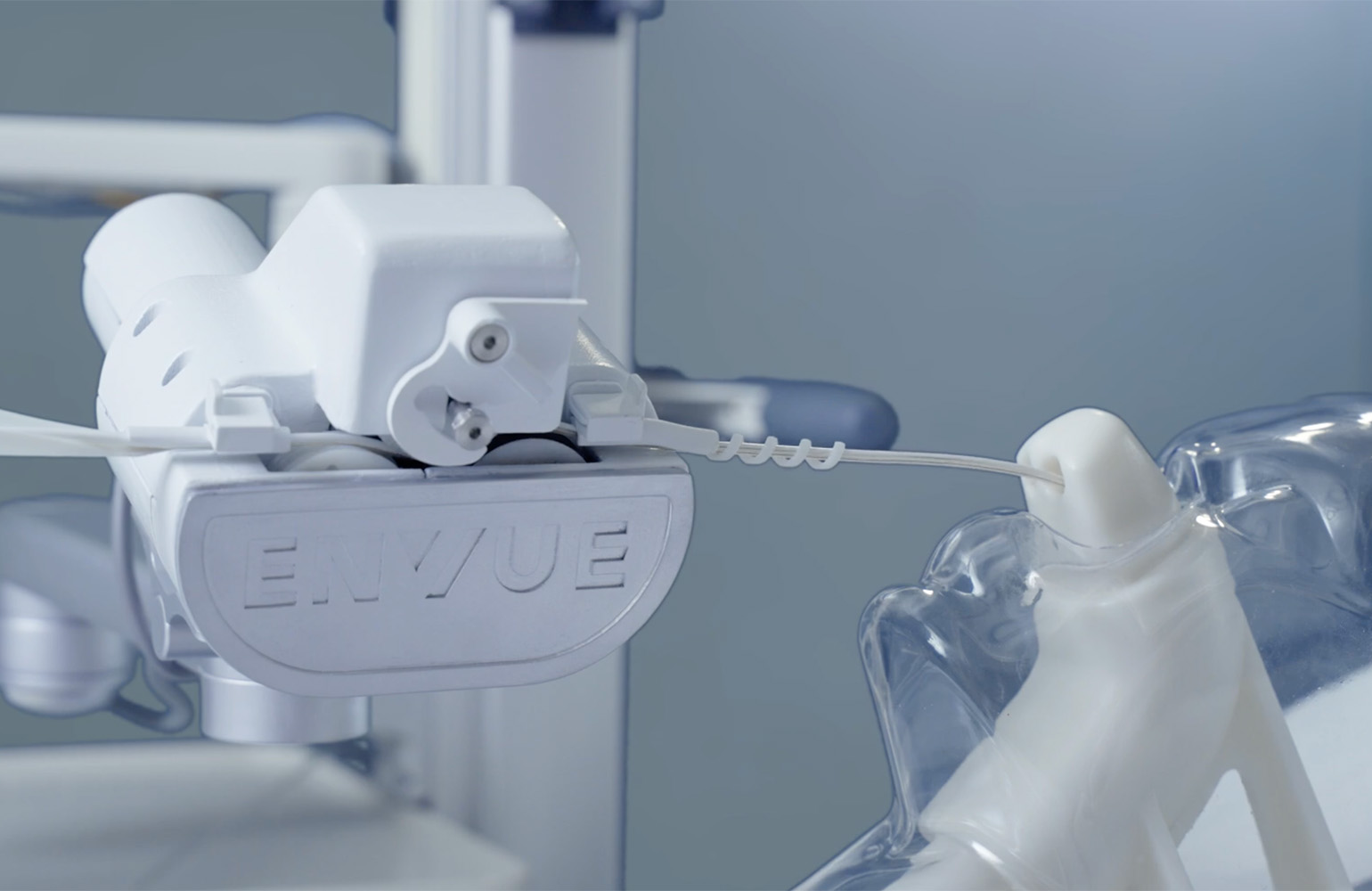
ENvue Drive demonstrates insertion of a feeding tube into a patient. | Source: ENvue Medical
ENvue Medical Inc. recently unveiled ENvue Drive, its robotic-assisted tool for automatically placing feeding tubes. The tool is built on the company’s electromagnetic navigation platform ecosystem, and is designed to integrate artificial intelligence, real-time navigation, and robotic-assisted procedural execution into a unified clinical workflow.
Each year, over a million feeding tubes are inserted into patients in the U.S. “It can be in critical care patients — that means elderly patients, adult patients, and all the way down to pediatrics and pre-term infants,” Dr. Doron Besser, CEO of ENvue Medical, told The Robot Report.
Most of the time, feeding tubes are placed blindly. This means the tube is inserted through the nose, and the person performing the procedure has to rely on their experience, and any resistance then feel while inserting, to get it right.
These procedures are always prescribed by a doctor, but they could be performed by nurses and dietitians, as well, said Besser.
“About 3% to 5% of all those procedures are misplaced, and they land in the lungs,” he said. “If that occurs, it creates a cascade of problems. It can cause lung collapse. Sometimes, one even leaves the feeding tube within the lungs, and it fills up the lung with fluid nutrients.”
Besser said the whole concept behind ENvue’s system was to make the procedure safer for patients, easier for the clinician, and less expensive for hospitals.
How does ENvue Drive work?
ENvue is building ENvue Drive on top of its 510(k) FDA-cleared ENvue Navigation Platform. This platform is currently used in hospitals across the United States to provide real-time electromagnetic guidance during enteral feeding tube placement. ENvue Drive takes this a step further, by having a robot insert the feeding tube itself.
ENvue’s system includes a sensor at the end of the feeding tube, which gives physicians visibility while placing the tube. It also integrates the company’s AI navigation software, Ask Oscar.
“When one inserts that feeding tube with that sensor within the field of electromagnetic waves, which covers the entire patient’s chest and abdomen, it becomes aligned,” Besser explained. “It’s activated, and that means with any movement, no matter in which direction, in 360º, the position is calculated by our system and presented on screen.”
He added that ENvue developed this sensor in-house. “One of the most important things with electromagnetic navigation systems is that the sensors have to have a very, very high refresh rate,” said Besser. “With ours, it’s about 40 times per second. Why is that important? Because if the clinician inserts that feeding tube, you want to see an immediate response on the screen, so there’s no delay.”
Once inside the patient, the system moves in five degrees of freedom, giving the clinician more flexibility when performing the procedure.
“Our system provides steering directions. In other words, the clinician will always know in which direction is the feeding tube pointing,” Besser said. “That’s very important because what we’ve done now is we have provided a GPS-like system, like Google Maps or Waze.”
ENvue must account for patient movements
With this latest demonstration, ENvue showed its system can identify anatomical pathways, detect trajectory deviations, provide corrective guidance, and assist advancement to a target position within the small intestine, under clinician supervision.
There are some unique challenges that come with feeding tube placements. One of the biggest ones is the unpredictability of the patient themselves.
“Even heavily sedated patients, even mechanically ventilated patients, can move during the procedure. Nobody likes to have a feeding tube inserted,” Besser said. “The nurse has to focus on the patient, calm the patient, and insert the feeding tube.”
To account for this, ENvue uses additional ECG sensors placed on the patients body. “If the patient moves during the procedure, gets upright or slightly uncalm, the system will always stay accurate,” Besser said.
Clinicians stay in charge of the entire procedure
When developing ENvue Drive, Besser said the team wanted to make sure it was creating an easy-to-use tool with clear instructions.
“Nurses and dietitians are under colossal amounts of pressure,” he noted. “They’re tired. Everybody’s understaffed, and we want to assist the user when he or she does a procedure to do it step-by-step.”
During the procedure, if the system detects the tube is nearing an area it shouldn’t be, it alerts the user and gives recommendations for how to proceed. The person performing the procedure is always in charge and ultimately tells the system what to do next.
“We don’t want robots to take over from the clinicians,” said Besser. “We want the robotic arm to assist, to provide more confidence, to facilitate the procedures, while having the clinician, who’s highly capable and is highly provisioned, still keep control of the system.”
 Save the date for RoboBusiness 2026
ENvue hopes to bring robotics to more bedside procedures
Besser said a lot of healthcare robotics have started with highly sophisticated, OR-based procedures, like orthopedic surgeries or spinal surgeries. Simpler, bedside procedures, however, are much more common. As robotics have gotten less expensive to produce, these procedures are becoming more practical to automate.
“The first step, naturally, would be internal feeding. The next step would be vascular access, and that specifically would be peripherally inserted central catheters,” Besser said. Each year, millions of catheters are inserted into the arm, and have to be accurately positioned to reach the year to administer medications.
By integrated chest X-rays into the company’s system, ENvue said it hopes to create a robot that could automate these procedures.
Right now, the core technology behind ENvue Drive is already 510(k) FDA-cleared. ENvue plans to pursue additional clearances for ENvue Drive in the coming years.
The post ENvue Medical develops robotic feeding tube placement system appeared first on The Robot Report.