

RoboCup is an international competition that promotes and advances robotics and AI through the challenges presented by its various leagues. We got the chance to sit down with Professor Manuela Veloso, one of RoboCup’s founders, to find out more about how it all started, how the community has grown over the years, and the vision for the future.
I think it would be very interesting to go right back to the beginning and hear how RoboCup got started. What was the initial idea, and how did it get set up?
So we are talking about the mid-90s. In terms of the research in those days, it was the beginning of the internet and many AI and computer science researchers were focused on the internet, first on sophisticated search algorithms, on natural language understanding, on information retrieval, and then on software agents and machine learning applied to digital information. From what I recall, there was a smaller group of researchers who were interested in actual, physical robots, and in particular in AI and robotics. I myself was specifically interested in the problem of creating autonomous robots with perception (get information from the world), cognition (select action to achieve goals), and then act (execute the planned actions). This combination of perception, cognition, and action is a very good framework for autonomous robots, because they have to get their information from their sensors, they have to reason about actions to achieve their goals, and then execute them. So, during the 90s, I was at Carnegie Mellon with this AI research goal of integrating perception, cognition, and action in autonomous robots.
Over in Canada there was Alan Mackworth, who jointly with his wonderful student, Michael Sahota, built a one-on-one little autonomous robot soccer set-up. Two robots ran on a small field that had a camera overhead, and aimed at scoring each in one of the two little goals. This work showed that this task of kicking a ball and defending and aiming at a goal could be done autonomously. So it was a tremendous demonstration that a robot soccer world could exist. Mostly at the same time, in Japan, Minoru Asada was showing that a big robot could learn with reinforcement learning how to push a ball into a goal. So you have these one-on-one, fully autonomous little robot cars that were pushing balls around in Canada, and then there was this effort of learning to score with a larger robot in Japan. The learning robot didn’t have a team, it was not a real game, but it was showing that reinforcement learning could learn the skill of aiming into a goal. And then there was also Hiroaki Kitano at Sony who was very interested in little humanoids.
So this is very beautiful because all these things came into play – all of us had different interests.
Alan Mackworth did not get involved with RoboCup, but he gave a demonstration of these one-on-one robots at AAAI in 1994. And in those days, I had a PhD student who had just joined – Peter Stone. And Peter was a serious and passionate soccer player. He saw this little game and he came to me and said, “this is what I want to do for my thesis research, robot soccer!” And for me, I was trying to find a research environment where autonomy was needed in the robot world. I had already a student, Karen Haigh, who was working with autonomous office robots, and learning to plan and execute. But with these soccer robots and Peter Stone’s interest everything came to play, and we started robot soccer research in my lab.
In 1996, there was also a robot soccer effort in South Korea, called MIROSOT, and that’s the first competition we participated in. So Peter Stone, myself, and the team we built at Carnegie Mellon – Sorin Achim and Kwun Han – went to South Korea to participate. From South Korea, we flew to a robot soccer workshop in Japan organized by Minoru Asada and Hiroaki Kitano. Also in attendance were Dominique Duhaut, Itsuki Noda, Silvia Coradeschi, and Enrico Pagello. And that’s where RoboCup really started – we decided to do a competition. And the good thing was that Kitano was the chair of IJCAI, which was going to happen in Osaka in the summer of 1997. So we are there in Osaka and literally we came up with this idea of having a robot soccer competition, RoboCup. It was a big moment for us as researchers. We had to come up with the rules of this competition so that people would be able to participate seven months later. We came up with the three leagues that we were interested in and had expertise in.
The small size league, building upon our Carnegie Mellon interests, would have a field with a camera overhead connected to a computer and then the computer would remotely control the robots through radio.
Then Minoru Asada had these bigger robots with wheels, and we created a league that we call the middle-size league to include the robotics research of Minoru Asada and others. And then Itsuki Noda was interested in creating a simulation environment. We thought that this would help get more people participating in this task of robot soccer.
So that’s how the three leagues started: the small size, the middle size, and the simulation. Hiroaki Kitano, Dominique Duhaut and I were in charge of the small-size league, Minoru Asada was in charge of the middle-size league, and Itsuki Noda ran the simulation league.
One of the challenges was to come up with the rules and define the robots and playing fields. I remember my own pragmatism in suggesting that we play on a ping-pong table for the small-size, as a ping-pong table is something that exists in the whole world. That meant that we would have a playing surface, with defined size and texture, anywhere in the world. We decided one ping-pong table for the small-size league, and nine ping-pong tables for the middle-size league.
In the summer of 1997, at IJCAI, when we all went to the actual first RoboCup competition, the space was gorgeous. Hiroaki Kitano had made these beautiful fields and white bleachers around the fields. It was a very beautiful space with an area with computers for the simulation league. There were 80 teams that had joined the simulation online. We were, I believe, five teams for the small size league and about eight to ten for the middle size league.
That’s how it all started. And 1997 it was in Osaka, in 1998 Dominique Duhaut organized RoboCup in Paris, at a modern Science Center, La Villette. And then in 1999, RoboCup was organized by Silvia Coradeschi, in Stockholm, again co-located with the IJCAI conference. In these three years 1997, ’98, and ’99, there were only these three leagues, small size, middle size, and simulation. It was the foundation of everything. RoboCup grew consistently every year in terms of the number of teams, the number of participants, and the number of participating countries.
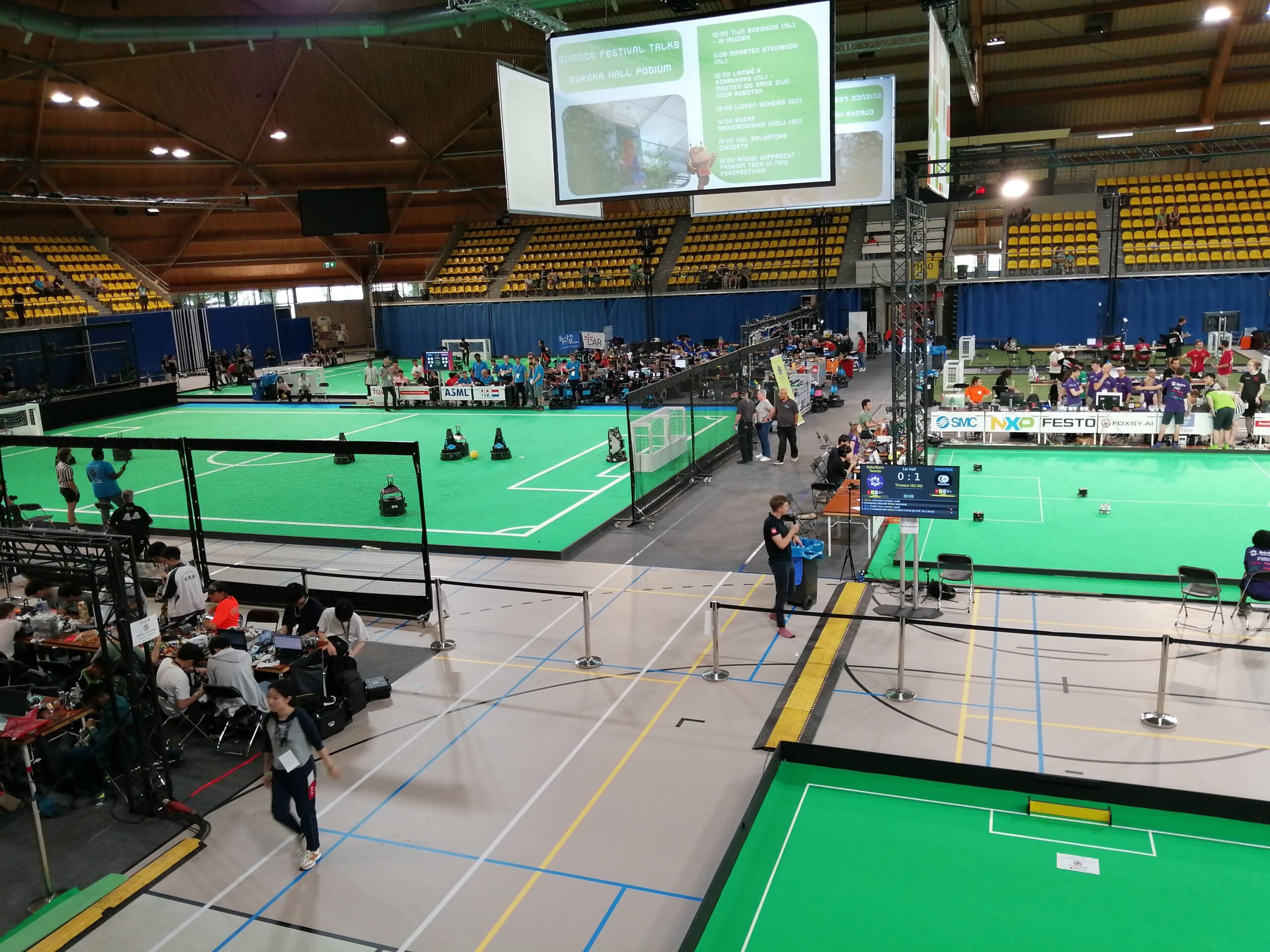 Some of the pitches in the main soccer arena at RoboCup 2024, held in Eindhoven, The Netherlands.
So how did RoboCup expand and could you talk about the decisions to add extra leagues?
Well, nothing was necessarily planned, it was more related to the research interests that people had. So when we were in Melbourne in 2000, there were two things that were added. One was RoboCupJunior. There was a professor, Elizabeth Sklar, who had a tremendous interest in robotics education for children. She proposed the RoboCupJunior competitions for children K-12. The goal of RoboCupJunior was to train all these young people to do research in robotics. It was and it still is extremely successful. In Melbourne there were probably the same number of children as there were people competing in what we now call the major leagues. As well as the soccer leagues, Elizabeth also ran a dance competition. This was very impressive – the children would dance on stage with their designed, built, and programmed mobile robots.
I believe that the rescue league was also introduced in 2000. The reason why we came up with rescue was because in those days, there was a lot of research on robots in disaster environments. So many people in our groups had an interest in developing robots that were able to handle disaster environments. So, we included that interest. And later on, @home was also introduced because people had an interest in service robots.
The logistics league came later to cover robots inside factories. The reason for introducing new leagues was always to include the community. And we didn’t want anyone to feel they could not come to RoboCup because they did different research with their robots. And so it was a very intellectually inclusive environment for AI and robotics researchers that could perform tasks autonomously – with perception, cognition, and action mostly in teams for particular tasks.
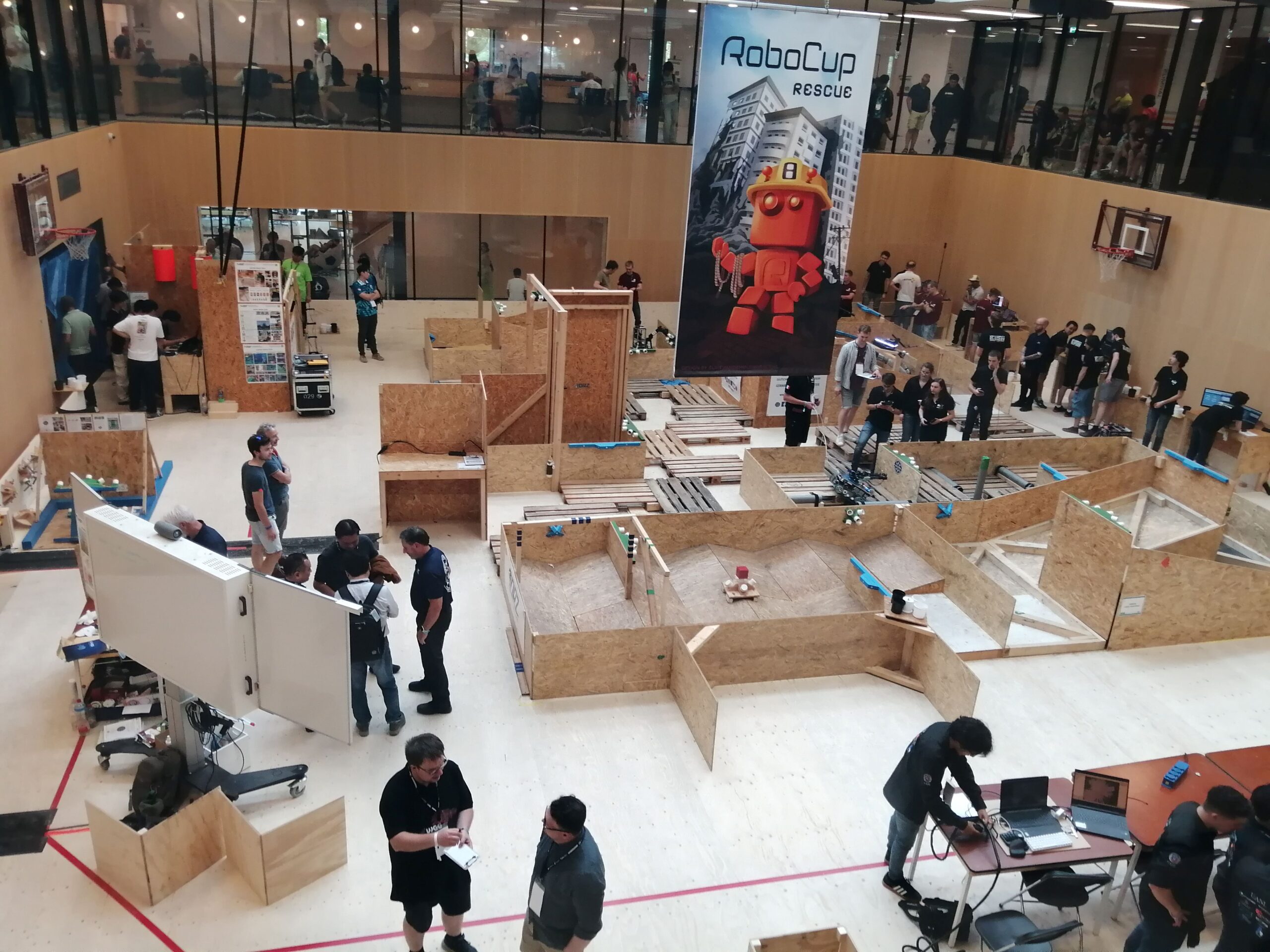 Rescue league arena at RoboCup 2024.
Could you talk about the changes that were announced last year, and the decision behind those?
Back in 1997, Hiroaki Kitano came up with this goal of a robot soccer team being able to beat the human World Cup winners by 2025. (I later tried, in the early 2000s, to rephrase that goal so that it was not about the robots beating the humans, but instead having robots playing alongside human players by 2050.) However, for this to happen, we have started the humanoid league so that the robots would have legs, not wheels. Our roadmap hence moves towards humanoid robots. It also happens that currently there are several robot companies who are producing humanoid robots that are easy to acquire, so researchers do not have the design and build their own humanoid robots, which was a difficult task that was pursued only by a limited group of researchers. In parallel, events started aiming at including humanoid robot soccer. We believed that RoboCup should be visible and a reference for humanoid robot soccer. We then proposed and changed that, in the international RoboCup competitions, robot soccer will focus solely on humanoid robots. That doesn’t mean that the other RoboCup leagues aren’t valuable. But if they continue at a regional level, there will still be venues to foster these other types of interests. The RoboCup international competitions would be solely focused on humanoid robot soccer.
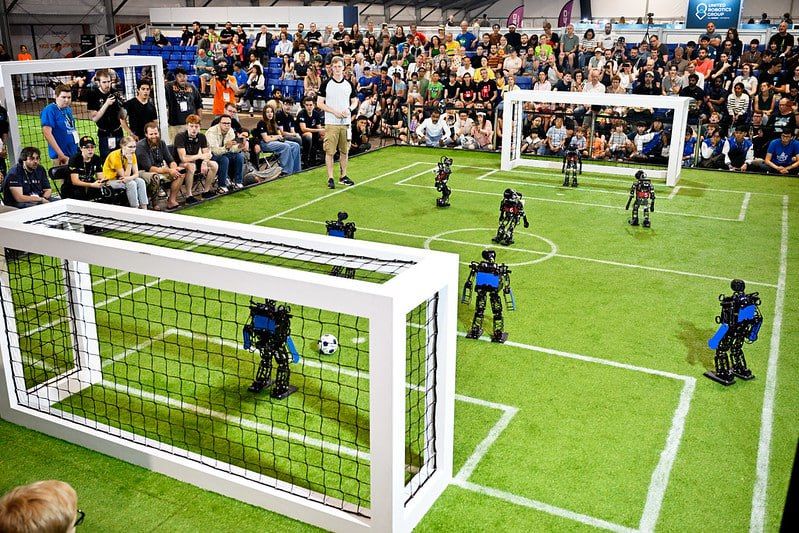 Action from the humanoid soccer league at RoboCup 2025. Image courtesy of Alessandra Rossi.
RoboCup was tremendously successful in terms of including a variety of different autonomous robot research interests from the community. But I also believe that now we should move into just humanoid soccer at the international level. This will help with visibility of the competition and also for consolidation. We can now buy humanoid robots that we didn’t have before. Previously, you had to build them in your universities, and that was not a research direction for many people. But there is not that excuse anymore. You can buy humanoid robots, and increasingly, you can talk with these humanoid robots using GenAI. So it became a different challenge, a much more accessible challenge than before. The challenge will be: can these platforms play soccer in the presence of another team? I think it’s a fascinating new direction to try to focus on this challenge of the game of soccer – multiple players, two teams in a large space, eventually coordinating, collaborating, or playing with and against humans. So that’s the rationale.
When people don’t know the story, they tend to wonder why we have all these other leagues, such as rescue and logistics. It was always driven by the interests of the community and a big heart for a research approach. And we always thought that because we were organizing an event with a venue, that we could include these people that have interests outside of soccer. That has always been our drive. However, it’s true that it diluted a little bit the goal of 2050 – the humanoid soccer robots. Now I think it’s time to go back to soccer as a main focus, and still keep supporting the other interests that we have fostered, more at a regional level.
There are still a lot of details to be sorted out. And, of course, people may be upset by leagues terminating at the international level. I have always participated in the small-size league myself, 20 years of participating, and I am very attached to it. I was always the trustee representing the small-size league, and I am not sure I am happy with the small-size not being in the international event. But I need to think beyond what my personal interests are and try to understand what would have a bigger impact for AI, robotics, and RoboCup. I think that that’s demonstrating a group of humanoids playing soccer. And if we don’t do it at RoboCup, maybe someone else will.
The way I think about it is that we have made this decision and we can reevaluate it in five or ten years. But not making a change and never having the courage to deviate from what we have been pursuing is less exciting. Things have stalled a bit, with the same number of teams, the same people, the same rules, the same type of intellectual and research accomplishments. We need to excite people about something major again. So I think that the community will greatly embrace this new RoboCup international. And we are so well organized locally, that we can support other leagues at the local events.
I do think that, from a scientific and research point of view, it’s the right moment to target the soccer humanoid robots, because of their availability and our RoboCup ultimate goal. I think it would be amazing if people knew RoboCup international as the humanoid robot soccer competition. Can you imagine in 2027 having 100 teams all playing soccer with humanoids? We’ll see.
About Manuela Veloso
|
|
|
For the last eight years, Manuela Veloso has been the founder and Head of JPMorganChase AI Research and Herbert A. Simon University Professor Emerita at Carnegie Mellon University, where she was faculty in the Computer Science Department and then Head of the Machine Learning Department.
At JPMorganChase, she built a team of 100 top talented members with graduate education (PhD and Masters) in AI and related disciplines. The team focused on pillar areas of AI in finance, including data-driven optimization, planning and search, document analysis, trustworthy AI, AI and mathematical reasoning, continual learning, and multiagent systems. The team published their research in academic venues and addressed and contributed to business needs and vision.
Veloso has a licenciatura degree in Electrical Engineering and an M.Sc. in Electrical and Computer Engineering from Instituto Superior Técnico, Lisbon, an M.A. in Computer Science from Boston University, and a Ph.D. in Computer Science from Carnegie Mellon University. Veloso has Doctorate Honoris Causa degrees from the Örebro University, Sweden, the Instituto Universitário de Lisboa (ISCTE), Portugal, the Université de Bordeaux, France, and the Universidade Católica of Portugal.
She served as president of the Association for the Advancement of Artificial Intelligence (AAAI), and she is co-founder and a Past President of the RoboCup Federation. She is a fellow of main professional organizations in her area, namely AAAI, IEEE, AAAS, and ACM. She is the recipient of the ACM/SIGART Autonomous Agents Research Award, the Einstein Chair of the Chinese Academy of Sciences, an NSF Career Award, and the Allen Newell Medal for Excellence in Research. Veloso is a member of the National Academy of Engineering with a citation “for contributions to artificial intelligence and its applications in robotics and the financial services industry.” She is also a member of the Academy of Sciences of Portugal.
Her research interests are in AI, including Multiagent Systems, Autonomous Robots, Continual Learning Agents, and AI in Finance. For further details, see Manuela’s webpage.