
Episode 239 of The Robot Report Podcast features Dr. Jan Liphardt, Stanford bioengineering professor, founder of OpenMind, and OM1.
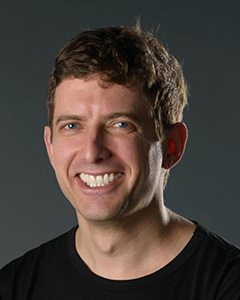
Dr. Jan Liphardt, Stanford bioengineering professor, founder of Open Mind and OM1.
Dr. Jan Liphardt is an Associate Professor of Bioengineering at Stanford University whose interdisciplinary career spans the fields of biophysics, computational genomics, and distributed trust systems.
From his early work at Cambridge and UC Berkeley using advanced computational tools and optical tweezers to decode the complexities of RNA, Liphardt has evolved into a versatile scholar now exploring the frontiers of engineering, living matter, and blockchain technology.
A recognized Searle Scholar and Sloan Research Fellow, he currently balances high-level federal research with innovative teaching that ranges from artificial intelligence in bioengineering to the applications of decentralized trust.
Show timeline
- 4:00 – News of the week
- 14:22 – Dr. Jan Liphardt, Stanford bioengineering professor, founder of OpenMind, and OM1
News of the week
Tesla targets 10M Optimus units with new Texas plant
During its Q1 2026 earnings call on Wednesday this week, Tesla made several announcements related to its robotics roadmap. In Fremont, Calif., Tesla plans to start preparations for the first large-scale Optimus humanoid factory in Q2 2026.
The company designed this first-generation line for a capacity of one million robots per year and will replace the existing Model S and Model X production lines.
At the Gigafactory in Texas, Tesla is designing a second-generation line with a long-term target annual production capacity of 10 million robots. Site preparation for this facility is already underway.
Tesla is expanding its manufacturing to include semiconductor fabrication. This includes the development of the Tesla AI5 inference processor, designed to handle the compute demands of its robotaxi and Optimus programs.
German court rules in favor of Teradyne Robotics, issues injunction against Elite Robots
In another example of legal wrangling of alleged robotic patents, just as the Hannover Messe trade show began in Germany this week, the Regional Court of Hamburg has issued a preliminary injunction against Elite Robots Deutschland GmbH as Teradyne Robotics A/S sues it for copyright infringement.
Teradyne Robotics, a subsidiary of Teradyne Inc., had begun legal proceedings against Elite Robots’ Germany subsidiary last month. It had already sent a cease-and-desist letter accusing the Chinese force- and power-limited robot maker of infringing on the proprietary software of Universal Robots A/S, a Teradyne unit, and cobot market leader.
David Brandt, vice president of research and development and the chief technology officer of UR, said, “The reason we started looking into this is because of increasing competition from lots of small companies.”
“There are a lot of cheap variants of collaborative robots entering the market,” he noted. “One of those we looked at was from Elite, and it was clear that it looked very much like our own. Our team in the U.S. looked at the software, and it was something very close to our software in their robots.”
It’s worth noting that the other recent patent enforcement happened last month in a disagreement between OCADO and BrightPick at the LogiMAT show, effectively shutting down BrightPick’s booth and display of its new product. Germany is particularly aggressive at patent enforcement, and the side effect, as these two cases have shown, is that companies might want to think twice before exhibiting in Germany if there’s any patent tension.
HII part to accelerate shipbuilding with physical AI
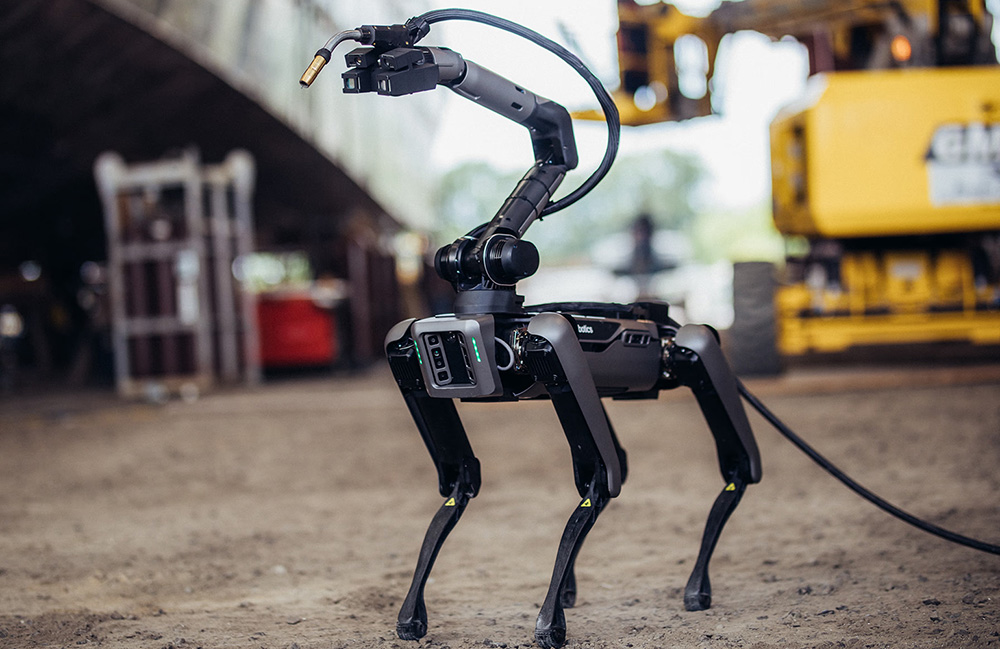
Path Robotics’ latest release is the Rove mobile robotic welding system. | Source: Path Robotics
HII, Path Robotics, and GrayMatter Robotics this week introduced the High-Yield Production Robotics, or HYPR, program. It seeks to use a network of emerging physical AI technologies from Path Robotics and GrayMatter Robotics to rapidly accelerate advanced, adaptive automation in the fabrication process of both crewed and uncrewed naval platforms.
Register now for the 2026 Robotics Summit & Expo
Registration is now open for the Robotics Summit & Expo, the world’s leading technical event for commercial robotics developers. The event is produced by The Robot Report and WTWH Media.
>> LISTEN TO THE PODCAST EPISODE FOR A DISCOUNT CODE TO REGISTER! <<
The show will have more than 50 sessions in tracks on physical AI, design and development, enabling technologies, healthcare, and logistics. The Engineering Theater on the show floor will also feature presentations by industry experts.
More than 70 speakers are confirmed from companies such as AWS, Brain Corp, Fictiv, Harmonic Drive, maxon, PickNik Robotics, RealSense, the Robotics and AI Institute, Robust AI, Tesla, Toyota Research Institute, and more.
The Robotics Summit will also feature a number of networking opportunities. They include a Mix & Mingle Networking Reception after the first day of the show and the ticketed RBR50 Awards Dinner.
The Robotics Summit & Expo is co-located with DeviceTalks Boston, which focuses on medical devices.

The post From sci-fi to reality: Physical AI’s future with Dr. Jan Liphardt appeared first on The Robot Report.