
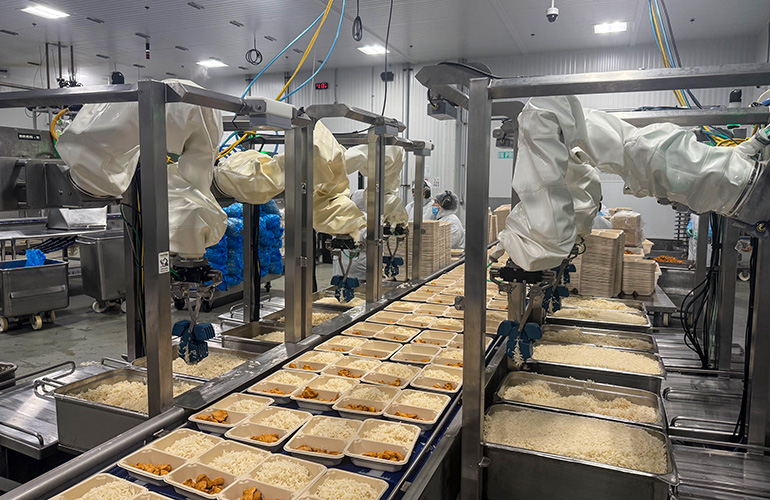
Chef Robots in production at Chef Bombay. | Credit: Chef Robotics
Chef Robotics Inc. yesterday said its robots have completed 100 million servings in production at customer facilities, which it claimed was an order of magnitude more than all other food robotics companies combined. Chef added that it has created the world’s largest real-world food-manipulation dataset and that it has more in-production deformable-material training data than any other physical AI company.
San Francisco-based Chef Robotics said this milestone reflects deployments across more than a dozen facilities across the U.S., Canada, and Europe. The company asserted that its systems have helped food manufacturers improve yield, consistency, and labor productivity.
Chef completed a Series A fundraise of $43 million in March 2025. This funding round enabled it to hire more development engineers and improve product functionality. But more importantly, the company said the investment helped fuel the expansion of its customer base and support team, leading to the 100 million-meal milestone.
Chef cooks with physical AI
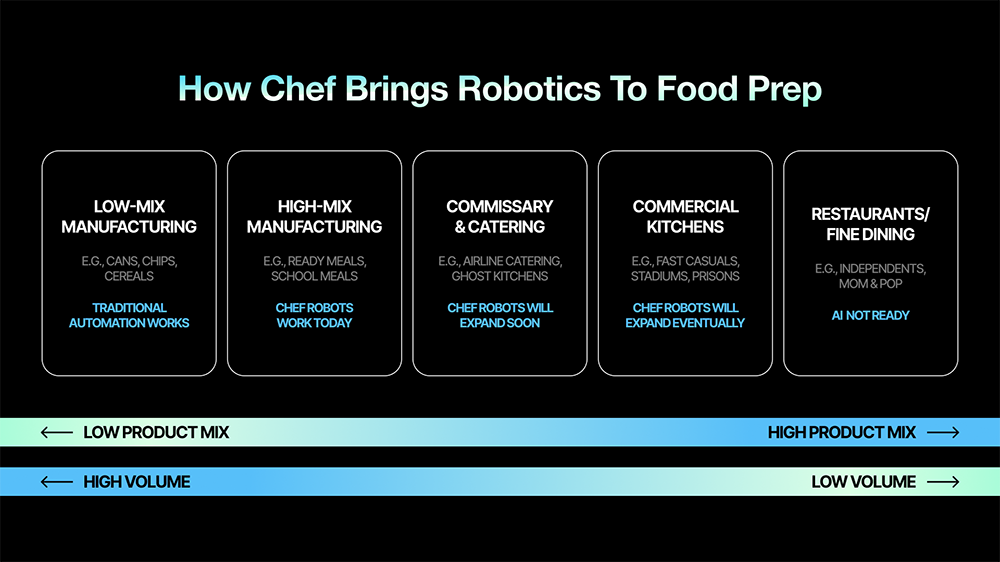
Chef Robotics is focused on high-mix food manufacturing use cases. | Credit: Chef Robotics
Founded in 2019, Chef Robotics asserted that physical AI was opening up food preparation, a multi-trillion-dollar market struggling with a chronic labor shortage, to new possibilities for automation.
The company deliberately started with high-volume, lower-complexity tasks like portioning and assembly rather than commercial kitchens, where volumes were lower and tasks were too complex for robots to deliver value right away.
Food production feeds data flywheel
Unlike autonomous vehicles, warehouse robots, or large language models (LLMs), food robotics cannot rely on simulation, synthetic data, or internet data for training. Food ingredients are organic, deformable, and highly variable, making them difficult to replicate in a synthetic environment, noted Chef Robotics.
Real-world production data is the only reliable path to building models that perform well in live customer environments, said the startup.
Rather than using simulation or lab data, the company explained that it trains its models on real-world production data from customer facilities. Each new deployment generates more diverse training data, which improves model performance and enables more ingredients, use cases, and customer sites—a flywheel that, once in motion, compounds over time, it said.
Chef Robotics climbs from zero to 100 million servings
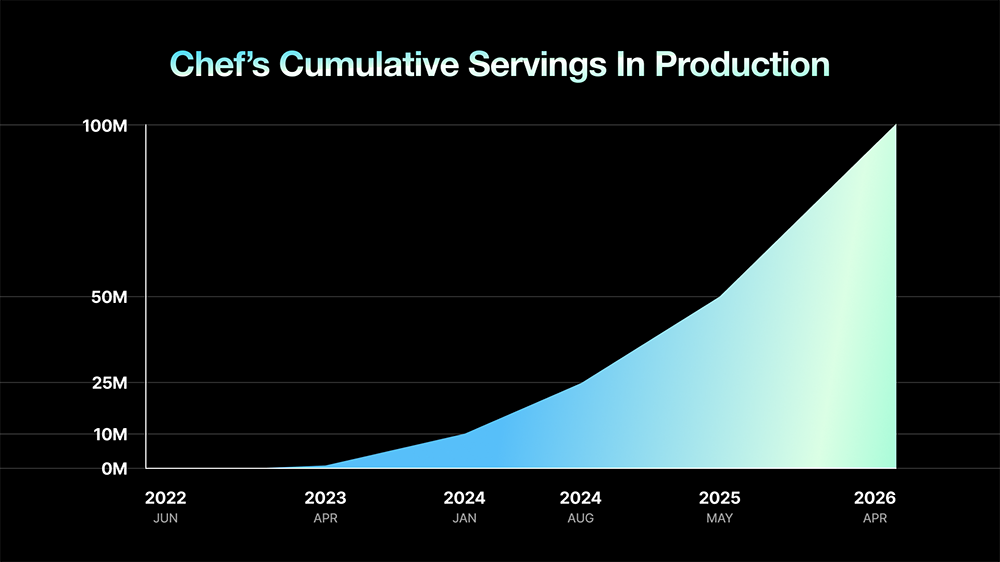
Since June 2022, Chef Robotics has incrementally grown its installed base. | Credit: Chef Robotics
After deploying with its first customer, Amy’s Kitchen, in 2022, Chef has achieved several milestones: 1 million servings in April 2023, 10 million in January 2024, 25 million in August 2024, and 50 million in May 2025.
The company has now doubled its cumulative number of servings again in less than a year.
“Food is one of the most technically demanding manipulation environments in the physical world,” stated Rajat Bhageria, founder and CEO of Chef Robotics. “By solving high-variance, deformable food production first, we’ve positioned ourselves not just as a food robotics leader, but as the category-defining physical AI platform for real-world automation.”

The post Chef Robotics completes 100M meal servings milestone appeared first on The Robot Report.