
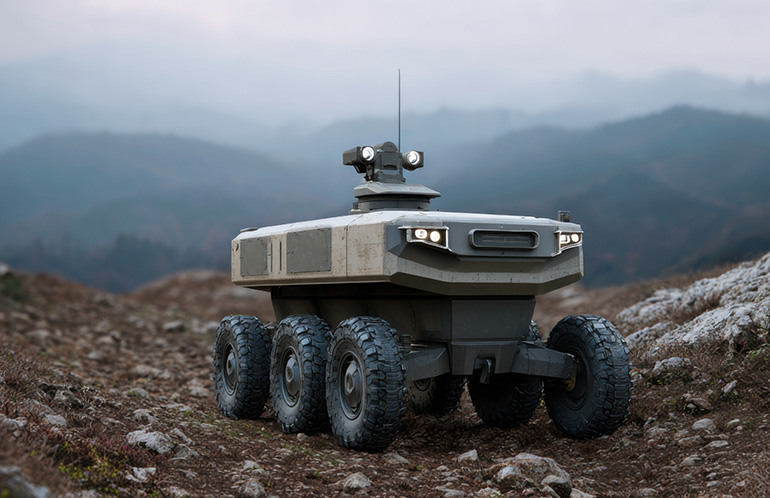
A UGV can explore uneven ground with the help of vibration sensors. Source: ckybe, AI, via Adobe Stock
A few years back, during a field trial, we had a midsized uncrewed ground vehicle, or UGV, climbing what looked like a harmless patch of broken ground. Nothing extreme. Some loose stones, a bit of dust, slight incline. The kind of terrain you wouldn’t think twice about.
Halfway up, the robot hesitated. Then one wheel dropped slightly, the chassis leaned forward, and before anyone could react, it tipped.
The strange part? The camera feed looked fine. Lidar didn’t flag anything serious either. On paper, the path was “safe.”
But the robot knew something was wrong before we did. It just didn’t know how to act on it.
That gap between what the robot sees and what it feels, is at the heart of mobile robot stability and uneven terrain problems.
Out in the real world, terrain lies. A surface can look compact but behave like powder under load. Rocks hide under thin layers of soil. Even slight ruts can shift weight enough to push a UGV past its stability margin. And once that tipping point is crossed, recovery is rarely graceful.
Most navigation stacks today are still heavily vision-driven. Cameras, lidar, SLAM—they do a great job building maps. But they don’t tell you how the ground will respond when you drive over it. That’s where things break.
Vibration monitoring changes the approach entirely. Instead of relying only on external perception, the robot starts listening to its own body. Every bump, every micro-slip, every impact, it’s all data. And when you start treating those signals seriously, they become predictive.
The closest analogy is a person walking on loose gravel. You don’t analyze the terrain visually at every step. You feel it. Tiny shifts under your feet tell you when to slow down, adjust your balance, or change direction.
That’s what we’re trying to give robots.
What follows isn’t theory-heavy discussion. This is based on what actually works in the field, how vibration data is captured, what it tells you, and how to turn it into something that keeps your robot upright when the ground gets unpredictable.
Why vibration signals matter for stability
Let’s start with the basic question engineers often ask: How do vibrations actually affect stability?
Short answer: They don’t just affect it; they reveal it.
Every time a wheel interacts with terrain, it generates a force. That force isn’t constant. It changes depending on whether the surface is hard, soft, uneven, or shifting. Those changes travel through the robot as vibrations.
If you ignore them, they’re noise. If you analyze them, they’re insightful.
In one of our off-road test runs, we drove the same robot across three surfaces: compact dirt, loose gravel, and soft sand. Visually, all three looked manageable. But the vibration profiles were completely different.
On compact dirt, the signal was stable. Low amplitude, consistent.
On gravel, it turned chaotic. Sharp spikes, high-frequency chatter.
On sand, everything slowed down. The signal became heavier, almost sluggish, with noticeable low-frequency oscillations. That difference matters.
High-frequency spikes usually mean impacts—rocks, debris, hard edges. These are the moments that can suddenly shift load distribution and trigger instability.
Low-frequency oscillations are more subtle but just as dangerous. They often indicate loss of support, like when a wheel starts sinking or slipping. You don’t get a sudden jolt. Instead, you get a gradual loss of stability.
Now here’s the important part: you often feel these effects before you see them.
We ran into this during rover-style testing. A stretch of terrain looked smooth because a thin layer of sand covered embedded rocks. Cameras saw flat ground. Lidar saw a clean surface.
But the IMU told a different story. As soon as the wheels rolled over those hidden rocks, the vibration signal lit up with high-frequency spikes. That gave us an early warning—before the robot physically destabilized.
That’s why vibration sensing is so powerful. It doesn’t depend on visibility. It doesn’t care about lighting or dust. It reflects actual contact physics.
In rough environments, that’s often the only truth that matters.

Core sensors for vibration monitoring
If vibration is the signal, sensors are your ears. And like any sensing system, placement and quality matter more than most people expect.
At the core, you’re working with three components: accelerometers, gyroscopes, and inertial measurement units (IMUs).
Accelerometers do the heavy lifting. They measure linear acceleration along three axes, which means they capture both shocks and continuous vibration. If a wheel hits a rock, the accelerometer sees it instantly. If the chassis starts oscillating, it shows up there too.
Gyroscopes add another layer. They track angular motion—roll, pitch, yaw. This is what tells you if the robot is starting to tilt or rotate in a way that might lead to tipping.
Combine the two, and you get an IMU. Most modern systems rely on IMUs because they give you a complete picture of motion.
But here’s where real-world experience comes in: where you mount these sensors matters as much as the sensors themselves.
Mounting an IMU at the center of mass is standard practice, and for good reason. It gives you a stable reference for overall motion. But if that’s all you use, you’ll miss a lot of detail.
In rough terrain, most of the action happens at the wheels. We’ve had much better results adding secondary accelerometers closer to the wheel assemblies. These pick up localized impacts that never fully propagate to the center of the chassis.
Another mistake I’ve seen is soft mounting. It sounds minor, but it’s not. If your sensor mount flexes even slightly, you’re no longer measuring true vibration—you’re measuring a filtered version of it. That leads to wrong conclusions.
Sampling rate is another practical consideration. For most mobile robots, staying in the 100 to 500 Hz range is enough. Go too low and you miss critical events. Go too high and you’re just adding processing overhead without much benefit.
As for hardware, you don’t need exotic components. There are plenty of reliable accelerometer sensors available that can handle harsh environments without blowing your budget. What matters more is calibration and consistency.
Real-time vibration processing techniques
Raw vibration data is messy. If you’ve ever plotted it straight from an IMU, you know what I mean. It looks like noise.
The trick is not to clean it completely, but to clean it just enough to reveal patterns.
The first step is filtering. Motors, gearboxes, and even structural resonance all introduce their own vibrations. If you don’t deal with those, they’ll drown out terrain signals.
We typically start with a bandpass filter to isolate the frequency range where terrain interaction lives. Then, if there’s a known noise source like a motor spinning at a fixed frequency we drop in a notch filter to remove it.
I’ve seen cases where a simple notch filter made the difference between unusable data and clear terrain signatures. Once the signal is usable, you move into analysis.
Time-domain analysis gives you a sense of how the signal evolves. But frequency-domain analysis is where things get interesting. Using FFT, you can see exactly where energy is concentrated.
Different terrains leave different fingerprints. Gravel spreads energy across high frequencies. Grass sits somewhere in the middle. Sand shifts everything lower and dampens it.
From there, you extract features. Not dozens — just a few meaningful ones. RMS amplitude, spectral power, and maybe variance. That’s usually enough.
We once built a simple terrain classifier using just a handful of these features and got close to 90% accuracy at low speeds. Nothing fancy. No deep learning. Just clean data and good feature selection.
The key lesson? You don’t always need complex models. You need good signals.
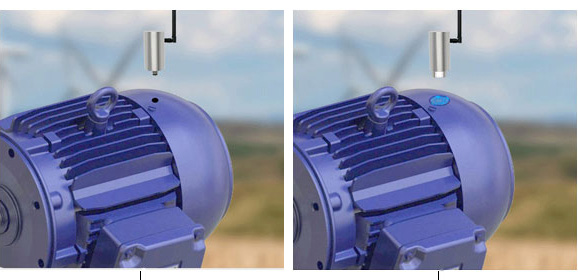
Different methods of connecting a three-axis vibration sensor. Source: ATO
Stability prediction from vibration data
This is where things get interesting. Most systems react to instability after it starts. By then, you’re already in trouble. What vibration monitoring allows you to do is shift from reaction to prediction.
Traditionally, engineers rely on metrics like stability margin or force distribution models. These work well in controlled environments but struggle when terrain behavior changes unpredictably.
Vibration data fills that gap. Instead of estimating forces purely from models, you infer them from actual interaction. That makes your stability assessment more grounded in reality.
More recently, we’ve seen learning-based approaches take over this space. Feed acceleration, angular velocity, and velocity data into a model, and it outputs a stability score.
What’s impressive is how well these models generalize.
In one test, we trained a model on grass, gravel, and dirt. Then we ran it on mixed terrain it had never seen before. It still performed well. Not perfect, but good enough to be useful.
In practical terms, this allows you to do things like gating behavior.
We had a UGV with a small manipulator arm. When vibration levels crossed a threshold, the system would pause arm movement automatically. That alone prevented several near-tip incidents.
The important thing here isn’t the model itself. It’s the idea that stability becomes something you monitor continuously, not something you check after the fact.
Control strategies for enhanced balance
Once you trust your vibration data, you can start using it in control. The simplest approach is speed adaptation. And honestly, it’s one of the most effective. When vibration increases, slow down. That’s it.
It sounds basic, but it works because most instability issues scale with speed. Lower speed means lower dynamic forces, which gives your system more time to react.
Beyond that, you can feed vibration data into your control loops. PID controllers, for example, can benefit from an additional input that reflects disturbance levels. This helps reduce oscillations and improves response.
Sensor fusion also plays a role. Vibration data alone is powerful, but combining it with odometry or visual feedback makes it even more reliable.
One practical improvement we saw came from cleaning up internal noise. By filtering out mechanical vibrations from internal components, the control system became noticeably smoother. Less jitter, better balance.
Sometimes stability improvements don’t come from adding complexity. They come from removing noise.
Implementation challenges and fixes
Of course, none of this is plug-and-play. Noise is the biggest challenge. Not all vibrations are useful. Some come from motors, some from structure, some from the environment. The goal is to separate signal from noise without losing important information.
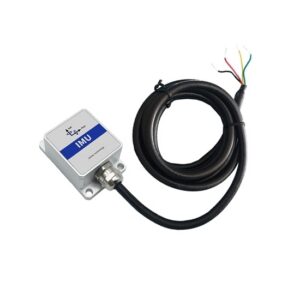
A small IMU sensor for robots and drones. Source: ATO
Sensor drift is another issue, especially with gyroscopes. Over time, small errors build up. That’s where sensor fusion techniques like Kalman filtering become essential.
Then there’s variability. Change the robot’s speed or payload, and your vibration profile changes too. If your system isn’t designed to handle that, performance drops quickly.
The only real solution here is testing. Not controlled lab testing real terrain, real conditions, real edge cases. That’s where systems prove themselves.
Robots need to feel the ground
If there’s one takeaway from all of this, it’s simple: robots need to feel the ground, not just see it.
Mobile robot stability and uneven terrain challenges won’t be solved by better maps alone. They require a deeper connection between the machine and its environment.
Vibration monitoring provides that connection. It turns impacts, slips, and subtle shifts into usable data. It allows robots to anticipate problems instead of reacting to them. And in environments where a single mistake can end a mission, that makes all the difference.
The technology isn’t out of reach. A solid IMU setup, some thoughtful processing, and a bit of field testing can take you a long way. From there, it’s iteration.
Because the terrain will always surprise you. The goal is to make sure your robot isn’t surprised for long.
 About the author
Faisal Mahmood is a seasoned digital marketing and tech content strategist with extensive experience in AI, software development, and SEO-driven content. He specializes in creating deeply researched, fact-based articles that help developers, enterprises, and tech teams understand the latest trends in AI-powered tools, coding best practices, and secure software development.
Mahmood is passionate about bridging the gap between emerging technology and practical insights for global audiences. He is reachable at faisal@aidetector.pro.
The post Improving mobile robot stability on uneven terrain through vibration monitoring techniques appeared first on The Robot Report.