
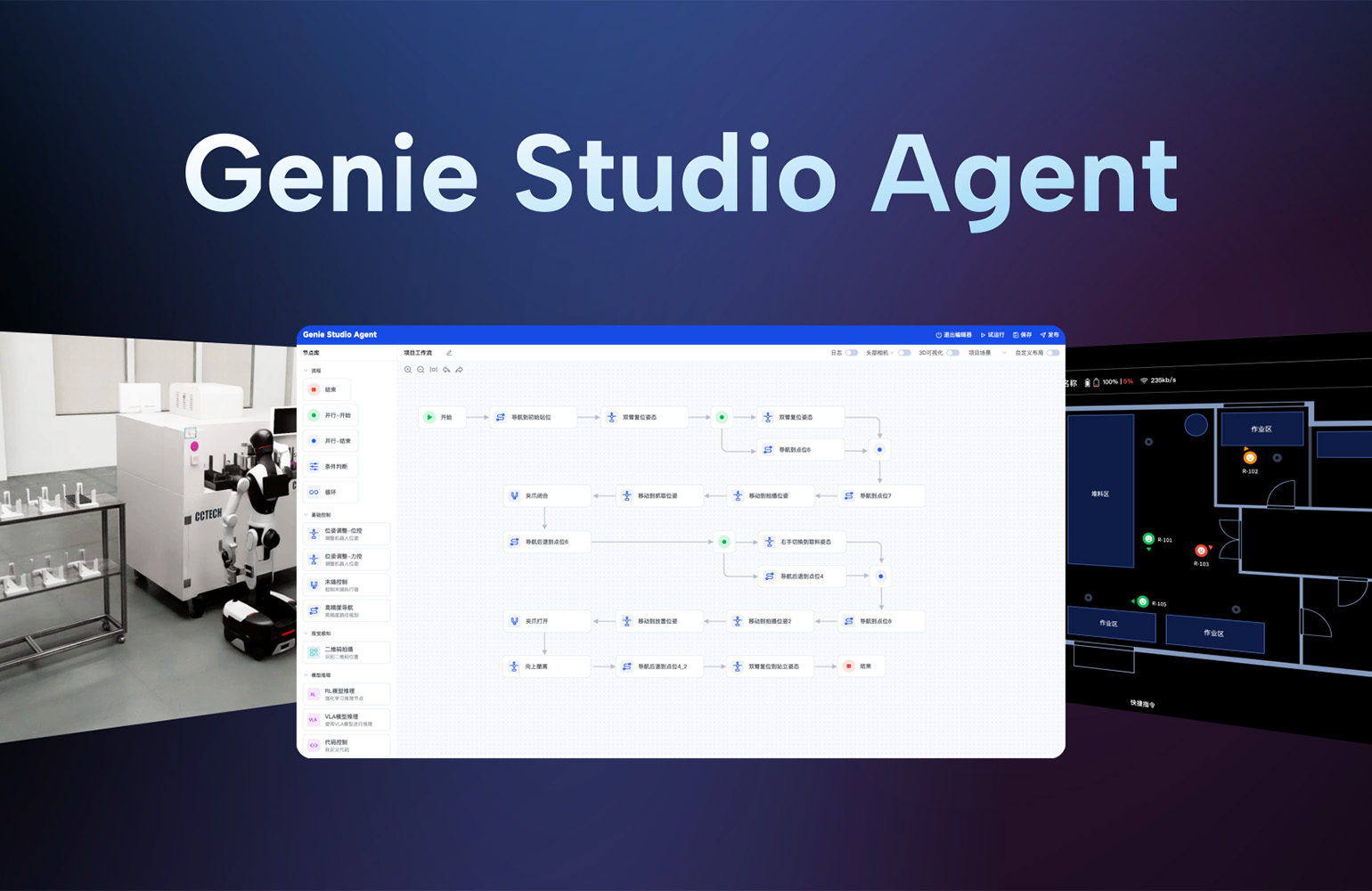
With Genie Studio Agent, AGIBOT said it is shifting from project-based deployments to ecosystem-driven scaling. | Source: AGIBOT
AGIBOT today launched Genie Studio Agent, a zero-code application platform for robot development. The company said it designed the agent to make building and scaling robot applications as simple as assembling blocks.
As embodied AI advances rapidly, breakthroughs in perception, decision-making, and control, powered by increasingly capable models and algorithms, are pushing the industry toward a new phase of scalability. Yet a critical challenge remains: how to deploy robots in real-world environments efficiently and at scale, especially for those without coding or engineering expertise.
AGIBOT said it is releasing Genie Studio Agent in response to this challenge.
From model capability to deployment at scale
In 2025, AGIBOT introduced Genie Studio, a one-stop embodied AI development platform, enabling end-to-end workflows across data collection, model training, evaluation, and deployment for Vision-Language-Action (VLA) models.
However, as these capabilities moved into factories, workshops, and complex real-world environments, a new bottleneck emerged: deployment.
In many cases, deploying a robot system still requires extensive custom engineering, long integration cycles, and high operational risks. Each rollout can involve costly downtime, repeated testing, and scenario-specific development—making large-scale replication difficult.
AGIBOT said it designed Genie Studio Agent to overcome this barrier by providing a full lifecycle software infrastructure—from development and deployment to operation and optimization—covering VLA models, reinforcement learning (RL), perception, motion control, and navigation.
Genie Studio Agent introduces a standardized, ready-to-use deployment framework built on top of SDKs from AGIBOT. It combines a visual, user-friendly interface, customizable, orchestrated workflows, and pre-built templates for real industry scenarios.
This enables even non-technical users to configure and deploy robot applications, significantly lowering the barrier to entry for embodied AI.

Four capabilities redefining deployment efficiency
AGIBOT said four capabilities are at the core of Genie Studio Agent. The first is no-code workflow orchestration. Genie Studio Agent transforms robot development from a code-intensive process into a modular, composable system.
The system encapsulates capabilities such as perception, motion control, navigation, VLA models, and RL toolchains into reusable components. With a built-in no-code/low-code task editor, users can design workflows simply by dragging and connecting nodes. Instead of building from scratch, users can assemble robot applications like building blocks—enabling faster development and shifting control from engineering teams to scenario-driven users.
Next is simulation-first deployment. The platform integrates 3D reconstruction and simulation capabilities, allowing users to fully test workflows in a virtual environment before real-world deployment. Task execution, path planning, and interactions can all be validated and optimized in simulation—reducing on-site debugging time, minimizing risks, and avoiding costly operational disruptions.
By the time robots enter production environments, they are already pre-validated rather than deployed for the first time.
The third is real-world reinforcement learning (RL) for continuous optimization. The platform brings RL directly into real-world operations. Robots can continuously refine their strategies through real-time feedback—combining force control and visual perception to improve precision over repeated tasks such as grasping and placement. This enables a shift from instruction-based execution to self-optimizing behavior, allowing robot performance to improve over time.
Finally, Genie Studio Agent includes end-to-end monitoring and proactive management. Beyond deployment, the platform provides full lifecycle operational monitoring. Data, system states, and anomalies are integrated into a unified visualization system, enabling early detection of potential issues. This shifts operations from reactive maintenance to proactive system management—ensuring long-term stability and reliability.
Real-world validation in semiconductor manufacturing
AGIBOT said Genie Studio Agent has already been deployed in collaboration with Huatian Technology, where it successfully powered a full workflow for wafer handling in semiconductor packaging and testing. The deployment integrates multiple task stages—including high-precision pose adjustment, navigation in complex environments, force-controlled grasping, and RL-driven placement—into a unified and stable execution pipeline.
This demonstrates not only improved operational efficiency but also a fundamental shift in how robot systems are delivered and scaled.
Genie Studio Agent is designed as an open platform, enabling partners—including system integrators and industry innovators—to build on top of its capabilities. By standardizing deployment and enabling modular integration, AGIBOT said it aims to make robot applications replicable, scalable, and adaptable across industries.
The post AGIBOT launches Genie Studio Agent zero-code application platform for robots appeared first on The Robot Report.