
Amazon’s acquisition of Fauna Robotics looks more like a platform move than a consumer robotics play. This makes Fauna’s humanoid, Sprout, significant beyond the deal itself. The system offers an early view of what a credible developer-facing humanoid stack looks like before higher-level autonomy is mature.
Speed over speculation
A technical report published by Fauna earlier in 2026 offers a glimpse into a platform built around constrained learned control, whole-body VR teleoperation, along with a pipeline designed to turn autonomy failures into training data. The timeline here is aggressive. Fauna was founded in early 2024. It raised between $16.6 million, per its SEC filing, and $30 million, per CNBC reporting, from investors including Kleiner Perkins and Lux Capital.
It launched Sprout to R&D partners in January 2026 and was acquired by Amazon two months later. Reaching a working humanoid platform and an acquisition on that timeline is impressive. The report reads less like a long-horizon research program than a focused effort to build a system that can improve quickly under real-world constraints.
Designing for the developer, not the demo
Sprout is small by humanoid standards. It stands 1.07 meters tall and weighs 22.7 kg, with 29 degrees of freedom. The size choice shapes the rest of the system. It has soft exteriors, minimized pinch points, backdrivable motors, conservative torque limits, and a single DoF gripper. The design seems to prioritize keeping physical interaction manageable over delivering the most impressive demo.
Sprout uses a head-mounted ZED 2i stereo camera, torso-mounted time-of-flight sensors, IMUs, and a four-microphone array, with no wrist-mounted cameras. Fauna argues that teleoperation fills the sensing gaps, and the combination covers enough research use cases to be practical. That simplification comes with limits in close-range manipulation. These are the tradeoffs of a bounded system meant to be safe enough, cheap enough, and modifiable enough for developers to use now.

Most of Sprout’s subsystems rely on established methods. The motor policies are trained in NVIDIA Isaac Sim. It uses standard consumer VR hardware with inverse-kinematics retargeting for the teleop interface. The mapping stack fuses visual, inertial, and leg-motion data and builds dense 3D maps using volumetric fusion. Navigation uses familiar planning and tracking methods, and the voice pipeline relies on off-the-shelf speech recognition and synthesis providers.
In my experience, robotics products break on integration, failure handling, and misplaced confidence in immature autonomy, not because the underlying algorithms lack novelty.
Where the integration actually matters
To ensure deterministic control, the system deliberately isolates application-level workloads from time-critical loops. While a Jetson AGX Orin runs high-level perception and planning software, a custom board relies on embedded controllers for power distribution, sensor acquisition, and motor control.
Fauna applies the same discipline to where learning lives in the system. An end-to-end learned policy sounds great in a pitch deck, but Fauna went in a different direction. They built entirely separate RL policies for distinct movements, whether that’s walking, crawling, kneeling, sitting, or dancing. Standard PD control and hard power limits act as the necessary guardrails to keep that execution bounded. It might be less conceptually ambitious, but it’s a far better short-term bet for keeping the system reliable across messy, real-world conditions.
Transitions between control modes have their own learned tracking controllers, trained from motion-capture and animated trajectories. There are also separate safety constraints and abort logic when posture or actuator limits drift out of range. That is critical because transition failures are where humanoids tend to get most brittle.
Turning failures into data
The teleoperation data loop may be the most valuable part of the stack. The underlying DAgger training framework is an industry standard, but Fauna significantly improved its operational utility. When an autonomous behavior drifts, the operator pauses. They see the robot’s frozen pose projected as a ghost in VR space. Then they can align their controllers to that ghost and resume from the same physical state. Every failure becomes labeled training data captured at the moment it matters most, instead of being discarded with a hard reset.
Small bipeds pose specific mapping problems that the team had to address. Foot contacts are intermittent, position estimates can drift, and depth quality can be unpredictable. To handle this, Fauna divides the environment into locally consistent volumetric submaps, or maplets, so a localized sensor glitch corrupts only one region rather than the entire map. Global correction runs asynchronously. Fauna says this reduced compute load by roughly 30% compared to an industry-standard open-source baseline. On a robot running everything onboard, even modest compute savings widen the margin for everything else the developer wants to run.
Fauna built a slot-based behavior hierarchy that orchestrates lights, audio, head pose, eyebrows, and body motion through per-slot priority rules. If a safety alert triggers, the robot immediately drops its current expression. When operating safely, idle and interactive behaviors merge. For a machine aimed at developers and non-expert operators, observability is a key requirement.
What ships and what doesn’t
Fauna appears to have optimized Sprout for speed to deployment rather than for any broad claim of general intelligence. When you look at what ships at the $50,000 price point, you get a solid foundation in navigation, teleoperation, and developer tools. Fauna’s own architecture diagrams strip reasoning and social context from the initial SDK entirely. Rather than shipping a fully integrated autonomy stack out of the box, they built a highly modular physical vessel. It relies heavily on standard ROS 2 interfaces and a Model Context Protocol server to interface with external agents.
Safe enough is not certified
Safety is where the gap between platform and product becomes noteworthy. Fauna describes three layers – hardware safeguards, an independent embedded safety subsystem, and application-level compliant control. The paper does not provide the evidence needed to evaluate a certification case. The proximity sensing appears to rely on consumer-grade components. The grip force is controlled by software, and there is no mention of force or torque sensing in the kinematic chain. None of that negates the platform’s value. But a safe developer system and a certifiable consumer product are still very different things.
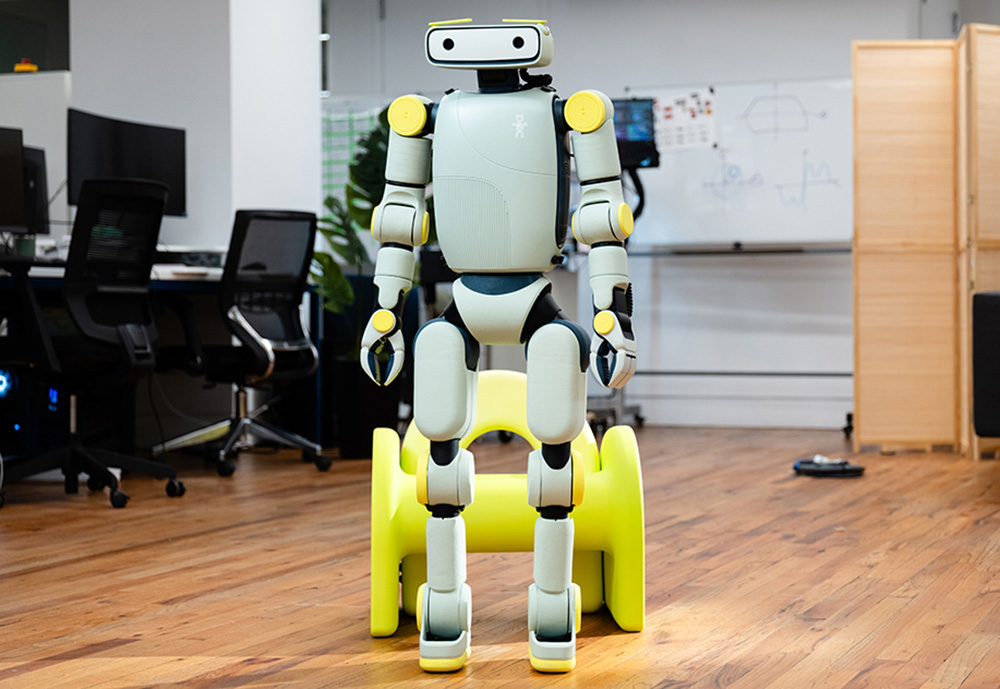
Fauna Robotics’ Sprout humanoid robot is small, lightweight, and soft to touch, making it safer than the average humanoid robot. | Source: Fauna Robotics
Buying the sandbox
Amazon has spent years building warehouse robotics, while its consumer robotics efforts have yet to produce a durable product line. Astro never broke through as a consumer product, and Astro for Business was discontinued within a year. Amazon had also recently shelved its Blue Jay warehouse robot.
Sprout will not be walking around your living room folding laundry anytime soon. Amazon did not acquire Fauna to ship a consumer humanoid. It acquired the tooling to build one. The integration choices around safety, supervision, data collection, and operator recovery are what make Sprout hard to replicate quickly, and none of those show up in a demo reel. Most companies in this space are racing to show what their robot can do. Amazon just paid for a system that’s optimized for learning what its robot can’t do yet. In robotics, that might be the more valuable starting point.

About the author
Deepak Jayaraj is the vice president of hardware engineering and manufacturing at Four Growers, an agricultural robotics company based in Pittsburgh. With over 15 years of experience spanning space robotics, medical devices, and AgTech, he specializes in guiding robotics companies through the critical transition from prototype to scaled deployment and the economics of hardware business models.
The post What Amazon saw in Fauna Robotics’ humanoid strategy appeared first on The Robot Report.