
For the first time since Apollo 17 touched down on the lunar surface in December 1972, the United States is sending humans back toward the Moon. NASA’s Artemis II mission is set to launch as early as this week from Kennedy Space Center in Florida, carrying four astronauts on a 10-day journey around the Moon and back to Earth. It will not land anyone on the surface this time, but it is the first crewed flight in over half a century to travel beyond low Earth orbit, and it sets the stage for Elon Musk’s SpaceX missions to follow.
The mission uses NASA’s Space Launch System rocket and the Orion spacecraft, which will fly around the Moon before splashing down in the Pacific Ocean around April 10. For context, an uncrewed Artemis I flew the same path in 2022, proving the hardware worked. Artemis II now tests it with people aboard.
According to NASA’s official countdown blog, launch preparations are on track with an 80 percent chance of favorable weather. “Hey, let’s go to the moon!” Commander Wiseman told reporters upon arriving at Kennedy Space Center.
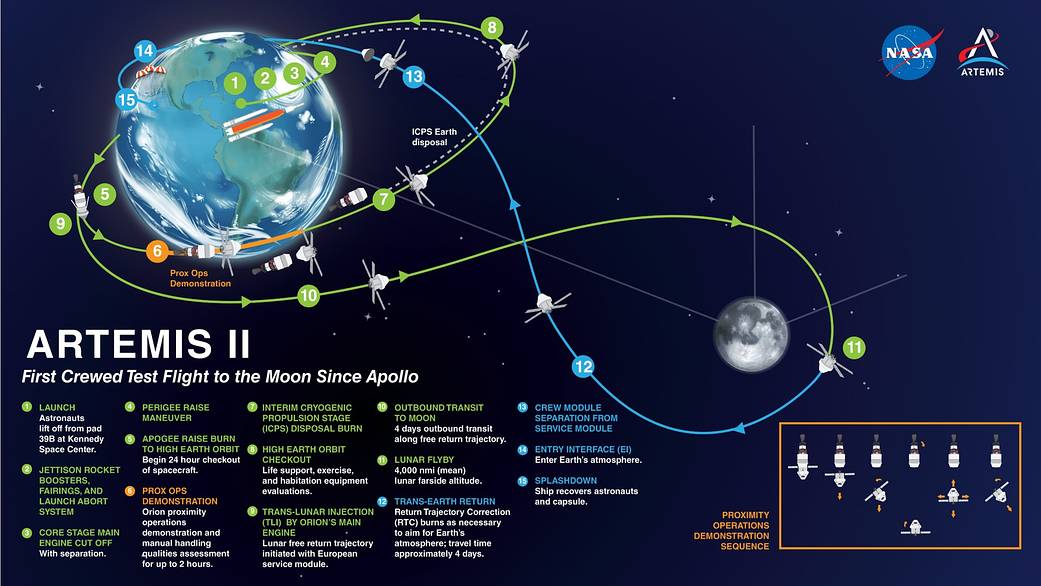
Source: NASA
Beyond Artemis II lies the lander question, and that is where SpaceX enters directly. In 2021, NASA awarded SpaceX a $2.89 billion contract to develop the Starship Human Landing System, a modified version of Starship designed to ferry astronauts from lunar orbit to the surface. The original plan called for SpaceX to deliver that lander for Artemis III, which was to be the first crewed lunar landing. Timing for Starship development, however, caused NASA to restructure the mission sequence entirely.
Before SpaceX’s Starship Human Landing System (HLS) can put anyone on the Moon, it has to solve a problem no rocket has demonstrated at scale, which is refueling in orbit. Because the Starship HLS requires approximately ten tanker launches worth of propellant loaded into a depot in low Earth orbit before it has enough fuel to reach the lunar surface, SpaceX plans to conduct this refueling process using its upgraded V3 Starship. And until that demonstration flies and succeeds, the Starship moon lander remains a question mark.
SpaceX’s Starship V3 is almost ready and it will change space travel forever
In February 2026, NASA Administrator Jared Isaacman confirmed that Artemis III, now planned for mid-2027, and will instead test lunar landers in low Earth orbit, with the actual landing pushed to Artemis IV that’s targeted for 2028.
Musk responded to earlier criticism of SpaceX’s schedule by posting on X that his company is “moving like lightning compared to the rest of the space industry,” and added that “Starship will end up doing the whole Moon mission.” The contract competition was also reopened in October 2025 by then NASA chief Sean Duffy, who cited Starship’s delays and said the agency needed speed given China’s own stated goal of landing astronauts on the Moon by 2030.
They won’t. SpaceX is moving like lightning compared to the rest of the space industry.
Moreover, Starship will end up doing the whole Moon mission. Mark my words.
— Elon Musk (@elonmusk) October 20, 2025
Artemis came from the first Trump administration’s 2017 Space Policy Directive 1, which directed NASA to return humans to the Moon. The program picked up pace through the 2020s, with the Orion spacecraft and SLS taking years to develop at enormous costs. SpaceX entered the picture in 2021 as the chosen lander contractor, tying the commercial space sector into what had historically been an all government undertaking.
Whether SpaceX’s Starship ultimately carries astronauts to the lunar surface or shares that role with Blue Origin’s competing lander, this week’s Artemis II launch is the necessary first step. Getting four humans to the Moon’s vicinity and back safely is the proof of concept everything else depends on.
The post Countdown: America is going back to the Moon and SpaceX holds the key to what comes after appeared first on TESLARATI.