
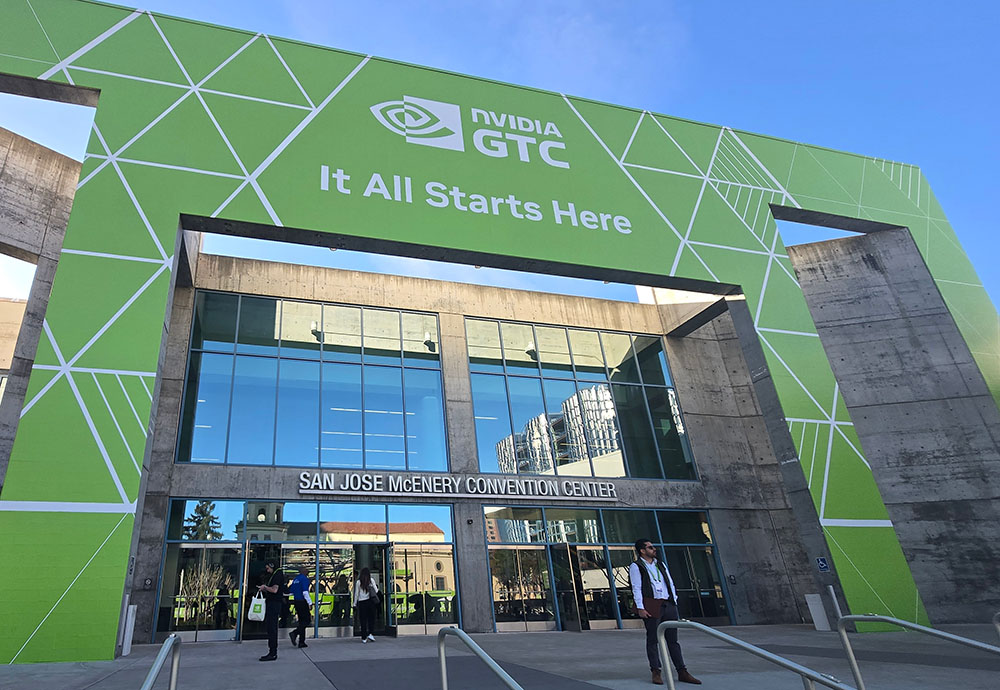
Last week, I attended NVIDIA’s 2026 GTC event in San Jose, Calif. This year, the company expected over 30,000 attendees across the four days of the show. To host everyone, NVIDIA held events across several different venues, including the San Jose Convention Center, the San Jose Center for Performing Arts, The Tech Interactive, and the SAP Center.
GTC kicked off with a keynote from NVIDIA founder and CEO Jensen Huang. During the keynote, he highlighted NVIDIA’s partnerships with leading robotics companies, like ABB Robotics, FANUC, Agility Robotics, Figure AI, Boston Dynamics, and more. At the end of the keynote, Disney Imagineering’s Olaf robot joined Huang onstage for a brief conversation.
“The list of issues with today’s robots is quite large, but they’re just engineering problems,” Huang said during a press Q&A at the show. “The fact [is] that you could see them walking around, and they’re already starting to do things. Once you see existence, proof of a technology, the refinement takes less than five years.”
Throughout this year’s GPU Technology Conference, I had the chance to interact with and even control robots, see new systems for the first time, and speak with industry experts. Here are three takeaways from the show.
1. Robots are growing more capable and are being taken more seriously
At a show like GTC, which focuses on a range of technical industries, the robots can sometimes feel more like science projects than commercial products. This wasn’t the feeling at GTC 2026, however. The robot demonstrations there focused on showing real tasks and specific skill sets.
“Multiple years ago, it was very research-oriented,” said Leo Ma, the co-founder and CEO of RoboForce. “Now, you’re looking at getting much closer to what the robot does. What value is it providing?”
For example, at the Vention booth, the company showcased its new Rapid Operator AI system with a deep bin-picking demo. In the NVIDIA booth, Workr showed one of its commercial deployments with Fireclay Tile, automating repetitive saw work at the California-based ceramics manufacturer.
Similarly, the humanoids at the show were mostly working or doing real demos, while a few were still standing still on the sidelines. Humanoid, a U.K.-based developer, showed the wheeled version of its robot listening to attendees and picking the items they asked for.
2. With AI, robots are easier to deploy than ever
Unsurprisingly, artificial intelligence was one of the biggest topics of conversation at GTC. When it comes to robotics, recent advances in AI are making deployments swifter and easier than ever before.
At the Teradyne booth, Universal Robots (UR) collaborated with Generalist, a company that creates AI foundation models for robotics. The companies showed a fine-precision phone packing demo, which came together in just a few days before the conference.
“We only had a few days in our office to prepare a live demo with a robot we had never touched before, and then we ran it live for four days,” Pete Florence, the co-founder and CEO of Generalist, told The Robot Report. “This speed of being able to put together a new robot demo, on brand new hardware, speaks to the strength of the generalization of GEN-0 and wouldn’t have been possible a few months ago.”
UR also debuted and demonstrated the UR AI Trainer, a system it created in collaboration with Scale AI. The AI Trainer allows a human operator to guide UR robots through tasks. At GTC, I got to guide two UR3e “leader” robots to control two UR7e “follower” robots. The system was intuitive, easy to use, and provided force feedback when the robots touched something.
Even on the hardware side, many developers are focusing on making it easier to create robots. Nexcom, for example, launched its humanoid robot development kit.
3. Simulation plays a role in every part of the robot lifecycle
As robots make their way into increasingly complicated environments, simulation training becomes more and more important.
Jenny Shern, the general manager of NexCOBOT, said simulation is key for tackling messy, outdoor environments. “I see a lot of users starting to bridge the gap between sim-to-real and real-to-sim,” she said.
ABB released its RoboStudio HyperReality, which integrates NVIDIA Omniverse libraries to close the long‑standing sim‑to‑real gap in industrial robotics.
“For our end users, OEMs, we can really cut engineering times for new products, because we’ll be able to do concurrent engineering around the product and the factory at the same time,” said Marc Segura, the president of ABB Robotics. “We’re going to get the drawings of the product, but with all the characteristics of physics and so on, we can already plan for the factory, for the robotic line.”
Also at the conference, many companies, such as Texas Instruments (TI), emphasized the importance of using simulation at each stage of robot development.
“In terms of technology, one thing that has been highlighted continuously at GTC is the importance of simulations,” said Giovanni Campanella, the industrial automation and robotics general manager at TI. “We talk a lot about hardware, and basically simulating the hardware before you even build it. Before you even build the device, you can simulate how the radar is performing in an environment where the robot is going to be.”
Sharpa, a company that develops robotic hands with tactile sensors, also highlighted the importance of simulation.
“GTC is a great place to understand the progress in the Physical AI space this past year, from greater model training efficiency to hardware improvements,” said Alicia Veneziani, Sharpa’s global vice president of GTM and president of Europe. “Sharpa has been riding this wave too. We demonstrated how our human-like hands improved tool manipulation using tactile AI, and we are solving the data drought with high-fidelity simulation and human video data in collaboration with Nvidia.”
GTC is becoming an AI and robotics show
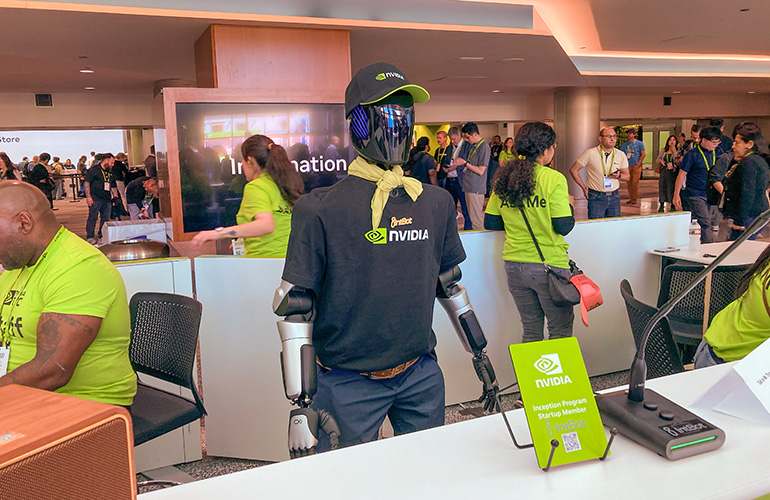
Front Desk Information Concierge assisted GTC26 visitors with navigation and event information. | Credit: The Robot Report
Generally, it felt like robots were becoming a larger part of GTC.
“I think overall at the conference it was great to see the ecosystem continue to develop,” said Generalist’s Florence. “There were several new robots on display, and the form factors continue to evolve. All of these robots will need brains, and it’s a very exciting time.”
Throughout the show, NVIDIA had integrated a range of robots into the attendee experience. Intbot‘s humanoid robot greeted people at the reception desk, while Serve Robots were zipping along inside and outside of the convention center.
“We are millions of truck drivers short. We are tens of millions of manufacturing workers short,” Huang said. “Employment is very high, and yet, many companies don’t have enough labor, so robots will fill in that gap.”
“No. 1, as a result of filling that gap, all of our country’s economy will grow, and when the economy grows, most companies tend to hire more people,” he added. “They’ll hire more people to manage more robots.”

The post 3 robotics trends from NVIDIA GTC 2026 appeared first on The Robot Report.