
Tesla is reportedly in talks to purchase $2.9 billion worth of solar manufacturing equipment from a group of Chinese suppliers, including Suzhou Maxwell Technologies, which is the world’s largest producer of screen-printing equipment used in solar cell production. According to Reuters sources, the equipment is expected to be delivered before autumn and shipped to Texas, where Tesla plans to anchor its next phase of domestic solar production.
The move is a direct extension of a vision Elon Musk has been building for months. At the World Economic Forum in Davos this past January, Musk announced that both Tesla and SpaceX were independently working to establish 100 gigawatts of annual solar manufacturing capacity inside the United States. Days later, on Tesla’s Q4 2025 earnings call, he made the ambition concrete: “We’re going to work toward getting 100 GW a year of solar cell production, integrating across the entire supply chain from raw materials all the way to finished solar panels.”
Job postings on Tesla’s website reflect that same target, with language explicitly calling for 100 GW of “solar manufacturing from raw materials on American soil before the end of 2028.”
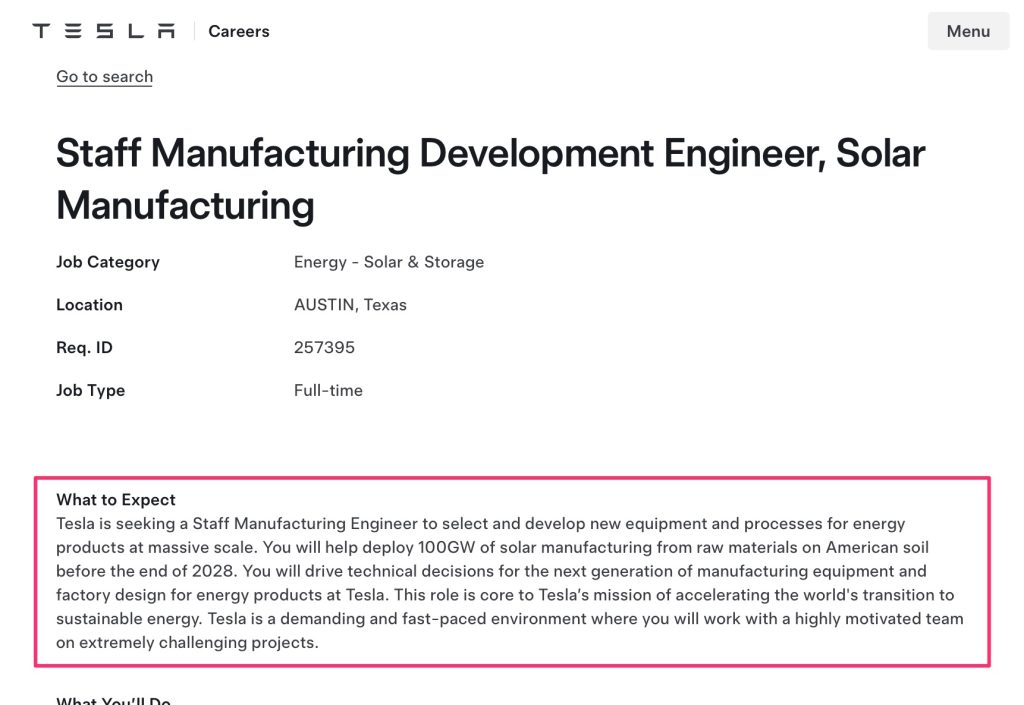
Tesla job listing for Staff Manufacturing Development Engineer, Solar Manufacturing
The urgency behind the latest solar manufacturing target is rooted in a set of rapidly emerging pressures related to AI and Tesla’s own energy business. U.S. power consumption hit its second consecutive record high in 2025 and is projected to climb further through 2026 and 2027, driven largely by the explosion in AI data centers and the broader electrification of transportation. Tesla’s own energy division, which produces the Megapack utility-scale battery storage system, has been growing rapidly, and solar supply is a critical companion component for the business to scale. Musk has argued that solar is not just a clean energy option but the only one that makes economic sense at the scale AI infrastructure demands.
Tesla lands in Texas for latest Megapack production facility
Ironically, the path to domestic solar independence currently runs through China. Sort of.
Despite Tesla’s stated push to localize its supply chain, mirrored recently by the company’s plan for a $4.3 billion LFP battery manufacturing partnership with LG Energy Solution in Michigan, Tesla still relies on China-based suppliers to keep its cost structure intact.
The $2.9 billion equipment deal underscores a tension Musk himself acknowledged at Davos: “Unfortunately, in the U.S. the tariff barriers for solar are extremely high and that makes the economics of deploying solar artificially high, because China makes almost all the solar.” Building the factory in America requires buying the machinery from the country Tesla is trying to reduce its dependence on.
Tesla named by U.S. Gov. in $4.3B battery deal for American-made cells
The regulatory pathway adds another layer of complexity. Suzhou Maxwell has been seeking export approval from China’s commerce ministry, and it remains unclear how quickly that clearance will come. Still, the market has already reacted, with shares in the Chinese firms reportedly involved in the talks surged more than 7% following the Reuters report that broke the story.
Whether Tesla can hit its 2028 target of 100GW of solar manufacturing remains an open question. Though that scale may seem staggering, especially in such a short timeframe, we know that Musk has a documented history of “always pulling it off” in the face of ambitious deadlines that may slip. But, rest assured – it’ll get done.
The post Tesla’s $2.9 billion bet: Why Elon Musk is turning to China to build America’s solar future appeared first on TESLARATI.