
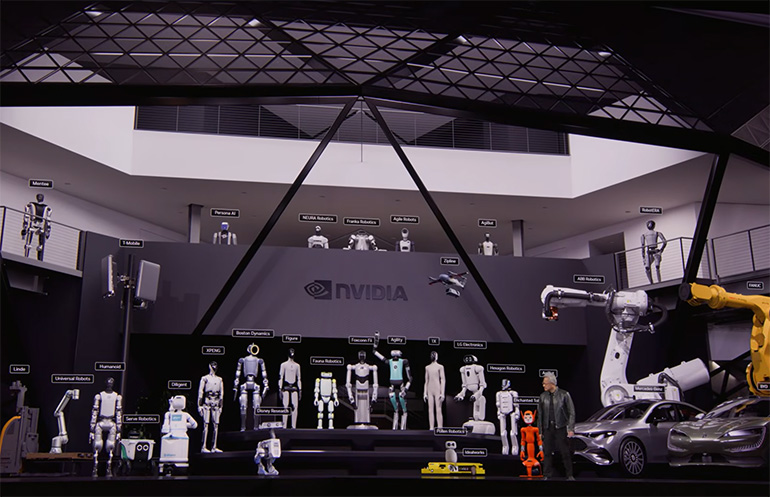
CEO Jensen Huang showed some of the robotics developers in NVIDIA’s ecosystem in his GTC 2026 keynote. Source: NVIDIA
At its annual GPU Technology Conference, or GTC, NVIDIA Corp. showed off its partnerships with the global robotics ecosystem, including 110 robot brain developers, industrial automation leaders, and humanoid pioneers. The company touted its processing hardware, simulation software, and partner connections powering “production-scale physical AI.”
NVIDIA this week unveiled new NVIDIA Isaac simulation frameworks and new NVIDIA Cosmos and NVIDIA Isaac GR00T open models for the industry to develop, train, and deploy the next generation of intelligent robots. Among the companies partnering with NVIDIA are ABB Robotics, AGIBOT, Agility, FANUC, Figure, Hexagon Robotics, KUKA, Skild AI, Universal Robots, World Labs, and Yaskawa.
“Physical AI has arrived — every industrial company will become a robotics company,” stated Jensen Huang, founder and CEO of NVIDIA. “NVIDIA’s full-stack platform — spanning computing, open models and software frameworks — is the foundation for the robotics industry, uniting a worldwide ecosystem to build the intelligent machines that will power the next generation of factories, logistics, transportation and infrastructure.”
Simulation validates the world’s largest robot fleets, says NVIDIA
As industrial robotics becomes more AI-driven, manufacturers need physically accurate, high-fidelity simulation to design, test and optimize systems before deployment, asserted NVIDIA.
With a global install base exceeding 2 million robots, FANUC, ABB Robotics, Yaskawa, and KUKA are integrating NVIDIA Omniverse libraries and NVIDIA Isaac simulation frameworks into their virtual commissioning solutions. NVIDIA said they are using them to develop and validate complex robot applications and entire production lines through physically accurate digital twins.
To power advanced intelligence on the production line, the companies are integrating NVIDIA Jetson modules into their controllers for real-time AI inference at the edge.

Robot developers building brains for any embodiment
Robotics is evolving from task-specific machines to adaptable generalist-specialist systems that maintain the precision and reliability required for industrial-grade deployment, according to NVIDIA. To achieve this, robots need humanlike reasoning and the ability to perceive, decide and act autonomously.
Leading developers such as FieldAI and Skild AI are building generalized robot brains using NVIDIA Cosmos world models for data generation and Isaac simulation frameworks to validate policies in simulation, enabling any robot to master new tasks with minimal retraining.
World Labs is using Isaac Sim to validate its generative world models, while Generalist AI is using Cosmos to explore generating synthetic data.
NVIDIA also announced Cosmos 3, which it claimed is the first world foundation model unifying synthetic world generation, vision reasoning, and action simulation to accelerate the development of generalized robot intelligence for complex environments.
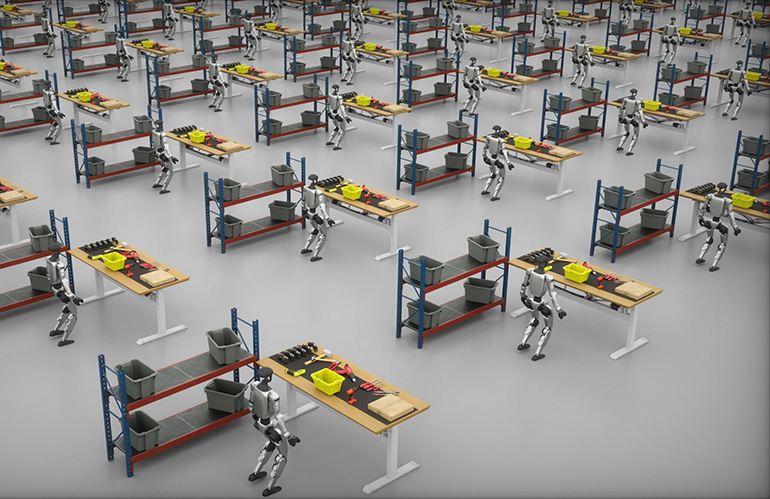
The latest Isaac Lab-Arena release simplifies environment composition and accelerates complex task creation to help developers evaluate various tasks in parallel. Source: NVIDIA
AI, models power the next generation of humanoids
Building humanoid robots is one of robotics’ greatest challenges, noted NVIDIA. Replicating human mobility, dexterity, and reasoning requires tightly integrating advanced AI, perception and real-time control into a safe, reliable and autonomous system.
Leaders including 1X, AGIBOT, Agility, Agile Robots, Boston Dynamics, Figure, Hexagon Robotics, Humanoid, Mentee, and NEURA Robotics are building the next generation of humanoids using Cosmos world models, Isaac Sim and Isaac Lab to accelerate the development and validation of their robots.
NVIDIA also introduced Isaac Lab 3.0 in early access, enabling faster, large-scale robot learning on NVIDIA DGX-class infrastructure. Built on the new Newton physics engine 1.0 and the NVIDIA PhysX software development kit (SDK), it adds multiphysics simulation and improved support for complex, dexterous manipulation.
AGIBOT, Humanoid, LG Electronics, NEURA Robotics, and Noble Machines are also adopting NVIDIA Isaac GR00T N models to accelerate industrial deployments of their humanoids. NVIDIA said that GR00T N1.7 is now available in early access with commercial licensing, bringing generalized robot skills including advanced dexterous control to production-ready robot deployments.
In addition, during his GTC keynote, Huang previewed GR00T N2, a next-generation robot foundation model based on DreamZero research. Built on a new world action model architecture, the model can help robots succeed at new tasks in new environments more than twice as often as leading vision language action models.
Slated to be available by the end of the year, GR00T N2 currently ranks No. 1 on MolmoSpaces and RoboArena for generalist robot policies, said NVIDIA.
These systems are powered by the NVIDIA Jetson Thor robotic computing platform, which the company said enables developers to move from simulation training to real-world deployment with greater speed, intelligence and reliability.
Partners expand physical AI to healthcare robotics
Healthcare is a defining opportunity for physical AI but deploying autonomous systems across surgery, imaging and hospitals demands infrastructure built for the highest standards of safety and regulatory rigor.
CMR Surgical is using Cosmos-H simulation to train and validate robotic intelligence for its Versius surgical system prior to clinical deployment.
Johnson & Johnson MedTech is using Isaac Sim- and Cosmos-based post-training workflows to train and validate systems for the Monarch Platform for Urology. In addition, Medtronic is exploring NVIDIA IGX Thor to deliver mission-critical precision and functional safety in surgical robotic systems.
NVIDIA acts as a global catalyst for robotic innovation
By building an open and integrated platform for designing, training, testing and deploying physical AI, NVIDIA said it fostering collaboration in the robotics ecosystem, which is essential to growing adoption. The Santa Clara, Calif.-based company said its partnerships with industry leaders are already translating platform integration into real-world impact.
Skild AI is partnering with industrial automation provider ABB Robotics and cobot leader Universal Robots to deploy its generalized robot intelligence across different industries and tasks. By embedding a shared intelligence layer into widely deployed systems, manufacturers can extend automation into more dynamic and variable applications without building task-specific code for every workflow.
At the same time, Skild AI is partnering with Foxconn on high-precision assembly for NVIDIA Blackwell production lines, enabling Foxconn’s AI-driven dual-arm manipulators to master the industry’s most complex manufacturing tasks.
NVIDIA cited as another example Lightwheel, which is co-developing and calibrating the Newton physics engine to enable Samsung’s assembly robots to master intricate cable handling in simulation, delivering higher precision and faster assembly lines.
PTC announced a new robotics design-to-simulation workflow from its cloud-native Onshape computer-aided design (CAD) and product data management platform to NVIDIA Isaac Sim. It has created a CAD-to-OpenUSD bridge to enable engineering teams like FANUC America Corp. and Fauna Robotics to design and validate their robotic systems within physically accurate digital twins.
WORKR is integrating its AI platform with ABB’s industrial robots. It uses NVIDIA Omniverse libraries as part of its WorkrCore to train a robotic workforce that can be deployed by small and midsize manufacturers in minutes, without programming knowledge.
KION Group is working with NVIDIA and Accenture to advance autonomous warehouse systems. It uses Omniverse and a physical AI-powered digital twin and systems architecture pioneered by Accenture. KION engineers can create large-scale, physics-accurate warehouse digital twins to train and test fleets of Jetson-based autonomous forklifts for GXO, the world’s largest pure-play contract logistics provider.
Microsoft Azure and Nebius are integrating the NVIDIA Physical AI Data Factory blueprint to enable scalable, agent-driven synthetic data generation for their developers, including FieldAI, Teradyne Robotics, Hexagon Robotics on Azure, and RoboForce on Nebius.
CoreWeave is integrating Isaac Lab to build robot learning pipelines, while Alibaba Cloud is integrating NVIDIA’s entire physical AI stack into its Platform for AI to accelerate end-to-end robotics development.
Kamino, a GPU-accelerated physics simulator built by Disney on the NVIDIA Warp framework and integrated into Newton, enables the training of robot policies for Disney Imagineering’s Olaf and BDX Droids. It allows Olaf to learn to manage its own heat and reduce impact noise, and enabling BDX Droids to navigate complex environments.
In his GTC keynote, Huang was joined by Disney ’s Olaf ahead of the robot’s debut at Disneyland Paris on March 29.
NVIDIA intends to help launch physical AI pioneers
NVIDIA said it is committed to ensuring that the tools for physical AI are accessible to every innovator, from early-stage startups to the global open source community.
Through the NVIDIA Inception program, a global startups incubator with over 40,000 members, NVIDIA provides robotics pioneers with a dedicated entry point to its open physical AI stack. Inception startup members such as Bedrock Robotics, Dexterity AI, Flexion, Lightwheel, RIVR, Standard Bots, Vention, and World Labs get access to technical guidance and high-performance computing resources, as well as connections to key partners and customers across the robotics ecosystem.
NVIDIA has also partnered with Hugging Face to integrate Isaac and GR00T into the LeRobot open-source framework, connecting NVIDIA’s 2 million robotics developers with Hugging Face’s 13 million AI builders worldwide to accelerate the development of open-source robotics.
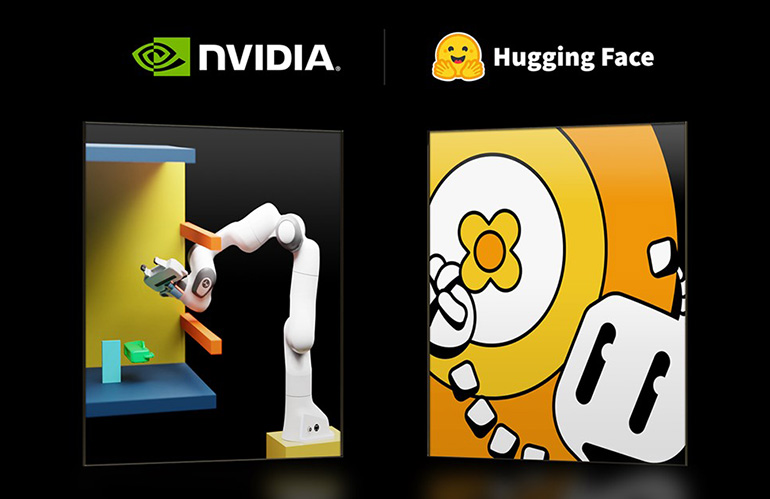
NVIDIA and Hugging Face are integrating robotics development tools into the LeRobot open-source framework. Source: NVIDIA
The post NVIDIA works with global robotics leaders to make physical AI a reality appeared first on The Robot Report.