
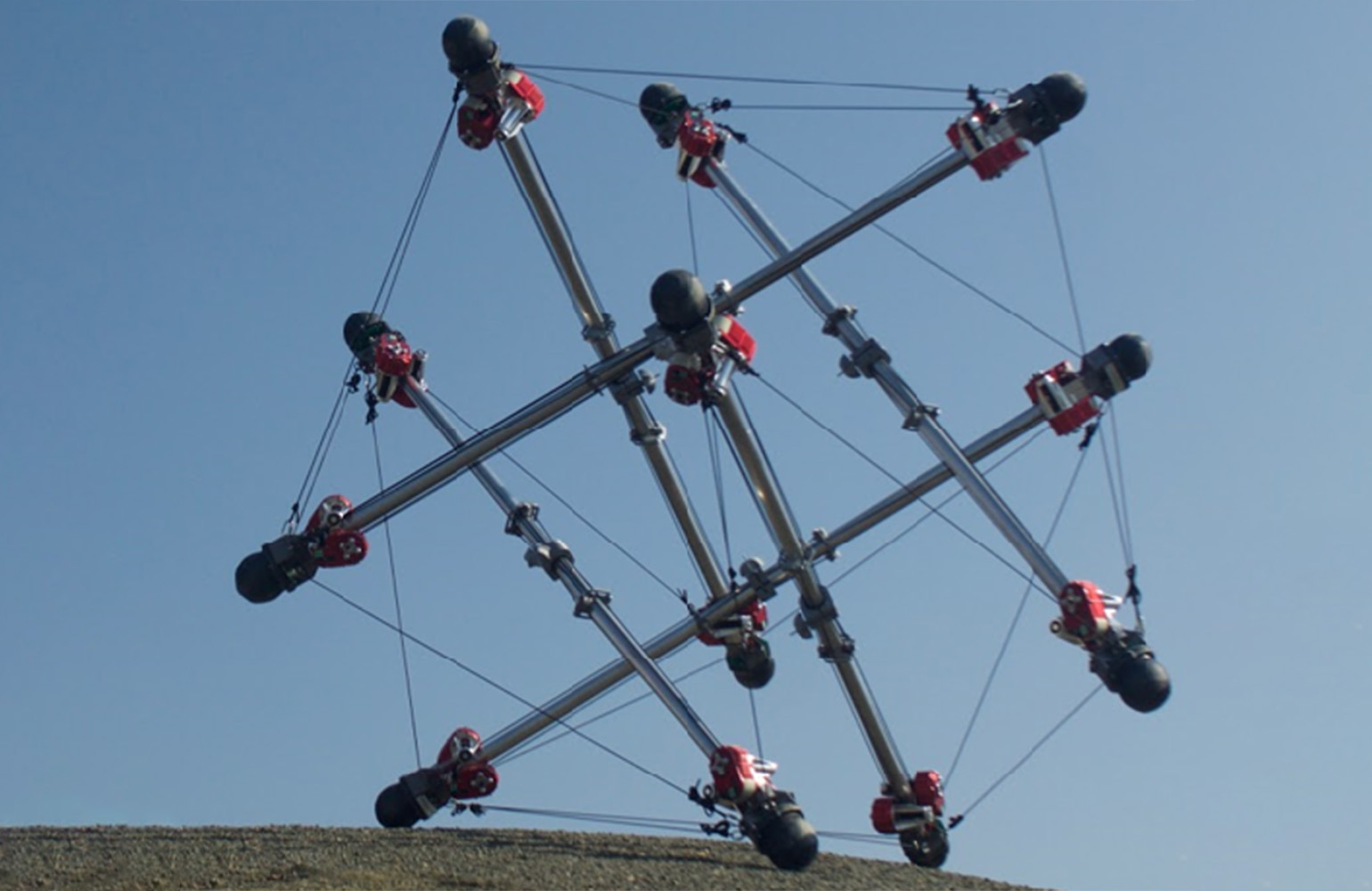
HEBI has prior experience with NASA, with projects such as this “Superball” mobile robot constructed with HEBI actuators. | Source: HEBI Robotics
NASA has awarded HEBI Robotics with continued Small Business Innovation Research (SBIR) funding. HEBI received a Phase II contract to develop and test actuation hardware designed to operate in harsh space environments.
The two-year, $850k project project includes building control electronics that work with the HEBI Robotics platform and third-party systems, helping speed up the development of flight-ready actuation technology for low Earth orbit (LEO) and geosynchronous Earth orbit (GEO) missions.
“HEBI’s long-term mission is to make it easy for any engineer to build robust, professional-grade, robotic systems without years of technical experience or training,” said Andrew Willig, director of hardware at HEBI Robotics. “Creating actuation technology that can withstand the harsh environment of space provides HEBI with a further expanded modular hardware platform with a broader application base. This allows the agile production of complex robotic systems for space applications that would otherwise require long, multi-million-dollar endeavors.”

HEBI Robotics said it provides flexible modulators for building custom robots quickly and reliably. It provides “Lego-like” modular actuation hardware with software designed to be intuitive for research labs and industrial teams worldwide.
The Carnegie Mellon University spinout said its technology can accelerate development and support practical automation in challenging environments. For instance, HEBI last year developed modular building blocks for NASA.
HEBI won a 2025 RBR50 Robotics Innovation Award for its “inchworm” family of robots.
NASA could use actuation for servicing satellites, construction, and more
NASA can use space-rated actuation hardware for a wide range of applications, including robotic arms that deploy equipment, solar panels, and more, as well as in space construction. Aging satellites require maintenance, while construction of new structures in orbit, on the moon, and on Mars continues to be a topic of national and international importance.
Difficult conditions such as ionizing radiation and the harsh reality of a vacuum, where traditional lubricants used in gearing otherwise outgas, make the challenge HEBI is taking on critical. Equipment, such as robotic actuation and manipulators, is needed to handle objects and perform tasks, such as in-space servicing, assembly, and maintenance (ISAM).
HEBI Robotics had previously demonstrated success with a NASA Phase I SBIR contract related to initial research and testing of actuators for space applications. SBIR awards provide government agencies with a way to diversify their technology portfolios while supporting American businesses with fewer than 500 employees. Phase II SBIRs are only selected when Phase I results show strong technical results with a high likelihood of commercial feasibility.
The benefits of the project could go beyond the direct scope of this SBIR work. It could also include the continued development of the NASA ARMADAS technology. This is a joint venture with NASA, also involving HEBI Robotics, to develop autonomously-assembling materials that build infrastructure such as habitat structures, large antenna arrays, and spaceports.
Terrestrial benefits of HEBI’s new technology include operators in the nuclear inspection field, as radiation-hardened actuators are increasingly required in the inspection and maintenance of nuclear sites, including land or sea-based reactors.
The post HEBI wins NASA SBIR to build space robot actuators appeared first on The Robot Report.