
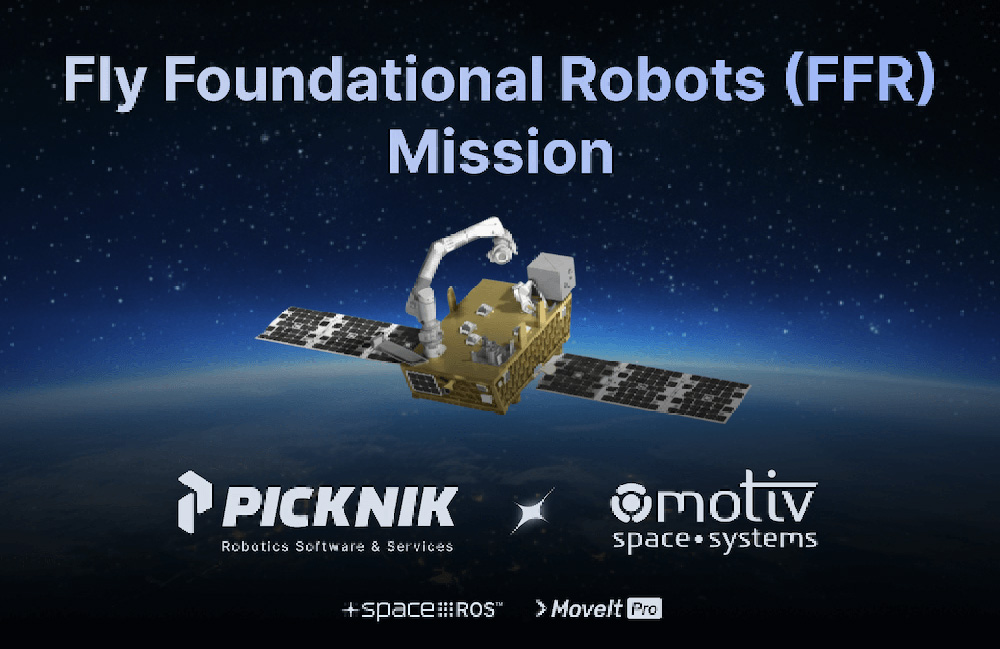
The FFR mission aims to advance NASA’s In-space Servicing, Assembly, and Manufacturing objectives. | Source: PickNik Robotics
Motiv Space Systems this week announced a contractual agreement with PickNik Robotics. The two companies will develop software for NASA’s Fly Foundational Robotics, or FFR, mission.
The FFR mission is focused on advancing on-orbit robotic manipulation capabilities and supporting NASA’s broader In-space Servicing, Assembly, and Manufacturing (ISAM) objectives.
Motiv plans to develop a system to demonstrate autonomous and ground-supervised manipulation tasks in low Earth orbit. Meanwhile, PickNik Robotics will provide motion control software based on its MoveIt Pro platform to support mission planning, simulation, and execution of robotic arm motion within spaceflight operational constraints.
“The Fly Foundational Robotics mission is a critical step toward demonstrating state-of-the-art flight robotic manipulation capabilities that can enable a sustainable and scalable ISAM economy,” said Chris Thayer, CEO of Motiv Space Systems. “We’re proud to support NASA as it advances the next generation of autonomous space operations.”
NASA to use Space ROS for FFR mission
A special version of the Robot Operating System (ROS) will be used for this flight mission. Space ROS is a project of the Open Source Robotics Foundation (OSRF), with PickNik and NASA among its largest contributors.
PickNik will also support integration activities between Motiv and the hosted orbital platform provider, Astro Digital. The company’s scope includes delivering a flight runtime configuration suitable for the mission compute environment.
It will also deliver a ground-based operator terminal powered by MoveIt Pro to support mission planning, testing, and validation before launch. These tools are intended to help the mission team evaluate robotic behaviors through simulation, digital twin analysis, and operational review before and during on-orbit execution.
Additional collaboration includes software integration and co-development support in areas such as behavior execution. The partners will also work on system monitoring interfaces and operational tooling aligned with the mission’s requirements for long-duration operations and intermittent communications.
These capabilities build on MoveIt Pro’s behavior sequencing and modular runtime architecture while using Space ROS to align with spaceflight-oriented software standards. PickNik said it will support representative development hardware used to mirror the flight compute environment during ground testing.
“FFR is an exciting opportunity to apply MoveIt Pro’s commercially available motion-planning software to the unique challenges of on-orbit operations,” said Dave Coleman, founder and chief product officer of PickNik Robotics. “We’re glad to support Motiv’s team as they prepare for on-orbit mission operations.”
NASA said it expects FFR to contribute operational experience and lessons that can help inform future robotic missions and capabilities.
PickNik and Motiv build on previous space experience
Both PickNik and Motiv have experience working with government agencies on space projects. Last year, PickNik partnered with the Japan Aerospace Exploration Agency, or JAXA, to change how the International Space Station (ISS) handles cargo and equipment.
That project is part of JAXA’s Payload Organization and Transportation Robotic System (PORTRS) initiative. Its goal was to demonstrate a complex, multi-armed robotic system capable of performing manipulation tasks in microgravity. These could include anything from crawling, payload swapping, to handling soft, flexible cargo transfer bags.
In 2022, Motiv collaborated with NASA to develop a robotic arm designed for operation in these areas. The Cold Operable Lunar Deployable Arm (COLDArm) system can function in temperatures as low as -280ºF (-173°C) without needing an internal heating system, which can use up to 30% of a mission’s daily energy budget.

The post PickNik Robotics to work with Motiv Space Systems on NASA ISAM mission appeared first on The Robot Report.