
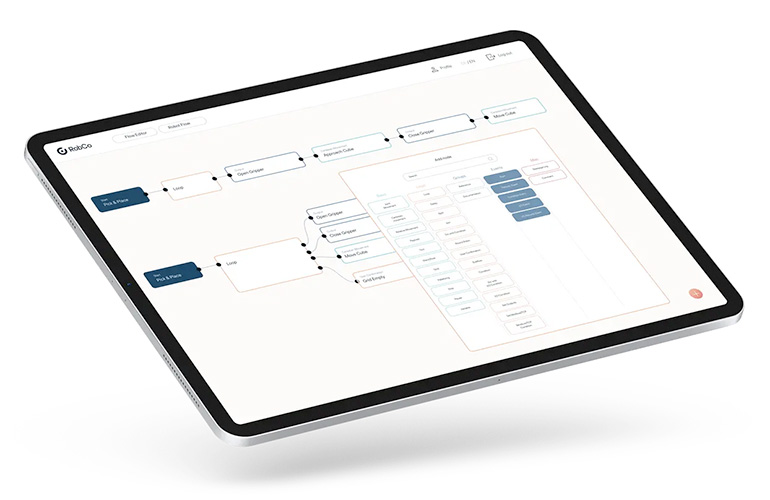
RobCo Studio software simplifies robot workcell configuration and operations. | Credit: RobCo

Roman Hölzl, cofounder and CEO of RobCo. | Credit: LinkedIn
Munich-based modular robotics company RobCo recently opened its U.S. headquarters in San Francisco and commissioned Sapio Research to survey 400 U.S. industrial decision-makers across manufacturing, construction, engineering, and healthcare.
The Automation Readiness Index survey examines how warehouses and factories are paying for automation and existing roadblocks for the next wave of robots.
The company also recently closed a Series C funding of $100 million to advance its physical AI roadmap, expand enterprise deployments, and deepen its presence in the U.S. market.
“With $100 million of additional funding, we will become the dominant AI robotics company for manufacturing in the U.S. and Europe,” stated Roman Hölzl, founder and CEO of RobCo. “This will allow us to execute on our purpose of automating the ordinary, so humans can do the extraordinary.”
The biggest takeaways from the Automation Readiness Index
The Robot Report (Mike Oitzman): What do you think was the most surprising data point in the recent research report about automation usage in the industry?
Roman Hölzl: It has to be the sheer absolute number representing the shortage of labor. The numbers show more than 1.6 million unfilled jobs in the next couple of years. And so the question is, how do we solve that? The absolute number of more than a million jobs in the manufacturing sector between the U.S. and Europe that will remain unfilled, and that storm is only going to increase, was astonishing. The way we look at it at RobCo is: there has to be a very clear, ROI driven solution, in terms of the commercial viability, but then also the technical feasibility.
We think at RobCo today, we have a solution that already works, that hits the requirements in terms of precision, technology, time cycle, time software integration at a very attractive ROI because we price at roughly the cost of a single worker, single shift per month.
TRR: What takeaways should robot developers take from this report about the industry?
Roman Hölzl: Developers need to sharpen the value proposition [for their solutions]. The data that we published shows that there has to be a clear driver for both robot solution providers and robot purchasers. In our mind, the value proposition is centered around whether we actually increase productivity with the solutions we deploy. And that is a very clear benchmark: Can our customers take on more orders, can they improve the output, and improve their productivity levels? This is the most important takeaway, and it’s key to dealing with the storm that is brewing up in the industry around the cost of labor.
What can end-users learn?
TRR: What do you think an end user might take away from the data in the report, and what advice would you give to them?
Roman Hölzl: End users should understand the challenges that have traditionally been associated with robotics, such as long implementation timelines, high six to seven-figure CapEx investment costs, and solutions that might be ultimately only usable by expert robotics users.
Those terms can actually be overcome now, and it starts with an attractive business model. What we do at RobCo is offer what we call Robots-as-a-Service (RaaS), a business model priced at roughly the equivalent of a human worker per month per shift. This is anywhere from a couple thousand U.S. dollars a month to 10,000 U.S. dollars a month. Together with deploying that business model, in the order of weeks, instead of quarters. That’s the big unlock, especially for mid-cap manufacturers in the U.S. and Europe.
TRR: What do you think are the trends to look for in 2026, taking into account the macroeconomic factors from 2025?
Roman Hölzl: I think that the macro trends for 2026 will be an extension of what we’ve seen in 2025. Number one is that many of the Western nations are reshoring their production capacities. This is paired with tremendous pressure on costs, because we’ve just gotten used to very attractive prices through Chinese suppliers. All of the regions want to manufacture locally. That’s a very clear governmental strategic pillar as well, and that will be a key focus point in 2026.
The question is, how do we do it? The answer can’t be a full year-long seven-figure capex investment process to get there. It’ll have to be a fast, attractively priced, and very simple to use solution that works for both mid-caps and the enterprise.
Hölzl on who can benefit the most from RaaS
TRR: Where do you think RaaS works best?
Roman Hölzl: So, we think robot-as-a-service is going to be the predominant business model for robotics in the future, and especially if you look at solutions being much more software-centric and AI-centric. To your point, the adoption today is the biggest in industries that are moving fast, that have a very, very clear automation challenge today, and not the financial means, or on the flip side, they’re very sophisticated in terms of financial setup, and do not want to burden their balance sheet with an investment into an automation solution.
The companies would rather keep it running as an operational expenditure, improving margins, improving the balance sheet size, and frankly, setting themselves up for the future. And so to my mind, that’s going to be for every customer out there. But today we see the biggest uptick either in larger companies that are very sophisticated financially, or conversely, with smaller customers that don’t have, frankly, the bank accounts and the cash statements to make sense of CapEx, robotics investments in the seven figures.
Prioritize organizational simplicity, Hölzl said
TRR: In my experience, having run a $50M SaaS business line for a Fortune 500 software company, I don’t think that you can run a business both as a SaaS and as a CapEx organization. You have to pick a lane and stick to it. In that organization, we had both SaaS and enterprise sales and support teams. They didn’t mix.
I’ve heard many young RaaS-based startups say that they’ll sell whatever the customer wants, however the customer wants to buy it. But this is not good for a small organization, in terms of the sales team design, compensation plans, support organization, your contracts department, all of it. If you attempt to sell both CapEx and OpEx, it’s a headache all around. As a startup CEO building a RaaS-based business, give me your inside view on that observation.
Roman Hölzl: We believe in simplicity within an organization to streamline the commission model, inventory design, and the order-to-cash process. However, we think there are two different, distinct business models. The first model drives recurring revenue as a service model, and the second is a CapEx model.
All end customer direct deployments online will have to be ordered as a service model with deep software integration. If we co-sell with a third party, an OEM partner who directly serves their customers, that’ll likely be a reselling CapEx motion even in the future. But then that’s a different part of the business, different team, different incentives, different numbers, you know, different setup. And so then it’ll still work, even as a company with only, you know, a couple 100 FTEs versus a much larger one.

The post The RaaS Blueprint: Key Insights from a conversation with RobCo’s Roman Hölzl appeared first on The Robot Report.