
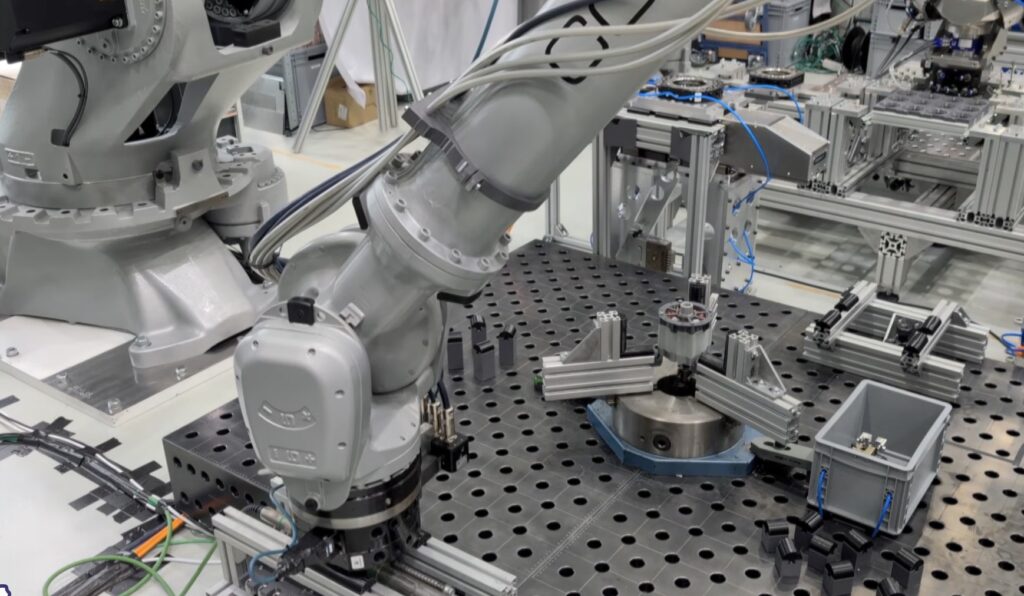
 Credit: Baumis Robots (Karlsruhe Institute of Technology).
By Emmet Cole
In our new monthly series, we showcase a selection of robotics stories from society, business, research, and culture, as we track the field’s ongoing journey from specialized industrial machines to an increasingly visible social phenomenon.
Reshoring reimagined?
In early August, The Information published an article that claimed U.S.-based founders, investors and startups, are travelling to an electronics market in Shenzhen to buy servomotors, sensors, controllers and gimbals. The report also claimed that Unitree and Zhiyuan robots are being bought intact, then stripped down into parts and carried back to the USA in suitcases.
By late August, in a separate development, reports emerged that a US Department of Energy lab is investigating whether Chinese LiDAR sensors pose a security risk, if widely used on vehicles in the United States. According to TechCrunch, the research is being funded by one or more companies in the electric and autonomous vehicle industries.
Together, the stories highlight the ongoing tension between US security concerns and its robotics industry’s continuing dependence on Chinese hardware.
Motorless shape shifters
Don’t cancel any Shenzhen travel plans just yet, but engineers at Princeton have unveiled a motorless, origami-inspired robot that can roll, crawl, and change shape through a combination of magnetic control and multistable geometry.
Project lead Glaucio Paulino told Princeton Engineering:
Geometry is the real actuator here. Instead of relying on complicated mechanisms, we use mathematical principles to encode multiple stable configurations directly into the structure. That opens a new pathway for designing lightweight, adaptable systems.
Managing expectations
Robot deployments can fail for many reasons, making expectation management a key part of successful robotics projects. This might mean explaining that although collaborative robots can sometimes be deployed without fencing, that is not appropriate for every application, and a risk assessment is still required.
It might mean explaining that although robot-assisted radical prostatectomy typically reduces blood loss and shortens hospital stays compared with open surgery, longer-term outcomes depend heavily on the patient, the cancer and the surgeon.
In the humanoid space, where expectations are often formed by spectacle and driven by anthropomorphism and millions of years of evolution, the effects can be particularly acute.
A Drexel-led study involving 50 adult men that measured brain activity, hormones, self-reported attitudes and behaviour in order to assess trust in human-humanoid interaction, found that participants formed stronger initial connections with an expressive Pepper robot than with a stationary version that gave no nonverbal cues.
But when the expressive robot made errors, the participants’ brains responded as they would to a person breaking a social norm, rather than a machine making a technical error.
Counterintuitively:
[…] levels of “the bonding hormone,” oxytocin, which is typically present in higher amounts among friends, relatives and romantic partners, actually rose in participants as the engaging robot made mistakes. This led [researchers] to believe that the hormone functions as a warning signal, rather than a sign of connection, in human-robot interactions.
Read the full Science Robotics paper here.
Beyond automotive
For decades, the automotive sector has been the leading segment for robotics adoption. That’s still the case, but as the latest North American Q2 figures from the Association for Advancing Automation (A3) show, automotive OEM’s share is continuing to slide as robots diversify across other industry segments.
Notably, North American companies ordered 8,940 robots valued at US$622 million in the second quarter of 2026, a 4.3% increase in units ordered and a 21.3% increase in revenue, according to A3’s numbers.
Recycling robots
IEEE Spectrum profiled an automated recycling system developed by researchers at Germany’s Karlsruhe Institute of Technology. The system uses CAD data, physical observations and a predictive algorithm to predict defects in products and adapt its disassembly strategy while protecting valuable components.
All eyes on China
As August came to a close, the eyes of the robotics world (and the general public) turned to Beijing, China as the city played host to both the World Robot Conference (WRC) and the World Humanoid Robot Games.
The WRC, primarily a showcase of Chinese products, brought together ~300 companies exhibiting more than 2,000 products. These included robots for parcel sorting, manufacturing, surgery and domestic work.
Unitree supplied much of the spectacle with its remarkably fast “Superman” humanoid and an extraordinary stock-market debut. Its shares closed 460% above the IPO price, although by August 28 they had fallen almost 30% -another lesson in managing expectations. CEO Wang Xingxing also predicted that robotics is approaching a “ChatGPT moment”.
The World Humanoid Robot Games brought the theme of spectacle versus reality to another level. Robots kick-boxed, played table tennis, performed gymnastic routines, and played football. There were moments of hilarity…
…and some genuinely impressive technology demonstrations.
After watching several hours of livestreams from the games across several days, and looking at the print media coverage, I began to wonder whether events like these help people manage expectations around robots much.
The media focus on spectacle doesn’t help. Yes, a humanoid ran at Usain Bolt-like speeds and then into a wall. Yes, the kickboxing humanoids had an endearing Mr. Magoo-like quality. Technology demonstration aside, there isn’t much call for either in industrial applications.
Blink and you’d miss it -and much of the media coverage did- but the games also hosted multiple competitions centred around industrial manufacturing, logistics, household services and emergency response.
In the industrial “assembly and material supply” contest, for example, robots had to move containers onto shelves, identify and sort differently packaged components, and insert intake and exhaust valves into the correct openings in an engine cylinder head.
Other contests tested packaging and warehouse intake, while eight dexterous-hand challenges included screw fastening, unpacking boxes, connecting cables and picking up beans with tweezers. Some competitions required autonomous robots and others tested teleoperation capabilities.
These slower, less spectacular competitions tested the precision, perception and adaptability humanoids will need before they can perform useful work in factories and warehouses.
All that said, everybody needs a humanoid riding a giant quadruped.