
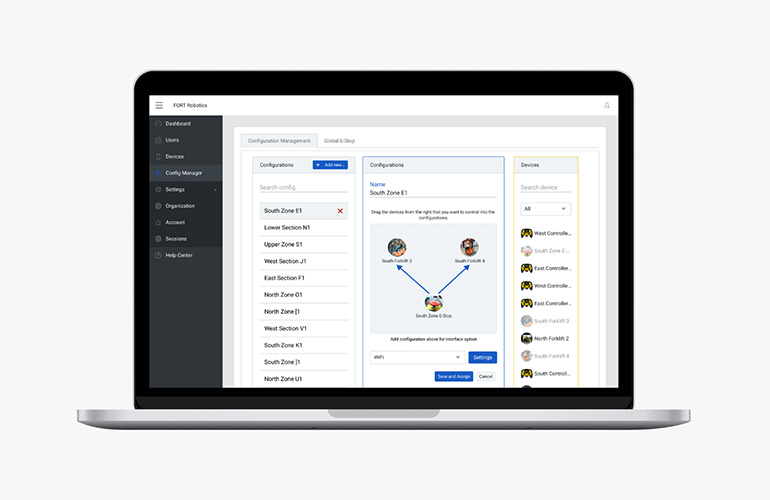
FORT extends robot perception beyond on-board sensors by including external sensors to dynamically control robot behavior and perform at maximum efficiency. | Credit: FORT Robotics
FORT Robotics announced today that it has joined the NVIDIA Halos for Robotics ecosystem. The companies introduced an AI-driven “Outside-In Safety” solution. They designed this solution to boost autonomous robot productivity and worker safety by utilizing external infrastructure sensors.
The company will demonstrate the new application this week at the Automate conference in Chicago, ahead of a joint presentation with NVIDIA in the Humanoid Robotics Pavilion on June 23rd.
The NVIDIA Outside-In Safety Blueprint, combined with the FORT Trust Layer, extends robot perception beyond onboard sensors by using external infrastructure sensors and visual AI agents to deliver real-time, safety-certifiable functional safety to maximize operational throughput.
Key benefits of outside-in safety
- Enhanced Productivity: Some traditional, conservative inside-out safety systems are limited to onboard sensors. This system automatically modulates robot efficiency across dynamic environments to minimize costly slowdowns.
- Worker Safety & Accident Prevention: Provides proactive situational awareness to protect workers and prevent incidents in mixed human-robot environments.
- Maximized ROI: Allows industries like warehousing and manufacturing to repurpose existing infrastructure (e.g., building-mounted cameras) to optimize throughput for tasks like inventory replenishment and truck unloading.
The system uses NVIDIA IGX Thor and NVIDIA Holoscan Sensor Bridge for AI compute and sensor connectivity. It enables robots to safely operate alongside workers at high-efficiency modes while dynamically adapting to complex environments. NVIDIA said it provides value beyond traditional inside-out functional safety systems that are limited to onboard sensors and conservative operating constraints.
 Submit your session idea for the 2026 RoboBusiness
A robotics safety ecosystem built for scale
FORT is a member of the NVIDIA Halos AI Systems Inspection Lab. This is an ANSI National Accreditation Board (ANAB)-accredited inspection lab designed specifically for physical AI and autonomous systems. It provides a unified framework to verify functional safety, cybersecurity, and AI compliance for autonomous vehicles (AVs), robotics, and sensor technologies. This collaboration reflects FORT’s ongoing work with NVIDIA to make physical AI trustworthy at an industrial scale.
“Safety has always been the precondition for scale — you can’t deploy robots broadly if you can’t guarantee they’ll operate safely around people and valuable infrastructure,” said Samuel Reeves, CEO of FORT. “What collaborating with NVIDIA gives us is enhanced perception that makes safety genuinely intelligent. Agentic robots that understand their environment and respond in real time aren’t just safer, they’re more productive. That’s the combination the industry has been waiting for.”
FORT provides autonomous systems with the essential hardware and software backbone required to mitigate real-world operational risk. Outside-In Safety extends FORT’s Trust Layer for Physical AI to be even broader.
- Outside-In Safety (new): Reduces costly robot slowdowns and improves safety without sacrificing productivity, by automatically modulating robot efficiency across dynamic environments.
- Onboard Active Safety: Onboard perception technology, either embedded or bolted-on, enables machines to actively detect, anticipate, and respond to their environments in real time. This predictive approach allows autonomous vehicles to execute smart, real-time planning and contingency maneuvers. NVIDIA said this is a meaningful leap beyond traditional reactive safety architectures.
- Human-in-the-Loop control: Safe and reliable remote operation, including both line-of-sight control and remote operation and intervention.
The post FORT and NVIDIA launch AI-driven Outside-In Safety blueprint appeared first on The Robot Report.