
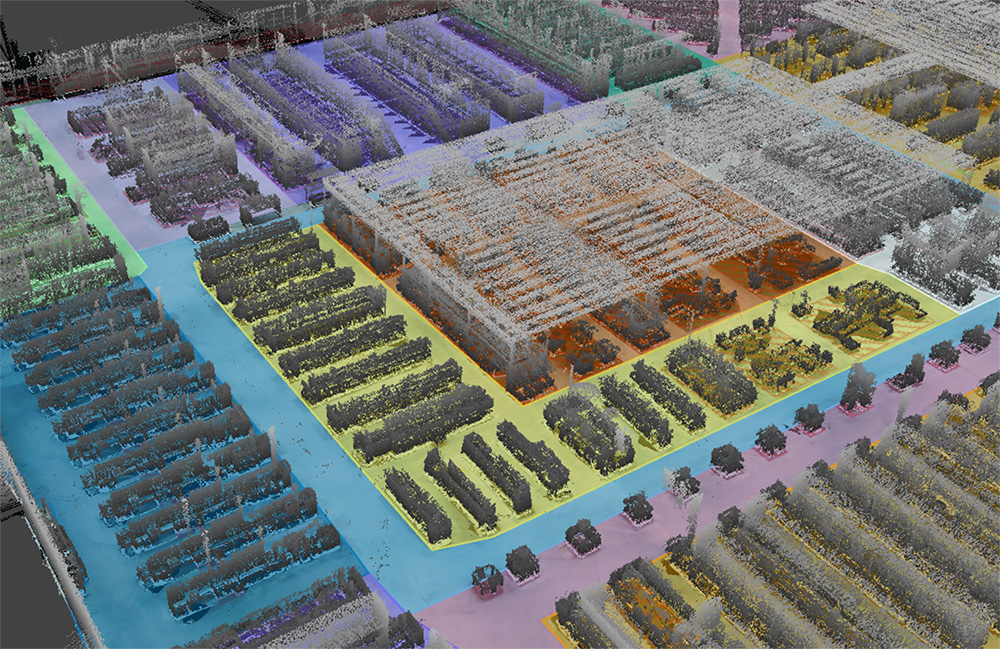
Brain Corp and UC San Diego are creating a contextual grounding layer for robot autonomy. | Source: Brain Corp
Brain Corp this week announced an expanded research collaboration with the University of California, San Diego. The partners said they plan to advance semantic mapping and contextual intelligence technologies for autonomous robots operating in complex commercial and industrial environments.
“Simultaneous localization and mapping, or SLAM, helped move robots beyond fixed industrial settings and into more dynamic environments,” said Dr. Nikolay Atanasov, a faculty member in the Jacobs School’s Department of Electrical and Computer Engineering at UC San Diego.
“Today, the industry is exploring AI systems that operate directly from visual data, but we believe contextual 3D semantic maps remain essential for robust autonomy in complex physical spaces,” he added. “Our collaboration with Brain Corp creates an exciting opportunity to demonstrate how richer spatial understanding can improve contextual awareness, resilience, and operational performance in real-world robotic deployments.”
The collaboration reflects the company and university‘s shared ambition to shape the future of physical AI.
Editor’s note: John Black, the chief technology officer at Brain Corp, will be speaking at the 2026 Robotics Summit & Expo in Boston next week. His talk, “Building Scalable Robot Systems That Learn, Adapt, and Earn Trust,” will give a behind-the-scenes view of how to turn complex, dynamic environments into structured intelligence. Register now to attend.

Brain Corp and UC San Diego hope to bring reliability to AI
Vision-language-action (VLA) and other generative AI models are transforming robotics, according to Brain Corp. The company and researchers at the UC San Diego Jacobs School of Engineering said they are tackling the industry’s most critical challenge: making next-generation autonomous systems reliable, scalable, and commercially deployable in dynamic real-world environments.
The latest collaboration is focused on what Brain Corp described as a “contextual grounding layer.” This is an intelligent digital representation of physical spaces that gives robots, drones, and self-driving vehicles the situational awareness to understand what is happening around them and respond intuitively.
This deeper layer of contextual understanding is essential for safely integrating advanced AI models into real-world commercial applications, explained Brain. It will enable systems to intuitively adapt to their physical environments and seamlessly interact with people, it asserted.
Rather than automating a single robotic task or workflow, Brain Corp said it is creating the intelligent platform infrastructure capable of orchestrating fleets of autonomous systems, fixed sensors, and AI-powered agents at enterprise scale.
The collaboration builds on Brain Corp’s large-scale operational footprint, including more than 50,000 autonomous mobile robots (AMRs) deployed globally and over 25 million hours of operations across commercial sites. It claimed those deployments provide significant real-world data and insight into how autonomous systems behave under changing environmental conditions.
Collaboration to combine commercial, academic strengths
Dr. Nikolay A. Atanasov, head of the Existential Robotics Laboratory at the UC San Diego Jacobs School of Engineering, is leading the research in collaboration with Brain Corp. His work focuses on robotic perception, semantic mapping, and autonomous systems.
Together, the teams will bridge the gap between advanced robotics research and large-scale commercial deployment. They said the work is aligned with Brain Corp’s BrainOS autonomy platform. By integrating advances in semantic mapping and contextual grounding into BrainOS, the company said it will help customers deploy and coordinate AMRs more safely, efficiently, and intelligently across entire facilities and commercial operations.
“Robotics has reached a point where the challenge is no longer simply movement or perception, but understanding,” stated John Black, chief technology officer at Brain Corp. “The industry is entering a new era of AI-powered robotics, but deploying these systems safely and reliably in real-world environments requires a much deeper layer of contextual intelligence.”
“This collaboration is focused on building that foundational understanding, creating the infrastructure that allows autonomous systems to operate consistently, adapt dynamically, and scale across complex commercial environments,” he said.
The post Brain Corp partners with UC San Diego to help robots operate in complex environments appeared first on The Robot Report.